
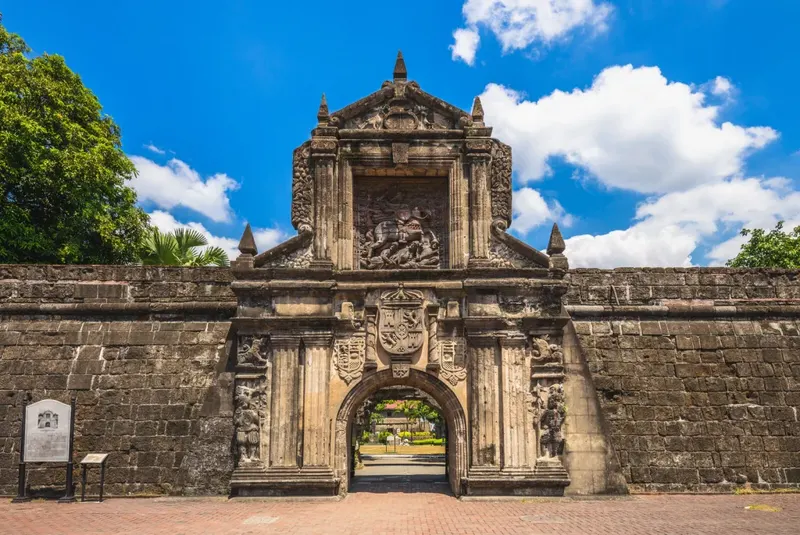
Manila is the dense, energetic heart of the Philippines, a sprawling metropolis on the shore of its great bay where more than four centuries of history layer over one another. Within the old walls of Intramuros stand Spanish-era churches and the ramparts of Fort Santiago; beyond them spread the towers of Makati, the seaside promenade of Roxas Boulevard and a tangle of districts that together form one of Asia's most crowded cities. Chaotic and warm-hearted, it is also the country's gateway to the islands.
Manila is a quieter alternative. It's ready to explore in the Nuvoha app: set your budget and see complete Manila trips.
Why visit Manila
Manila offers a vivid, often surprising encounter with Filipino history and street life. The walled district of Intramuros is the essential sight, its cobbles leading to Fort Santiago, San Agustin Church, the oldest stone church in the country, and the restored Casa Manila. Rizal Park honours the national hero, and the neighbouring National Museum complex holds Juan Luna's vast canvases and the country's finest archaeology. Old Manila layers Spanish, American and Chinese influences, seen in the world's oldest Chinatown at Binondo. Above all, sunset over Manila Bay is a nightly event. The honest caveats are real: traffic is notorious, the sprawl overwhelming, and many travellers pass through quickly on the way to the beaches and islands beyond.
Sights to plan around
- Intramuros: The walled city built by the Spanish in the 1570s, its cobbled streets, gates and bastions enclosing churches, plazas and colonial mansions, best explored on foot or by bamboo bicycle.
- Fort Santiago: The stone citadel guarding the mouth of the Pasig within Intramuros, a shrine to the national hero Jose Rizal, who was held here before his execution in 1896.
- San Agustin Church: The oldest stone church in the Philippines, completed in 1607 and a UNESCO World Heritage Site, its Baroque interior and carved doors surviving centuries of earthquakes.
- Rizal Park (Luneta): The vast seafront park where Rizal was executed and is now memorialised, a green gathering place at the foot of old Manila.
- Binondo: Founded in 1594, the world's oldest Chinatown, a warren of lanes packed with temples, bakeries, apothecaries and some of the city's best food.
- Manila Bay baywalk: The curve of Roxas Boulevard along the bay, lined with palms and a promenade, and the classic vantage for the city's celebrated sunsets.
Around the metropolis
- Intramuros and Ermita: Historic old Manila by the river and bay, taking in the walled city, Rizal Park, the museums and the older hotel district of Ermita and Malate.
- Binondo: The historic Chinatown north of the Pasig, a dense, aromatic grid of trading houses, temples and food stalls.
- Makati: The country's premier business district, a grid of high-rises, malls, restaurants and nightlife, and the base for many visitors.
- Bonifacio Global City (BGC): A modern, planned district in neighbouring Taguig, with clean grids, public art, malls and a lively dining and bar scene.
- Quiapo: A frenetic old district around Quiapo Church, home of the Black Nazarene, with markets selling everything from herbs and amulets to camera gear.
- Quezon City: The large city to the northeast, once the national capital, with government offices, universities, parks and sprawling residential neighbourhoods.
The Filipino table
Filipino food is a great crossroads cuisine, blending native, Malay, Spanish, Chinese and American flavours into something all its own, built on the interplay of sour, salty and sweet. The national touchstone is adobo, meat braised in vinegar, soy and garlic, alongside the sour tamarind soup sinigang and, for feasts, whole roast lechon. Chinese-influenced noodles and dumplings fill Binondo, while street stalls grill skewers and sell balut to the brave. Meals end with halo-halo, a tumble of shaved ice, sweet beans, fruit and purple yam. Manila also has a fast-rising modern dining scene in Makati and BGC.
- Adobo
- Sinigang
- Lechon
- Kare-kare
- Pancit
- Halo-halo
What Manila feels like
Manila assaults the senses and then wins you over. It is loud, hot and gridlocked, a city of jeepneys belching along boulevards, malls the size of towns and street vendors under every flyover, yet its people are among the warmest and most hospitable anywhere. Faith runs deep in this overwhelmingly Catholic country, so Sunday Mass, fiestas and the towering churches shape the calendar. Contrasts are everywhere: gated Makati high-rises and informal settlements, air-conditioned malls and sweltering markets, colonial stone and neon karaoke bars. Evenings soften as the crowds drift to the bay to watch the sun drop into the water in a blaze of orange. Resilient and irrepressible, Manila grows on you.
Getting from A to B
Getting around Manila takes patience, as traffic is heavy and the metro is limited. The elevated LRT and MRT lines cover a few key corridors but are often crowded, so many visitors rely on ride-hailing apps, which are reliable if slow in the jams. The iconic jeepneys and the smaller UV vans follow set routes for next to nothing, an experience in themselves, while metered taxis are widely available. For short central hops, Intramuros is walkable, and river ferries run along the Pasig. Ninoy Aquino International Airport (MNL), south of the city near Pasay and Paranaque, is the main gateway, with several terminals set some distance apart. Traffic to and from the airport can be very slow, so allow generous time; official airport taxis, coupon taxis and ride-hailing apps all serve the terminals.
Practical pointers
- Filipinos are warm and courteous, and adding po and opo when speaking to elders is a mark of respect.
- Dress modestly inside the many churches, which are active places of worship, and keep shoulders covered when attending Mass.
- Tipping is appreciated for good service; some bills add a service charge, and rounding up for taxis and porters is customary.
- Take the usual big-city precautions with valuables in crowds and on public transport, and agree fares or use an app to avoid confusion.
- Filipinos love karaoke and celebration, so expect singing at gatherings, and join in good-naturedly if invited.
- The dry season, roughly December to May, is the most comfortable; the wet season from June to November brings heavy rain and the risk of typhoons.
- Build in plenty of time for traffic, which is severe, especially at rush hour and around the airport.
- Sunset over Manila Bay is a nightly ritual, and the baywalk along Roxas Boulevard is the classic spot.
- Explore Intramuros on foot or by guided bamboo bicycle in the cooler morning hours.
- Manila is the main hub for domestic flights and ferries to the beaches and islands, from Palawan to Cebu and Boracay.
- Carry small notes for jeepneys, markets and tips, as not everywhere takes cards.
Best for
- City breaks
- Quieter travel
Key facts
| Country | Philippines |
|---|---|
| Region | Asia |
| Airports | MNL |
| Trip length fit | Short-trip friendly |
Manila essentials
| Currency | Philippine Peso (PHP) |
|---|---|
| Language | Filipino, based on Tagalog, and English are both official, and English is very widely spoken |
| Time zone | Philippine Standard Time (UTC+8), no daylight saving |
| Emergency number | 911 |
| Driving side | Right |
| Tap water | Best avoided from the tap; bottled and purified water are sold everywhere |
Climate & seasons
| Month | Typical range | Season |
|---|---|---|
| January | 23°C to 30°C | Warm dry season |
| April | 25°C to 34°C | Hot dry season |
| July | 25°C to 31°C | Wet season |
| October | 24°C to 31°C | Humid rainy season |
Typical stay
- Weekend-friendly
- Short break (2–5 days)
Manila works as a weekend break just as well as a longer stay.
Getting there
Manila is served via MNL.
- MNL
Is it your kind of trip?
Ideal if…
- you like walkable city energy
- you like places before everyone else finds them
Maybe not if…
- a beach-first holiday is the priority
Pairs well with
Compare with
| Manila | Da Nang | Ho Chi Minh | |
|---|---|---|---|
| Country | Philippines | Vietnam | Vietnam |
| Region | Asia | Asia | Asia |
| Styles | City | City | City |
| Trip length fit | Weekend-friendly | Weekend-friendly | Weekend-friendly |
| Airports | 1 | 1 | 1 |
More in Asia
Near Manila
Travel style
- Short-trip friendly
- City
Frequently asked questions
Which airports serve Manila?
Manila is served via MNL.
Is Manila good for a weekend trip?
Yes, Manila works for a weekend as well as a longer stay.
What kind of trip is Manila best for?
Manila is best for city trips.
Which destinations pair well with Manila?
Within multi-city range: Taipei (1,176 km), Da Nang (1,386 km).
Is Manila worth visiting?
Yes, for its history and atmosphere, though it divides opinion. Intramuros, the museums and the food of Binondo reward a day or two, and the bay sunsets are memorable. Many travellers use it as the gateway to the Philippines' beaches and islands.
When is the best time to visit Manila?
The dry season from December to May is the most comfortable, with the coolest months around December to February. The wet season, June to November, brings heavy downpours and the possibility of typhoons.
Is Manila safe for tourists?
The main tourist areas are generally fine with common-sense care. As in any large, crowded city, watch your belongings, avoid quiet areas late at night, and use registered taxis or ride-hailing apps rather than unmarked vehicles.
How do I get from Manila to the islands?
Manila is the country's main transport hub. Domestic flights from Ninoy Aquino International Airport reach destinations such as Palawan, Cebu, Boracay and Bohol in around an hour or two, and ferries also serve many island routes.