
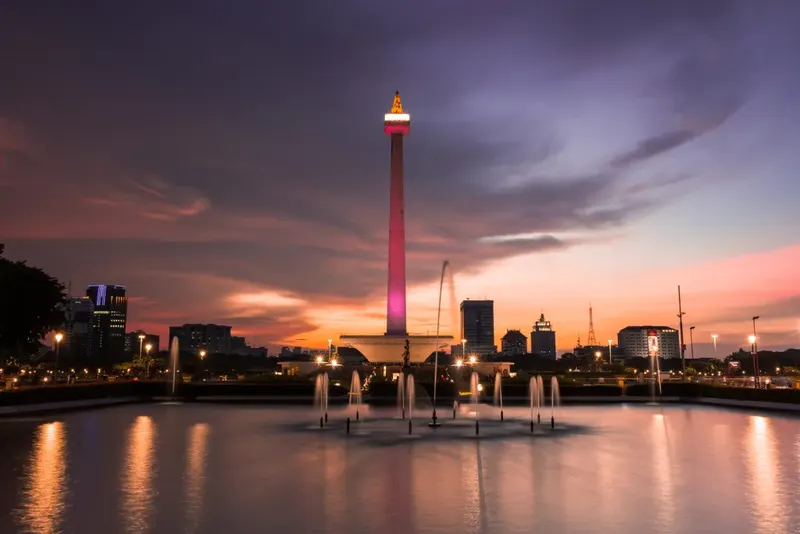
Jakarta is Indonesia's vast, restless capital, a metropolis of some ten million people spread across the swampy north coast of Java. It is a city of extremes, where glittering malls and skyscrapers rise above canals, kampung neighbourhoods and gridlocked traffic. The soaring Monas obelisk marks the centre, the old Dutch town of Kota Tua recalls the days of Batavia, and beneath the modern surface runs the easygoing Betawi culture of the original inhabitants. Chaotic and rewarding, Jakarta is the pulse of the nation.
Jakarta is a quieter alternative. It's ready to explore in the Nuvoha app: set your budget and see complete Jakarta trips.
Why visit Jakarta
Jakarta rewards the curious traveller willing to look past the traffic. Kota Tua, the old Batavia, preserves Dutch colonial squares, museums and cafes around Fatahillah Square, while the nearby harbour of Sunda Kelapa still berths tall wooden schooners. At the heart of the city, the Monas monument rises over Merdeka Square, flanked by the vast Istiqlal Mosque, the largest in Southeast Asia, and the neo-Gothic Catholic cathedral facing it, a symbol of the nation's tolerance. The National Museum tells the story of the archipelago, and the food, shopping and nightlife are among the best in the region. The honest caveats: notorious traffic, few conventional sights, and a sprawl that rewards patience over ticking off landmarks.
Sights to plan around
- National Monument (Monas): The 132-metre marble obelisk crowned with a gilded flame at the centre of Merdeka Square, with a viewing deck and a diorama of Indonesian history in its base.
- Kota Tua (Old Batavia): The cobbled old town of the Dutch East India Company, its Fatahillah Square ringed by colonial buildings, the Jakarta History Museum and the wayang puppet museum.
- Istiqlal Mosque: The largest mosque in Southeast Asia, a vast modernist hall of gleaming marble and steel that holds many tens of thousands, standing opposite the Catholic cathedral.
- National Museum (Museum Nasional): The country's foremost museum, tracing the archipelago's cultures and history through prehistoric, Hindu-Buddhist and ethnographic collections.
- Sunda Kelapa: The old harbour where brightly painted wooden Pinisi schooners still load and unload by hand, a working relic of Jakarta's trading past.
- Glodok: Jakarta's Chinatown, a bustling maze of markets, temples and food stalls just south of Kota Tua.
Around the city
- Kota Tua and Glodok: The historic north, home to old Batavia, Chinatown and the Sunda Kelapa harbour, the most atmospheric quarter for wandering.
- Central Jakarta (Merdeka): The civic heart around Merdeka Square, gathering Monas, the Istiqlal Mosque, the cathedral and the National Museum.
- Menteng: A leafy, upmarket district of tree-lined streets and colonial-era villas laid out by the Dutch, with galleries, embassies and antique markets.
- Thamrin and Sudirman: The main business spine of high-rise offices, hotels and malls, taking in the Selamat Datang roundabout and the SCBD financial district.
- Kemang: A southern district known for its restaurants, bars and cafes and its expatriate community, one of the city's dining and nightlife hubs.
- Ancol: The bayfront leisure zone on the north coast, with a theme park, beaches, a marina and the boats out to the Thousand Islands.
The Jakarta table
Jakarta gathers the whole archipelago onto its plates, and adds the sweet-savoury cooking of the local Betawi people. The national staples are here in force: nasi goreng and mie goreng fried to order, sate grilled over coals, and gado-gado, a salad of vegetables under peanut sauce. Betawi specialities include soto Betawi, a rich beef soup in coconut milk, and kerak telor, a spiced omelette of sticky rice cooked at street stalls. Padang restaurants line the tables with fiery Sumatran curries, and the city cools off with es campur and the green rice-flour worms of es cendol. Street food is a way of life.
- Nasi goreng
- Soto Betawi
- Gado-gado
- Sate
- Kerak telor
- Es cendol
What Jakarta feels like
Jakarta overwhelms at first, then reveals its rhythms. This is a city that runs on commerce and movement, its skyline forested with towers, its streets a river of cars, motorbikes and green-jacketed app-taxi riders that only rarely thins. Yet step into a kampung lane or a warung at dusk and the pace softens: neighbours chat over sweet iced tea, the call to prayer drifts across the rooftops, and satay smoke curls from a cart. The mood is young, aspirational and endlessly enterprising, its malls doubling as the city's living rooms in the tropical heat. Storms roll in most afternoons in the wet season. It is less a city of sights than of energy and encounter.
Getting from A to B
Jakarta's traffic is legendary, but transport is improving fast. A modern MRT line now runs north to south beneath the worst of it, complemented by the elevated LRT and the extensive TransJakarta bus rapid transit network in its dedicated lanes. For door to door, most people use ride-hailing apps, for cars and for the nimble motorbike taxis that weave through the jams. Metered taxis from reputable firms are reliable. Whatever you choose, plan around the peaks, when the city can seize up for hours. Soekarno-Hatta International Airport (CGK) lies northwest of the city near Tangerang, around an hour away in normal traffic and much longer in the jams. An Airport Rail Link connects it to stations in the city, a useful way to skip the road, alongside official taxis and ride-hailing pickups.
Practical pointers
- Indonesia is largely Muslim, so dress modestly away from the beach and cover shoulders and knees, especially when visiting mosques.
- At the Istiqlal Mosque and other mosques, remove your shoes, dress conservatively, and women should cover their hair; robes are often lent to visitors.
- Use your right hand for eating, giving and receiving, as the left is considered unclean.
- Dress and behave more conservatively during the fasting month of Ramadan, when many eat only after sunset.
- A smile and a little patience go a long way, as Indonesians are warm and value politeness over confrontation.
- The dry season, roughly May to September, is the most comfortable; the wet season from November to March brings heavy afternoon storms and occasional flooding.
- Traffic is severe, so plan journeys around the rush hours and lean on the MRT and TransJakarta where they reach.
- Kota Tua is best explored in the morning before the heat and crowds build.
- The Thousand Islands, a scatter of islets in the bay, make a popular escape from the city by boat from Ancol.
- Malls are a genuine part of local life, useful for air-conditioned respite, food courts and clean facilities.
- Carry small notes for street food, parking attendants and market stalls.
Best for
- City breaks
- Quieter travel
Key facts
| Country | Indonesia |
|---|---|
| Region | Asia |
| Airports | CGK |
| Trip length fit | Short-trip friendly |
Jakarta essentials
| Currency | Indonesian Rupiah (IDR) |
|---|---|
| Language | Indonesian (Bahasa Indonesia) is the national language, spoken alongside hundreds of regional tongues; English is common in tourist areas |
| Time zone | Three zones: Western (UTC+7) covering Sumatra and Java, Central (UTC+8) covering Bali and Sulawesi, and Eastern (UTC+9) covering Papua; no daylight saving |
| Emergency number | 112 (national emergency line) |
| Driving side | Left |
| Tap water | Not safe from the tap; bottled and boiled water are the norm |
Climate & seasons
| Month | Typical range | Season |
|---|---|---|
| January | 24°C to 30°C | Wet season |
| April | 25°C to 32°C | Humid transition |
| July | 24°C to 32°C | Drier season |
| October | 25°C to 33°C | Warmer transition |
Typical stay
- Weekend-friendly
- Short break (2–5 days)
Jakarta works as a weekend break just as well as a longer stay.
Getting there
Jakarta is served via Soekarno–Hatta (CGK).
- Soekarno–Hatta (CGK)
Is it your kind of trip?
Ideal if…
- you like walkable city energy
- you like places before everyone else finds them
Maybe not if…
- a beach-first holiday is the priority
Pairs well with
Compare with
| Jakarta | Bali | Kuala Lumpur | |
|---|---|---|---|
| Country | Indonesia | Indonesia | Malaysia |
| Region | Asia | Asia | Asia |
| Styles | City | Beach | City |
| Trip length fit | Weekend-friendly | Weekend-friendly | Weekend-friendly |
| Airports | 2 | 1 | 1 |
More in Asia
Near Jakarta
Travel style
- Short-trip friendly
- City
Frequently asked questions
Which airports serve Jakarta?
Jakarta is served via Soekarno–Hatta (CGK). Soekarno–Hatta (CGK).
Is Jakarta good for a weekend trip?
Yes, Jakarta works for a weekend as well as a longer stay.
What kind of trip is Jakarta best for?
Jakarta is best for city trips.
Which destinations pair well with Jakarta?
Within multi-city range: Singapore (900 km), Bali (960 km), Kuala Lumpur (1,147 km).
Is Jakarta worth visiting?
Jakarta is more a city of energy than of set-piece sights, but it rewards curious travellers with old Batavia, grand monuments, superb food and lively nightlife. Many use it as an entry point to Indonesia before heading on to Java's temples, volcanoes or the islands.
When is the best time to visit Jakarta?
The dry season from May to September is the most comfortable, with less rain and lower humidity. The wet season, November to March, brings heavy afternoon downpours and the risk of flooding, though showers are usually short.
How bad is Jakarta's traffic?
It is among the world's most congested, and journeys can take far longer than the distance suggests. The growing MRT, LRT and TransJakarta networks help on their routes, and motorbike taxis booked through apps are often the quickest way across town.
What is the difference between Jakarta and Bali?
Jakarta is Indonesia's dense urban capital on Java, a place of commerce, monuments and street life. Bali is a tropical island to the east, known for its beaches, rice terraces and temples. They offer completely different experiences of the same country.