
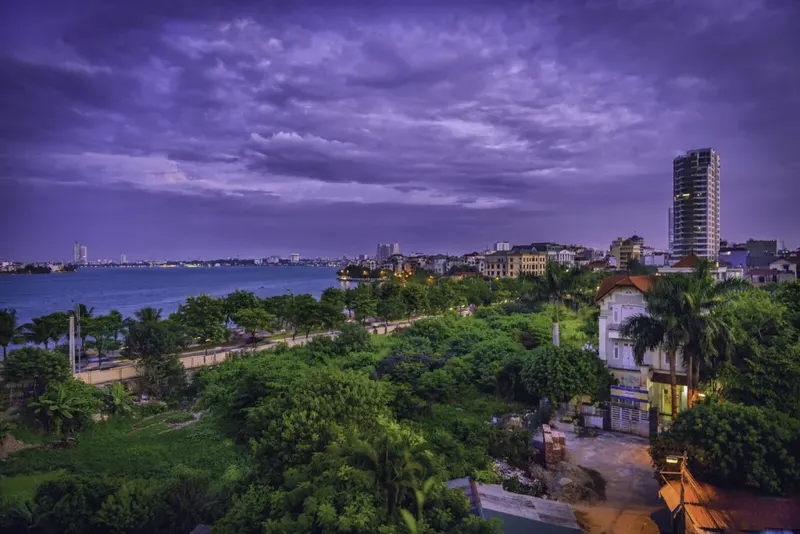
Hanoi has been Vietnam's capital for the better part of a thousand years, and that long history shows in its streets. The city gathers around Hoan Kiem Lake, with the tangled lanes of the Old Quarter to the north and wide, tree-lined French Quarter boulevards to the south. It is a place of morning tai chi by the water, pavement kitchens, and temples tucked between shophouses. Cooler winters set the north apart from the tropical south.
Hanoi is a quieter alternative. It's ready to explore in the Nuvoha app: set your budget and see complete Hanoi trips.
Why visit Hanoi
Hanoi rewards slow wandering more than ticking off sights. The Old Quarter still follows its old guild plan, where whole streets once specialised in silk, silver, tin or bamboo, and many still carry those trades in their names. Around Hoan Kiem Lake you will find Ngoc Son Temple on its small island, reached by a red wooden bridge. The Temple of Literature, Vietnam's first seat of learning, honours Confucius in a series of calm courtyards. Add the Ho Chi Minh Mausoleum, water puppet theatre and endless pavement dining, and the city becomes a study in everyday ritual. It also opens the way north to Halong Bay and Ninh Binh.
Highlights
- Hoan Kiem Lake and Ngoc Son Temple: The green heart of the city, with a small island temple reached by the scarlet The Huc Bridge and the old Turtle Tower rising from the water.
- The Old Quarter: Thirty-six ancient guild streets packed with shophouses, street kitchens and trades that still echo in the road names.
- Temple of Literature: Vietnam's first university, founded in the eleventh century, a series of walled courtyards dedicated to Confucius and to scholarship.
- Ho Chi Minh Mausoleum and Ba Dinh Square: The solemn resting place of the country's founding leader, set on the square where independence was declared in 1945.
- Thang Long Water Puppets: A northern folk art performed on water, with wooden puppets, live music and stories drawn from village life.
- Hoa Lo Prison: A sobering colonial-era prison museum, later nicknamed the Hanoi Hilton, tracing the city's turbulent twentieth century.
Areas to know
- Hoan Kiem: The central district wrapped around the lake, holding the Old Quarter, the night market and much of the colonial French Quarter.
- Ba Dinh: The political quarter, home to the mausoleum, the One Pillar Pagoda and wide ceremonial boulevards.
- Tay Ho (West Lake): A calmer, leafier area beside the city's largest lake, with Tran Quoc Pagoda, cafes and a large expatriate community.
- Hai Ba Trung: A busy residential and commercial district south of the lake, named after the Trung sisters who led a first-century revolt.
- Dong Da: An inland district associated with the Temple of Literature and a historic battlefield from the eighteenth century.
Food & drink
Hanoi is often called the birthplace of pho, and the northern version is clear, restrained and beef-based, seasoned at the table rather than sweetened. The city's signature is arguably bun cha, grilled pork patties served in a bowl of dipping broth with fresh herbs and rice noodles. Egg coffee, whisked with sweetened condensed milk into something like a warm dessert, was invented here. Eating happens on the pavement, at low tables, and often at stalls that cook one dish and nothing else.
- Pho (beef noodle soup)
- Bun cha (grilled pork with noodles)
- Egg coffee (ca phe trung)
- Cha ca (turmeric and dill fish)
- Banh cuon (steamed rice rolls)
- Bun rieu (crab noodle soup)
What Hanoi feels like
The mood in Hanoi is unhurried but never still. Mornings begin early, with vendors carrying shoulder poles of herbs and fruit, and tiny plastic stools spilling onto the pavement for bowls of pho. Motorbikes flow in constant streams, and crossing the road becomes a slow, steady art. The Old Quarter feels close and layered, its shophouses stacked with signs, lanterns and drying laundry. By the lake the pace softens, with couples, joggers and chess players sharing the shade. Evenings bring beer corners, grilled skewers and the low hum of conversation. Winter can turn grey and cool, lending the streets a quiet, reflective air.
Getting around
Central Hanoi is walkable, and the Old Quarter is best explored on foot, though its pavements are crowded and often given over to parked motorbikes. Ride-hailing apps such as Grab work well for cars and motorbike taxis, and metered taxis are common. The city has begun opening metro lines, though coverage is still limited. Cyclos offer a slow loop of the Old Quarter for those who want one. Traffic is dense, so allow extra time. Noi Bai International Airport lies north of the city, across the Red River, and is Hanoi's main gateway. The drive into the centre usually takes around forty-five minutes to an hour, depending on traffic. Airport taxis, ride-hailing cars and hotel transfers are all straightforward. There is also an airport bus service into the Old Quarter.
Good to know
- Dress modestly at temples, pagodas and mausoleums, covering shoulders and knees; the Ho Chi Minh Mausoleum in particular enforces a strict dress code and quiet conduct.
- Remove your shoes when entering temples and most homes.
- Use both hands when passing items to elders as a sign of respect.
- Bargaining is expected in markets, but keep it good-natured.
- Avoid touching people on the head, and try not to point with a single finger or your feet.
- Perfect the slow, steady road crossing: move at a constant pace and let the motorbikes flow around you rather than stopping suddenly.
- Carry cash in smaller notes for street food and markets, where vendors may not have change for large ones.
- Mornings are the best time for the lake and temples, before the heat and crowds build.
- Pack a light layer for the winter months, when the north turns cool and damp.
- Keep cash handy; many street kitchens and small shops do not take cards.
Best for
- City breaks
- Quieter travel
Key facts
| Country | Vietnam |
|---|---|
| Region | Asia |
| Airports | HAN |
| Trip length fit | Short-trip friendly |
Hanoi essentials
| Currency | Vietnamese dong (VND) |
|---|---|
| Language | Vietnamese; English is understood in tourist areas |
| Time zone | Indochina Time (UTC+7) |
| Emergency number | 113 police, 114 fire, 115 ambulance |
| Driving side | Right |
| Tap water | Not considered safe to drink; use bottled or filtered water |
Climate & seasons
| Month | Typical range | Season |
|---|---|---|
| January | 14°C to 21°C | Cool dry winter |
| April | 21°C to 28°C | Warm spring |
| July | 26°C to 34°C | Hot rainy season |
| October | 22°C to 29°C | Milder autumn |
Typical stay
- Weekend-friendly
- Short break (2–5 days)
Hanoi works as a weekend break just as well as a longer stay.
Getting there
Hanoi is served via HAN.
- HAN
Is it your kind of trip?
Ideal if…
- you like walkable city energy
- you like places before everyone else finds them
Maybe not if…
- a beach-first holiday is the priority
Pairs well with
Compare with
| Hanoi | Da Nang | Ho Chi Minh | |
|---|---|---|---|
| Country | Vietnam | Vietnam | Vietnam |
| Region | Asia | Asia | Asia |
| Styles | City | City | City |
| Trip length fit | Weekend-friendly | Weekend-friendly | Weekend-friendly |
| Airports | 1 | 1 | 1 |
More in Asia
Near Hanoi
Travel style
- Short-trip friendly
- City
Frequently asked questions
Which airports serve Hanoi?
Hanoi is served via HAN.
Is Hanoi good for a weekend trip?
Yes, Hanoi works for a weekend as well as a longer stay.
What kind of trip is Hanoi best for?
Hanoi is best for city trips.
Which destinations pair well with Hanoi?
Within multi-city range: Da Nang (628 km), Chiang Rai (633 km), Bangkok (994 km).
How many days do you need in Hanoi?
Most visitors find two to three days enough to see the Old Quarter, the lake, the main temples and museums at a relaxed pace. Adding an overnight trip to Halong Bay or Ninh Binh, both a few hours away, is a common way to extend a stay in the north.
What is the best time of year to visit Hanoi?
Autumn, roughly September to November, and spring, around March and April, are widely considered the most comfortable, with mild temperatures and lower humidity. Summers are hot and wet, while winters can be cool, grey and damp, unlike the tropical south.
Is Hanoi a good base for Halong Bay?
Yes. Hanoi is the usual departure point for cruises on Halong Bay and the quieter Lan Ha Bay, with the journey taking around two and a half to three hours by road. Many visitors take an overnight cruise and return to the city afterwards.
How do you get around Hanoi?
The centre is walkable, and ride-hailing apps and taxis cover longer distances. A metro network is slowly expanding, though it does not yet reach every district. Traffic is dense throughout the day, so it helps to allow extra time and to cross roads calmly and predictably.