
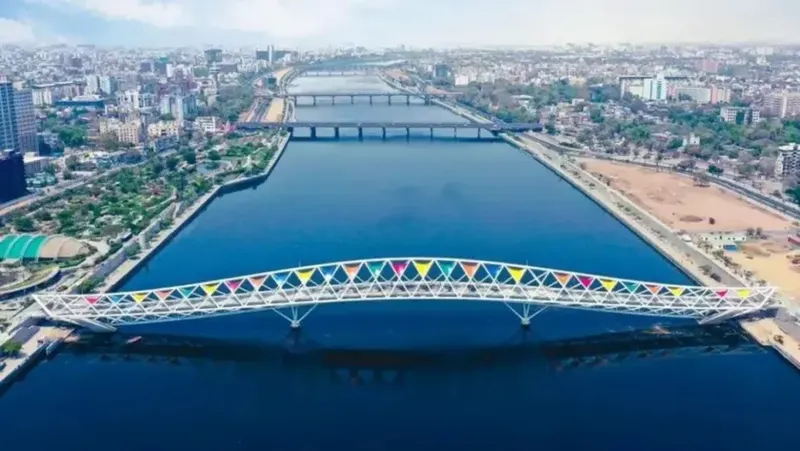
Ahmedabad is Gujarat's great commercial city, founded in 1411 on the banks of the Sabarmati and now a UNESCO World Heritage City. Its walled old town is a dense weave of pols, the tight residential quarters where carved wooden houses, shared courtyards and Hindu and Jain temples sit behind old gates. Beyond the walls lie Indo-Islamic mosques, a modernist university campus and the ashram from which Gandhi launched the Salt March.
Ahmedabad is a quieter alternative. It's ready to explore in the Nuvoha app: set your budget and see complete Ahmedabad trips.
Why visit Ahmedabad
Ahmedabad rewards travellers curious about craft, faith and the making of modern India. The old city, best explored on an early-morning heritage walk, holds intricately carved pols, stepwells and the Jama Masjid, while the Calico Museum of Textiles and the bustling markets speak to a centuries-old cloth trade. On the western bank, the Sabarmati Ashram preserves Gandhi's spare rooms and the story of the independence movement, and the landscaped Riverfront offers space to breathe. The city is also a gateway to Gujarat, from the stepwell at Adalaj to the old capital of Champaner. The honest caveats: summers are fierce, and the state is dry, so alcohol is restricted.
Sights to plan around
- Sabarmati Ashram: Gandhi's riverside home from 1917 to 1930 and the base for the 1930 Salt March, its simple rooms and museum tracing the independence struggle.
- The pols of the old city: Tight-knit residential quarters behind carved gateways, laced with wooden havelis, shared courtyards, secret passages and bird-feeders, best seen on an early-morning walk.
- Jama Masjid: One of India's most beautiful mosques, completed in 1424 in yellow sandstone, its prayer hall carried on some 260 carved columns.
- Adalaj Stepwell: An intricately carved five-storey stepwell of 1499 just north of the city, descending in cool galleries of Indo-Islamic stonework.
- Sabarmati Riverfront: A long landscaped promenade along both banks of the river, with gardens, walkways and a Sunday flea market at its edge.
- Sidi Saiyyed Mosque: A sixteenth-century mosque famed for its lattice windows, including the celebrated Tree of Life jali carved from a single stone.
Around the old city and beyond
- The Walled City (Old Ahmedabad): The historic east-bank core of pols, bazaars and monuments around Bhadra Fort and the Teen Darwaza gate, the heart of the UNESCO listing.
- Manek Chowk: A market square that trades in vegetables by morning, gold by afternoon and street food by night, in the thick of the old town.
- Ellisbridge and Ashram Road: The older west-bank districts across the river, with the Sabarmati Ashram, cultural institutions and university campuses nearby.
- Navrangpura and CG Road: A commercial and shopping heart of the newer west bank, lined with stores, cafes and offices.
- SG Highway: The modern corridor on the western edge, home to malls, hotels, restaurants and the corporate offices of the growing city.
- Kankaria: A southeastern district built around Kankaria Lake, a large fifteenth-century tank ringed by a lakefront promenade, a zoo and gardens.
The Gujarati table
Ahmedabad is one of India's great vegetarian cities, and the Gujarati thali is its masterpiece: an ever-refilled platter of dals, curries, farsan snacks and flatbreads that balances sweet, salty and spicy in every bite. The city grazes all day on farsan, from steamed dhokla and spiralled fafda to khaman and handvo. Street food peaks at night around Manek Chowk and Law Garden, and Kathiawadi restaurants bring the fierier, garlic-laced cooking of the Saurashtra countryside. Winter brings undhiyu, a slow-cooked medley of vegetables.
- Gujarati thali
- Dhokla
- Fafda and jalebi
- Khaman
- Undhiyu
- Handvo
What Ahmedabad feels like
Ahmedabad is an early riser, a working city of textile mills, traders and scholars that keeps one foot in tradition and one in industry. Dawn belongs to the old city, when the pols wake to temple bells, birdsong from carved wooden chabutaras and the smell of fried snacks. By day the bazaars around Manek Chowk roar with commerce, then reinvent themselves after dark as a street-food market. The mood is devout and industrious rather than showy: this is the land of Gandhi's simplicity and of Jain restraint, a proudly vegetarian, largely dry city where kite-flying at Uttarayan is a shared passion. The Sabarmati threads calmly through the middle.
Getting from A to B
Ahmedabad has a growing metro with two lines crossing near the centre, and a pioneering bus rapid transit network, the Janmarg, running in dedicated lanes. For shorter hops, autorickshaws are everywhere; agree the fare or ask for the meter. App-based cabs are reliable, and the compact old city is best unravelled on foot, ideally on a guided heritage walk. Traffic and summer heat both reward an early start. Sardar Vallabhbhai Patel International Airport (AMD) lies around ten kilometres north of the centre, with adjoining domestic and international terminals. Prepaid taxis and app-based cabs make the short and straightforward run into the city.
Practical pointers
- Remove your shoes before entering temples and mosques, and dress modestly with shoulders and knees covered.
- Use your right hand for eating and for giving or receiving, as is customary across India.
- Gujarat is a dry state, so alcohol is largely prohibited; visitors can apply for a temporary permit through licensed outlets and some hotels.
- Many pols and temples are lived-in, working places, so ask before photographing homes, shrines or people.
- November to February is the pleasant, cool season; April to June is punishingly hot, and the monsoon runs July to September.
- The old city comes alive on an early-morning heritage walk, several of which start near the Swaminarayan temple in Kalupur.
- If you can, time a visit to the Uttarayan kite festival in mid-January, when the skies fill with kites.
- Manek Chowk is a vegetable market by day and a celebrated street-food bazaar late into the night.
- Carry small notes for autorickshaws, temple offerings and street-food stalls.
- Drink sealed bottled or filtered water rather than tap.
Best for
- City breaks
- Quieter travel
Key facts
| Country | India |
|---|---|
| Region | Asia |
| Airports | AMD |
| Trip length fit | Short-trip friendly |
Ahmedabad essentials
| Currency | Indian rupee (INR) |
|---|---|
| Language | Hindi and English are the union-level official languages, alongside twenty-two scheduled languages and hundreds of others; English is widely used in cities, business and tourism. |
| Time zone | IST (UTC+5:30), a single time zone across the whole country |
| Emergency number | 112 |
| Driving side | Left |
| Tap water | Not reliably safe to drink; choose sealed bottled water, or water that has been filtered or boiled. |
Climate & seasons
| Month | Typical range | Season |
|---|---|---|
| January | 12°C to 29°C | Dry warm winter |
| April | 23°C to 40°C | Very hot spring |
| July | 26°C to 34°C | Humid monsoon season |
| October | 21°C to 36°C | Hot post-monsoon |
Typical stay
- Weekend-friendly
- Short break (2–5 days)
Ahmedabad works as a weekend break just as well as a longer stay.
Getting there
Ahmedabad is served via AMD.
- AMD
Is it your kind of trip?
Ideal if…
- you like walkable city energy
- you like places before everyone else finds them
Maybe not if…
- a beach-first holiday is the priority
Pairs well with
Compare with
More in Asia
Near Ahmedabad
Travel style
- Short-trip friendly
- City
Frequently asked questions
Which airports serve Ahmedabad?
Ahmedabad is served via AMD.
Is Ahmedabad good for a weekend trip?
Yes, Ahmedabad works for a weekend as well as a longer stay.
What kind of trip is Ahmedabad best for?
Ahmedabad is best for city trips.
Which destinations pair well with Ahmedabad?
Within multi-city range: Mumbai (444 km), Pune (517 km), Delhi (756 km).
Is Ahmedabad a UNESCO World Heritage Site?
Yes. In 2017 Ahmedabad became India's first UNESCO World Heritage City, recognised for its walled old town, the dense pol neighbourhoods, and its mix of Hindu, Jain and Indo-Islamic architecture.
When is the best time to visit Ahmedabad?
November to February brings cool, comfortable weather and the Uttarayan kite festival in January. March to June turns very hot, while the monsoon falls between July and September.
Can you drink alcohol in Ahmedabad?
Gujarat is a dry state, so alcohol is largely prohibited. Visitors can obtain a temporary liquor permit through licensed shops and certain hotels, but it is not freely available in restaurants and bars.
What is a pol?
A pol is a traditional, self-contained residential quarter of the old city, entered through gates and made up of tightly packed houses, shared courtyards and their own temples and wells. Exploring them is a highlight of Ahmedabad.