
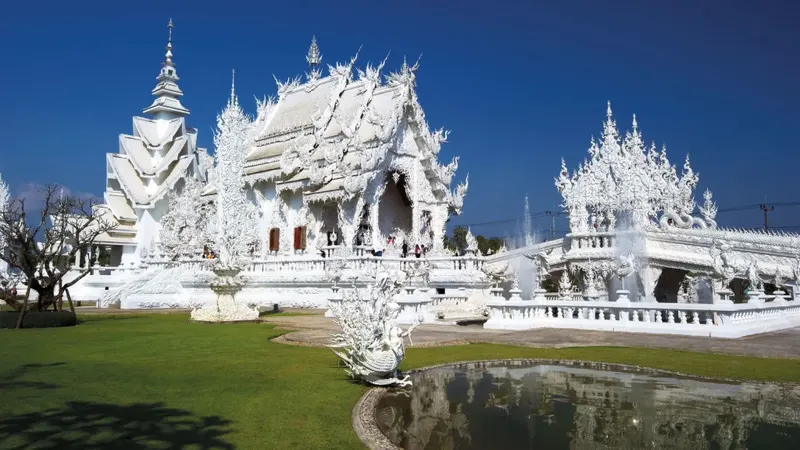
Chiang Rai lies in the far north of Thailand, a laid-back provincial city ringed by misty mountains where the borders of Myanmar and Laos are close at hand. Once the first capital of the Lanna kingdom, it is now known above all for its contemporary temples, the dazzling White Temple foremost among them. Beyond the city rise tea terraces, hill communities and the meeting of rivers at the Golden Triangle. Cooler and quieter than the south, it rewards travellers who like their landscapes green.
Chiang Rai is a quieter alternative. It's ready to explore in the Nuvoha app: set your budget and see complete Chiang Rai trips.
Why visit Chiang Rai
Chiang Rai pairs striking art with mountain scenery. Its trio of modern landmarks, the mirror-white Wat Rong Khun, the cobalt Blue Temple and the macabre Black House, are like nothing else in Thailand. The surrounding hills grow some of the country's best tea and coffee, with plantations such as Choui Fong and the Yunnanese town of Mae Salong open to visitors. To the north, three countries meet at the Golden Triangle on the Mekong, once the heart of the opium trade and now told through museums and viewpoints. Royal gardens at Doi Tung, waterfalls and diverse hill communities complete a province that reveals itself slowly.
Around the province
- Chiang Rai town: The compact provincial capital, walkable and friendly, with the golden clock tower, riverside temples, night bazaar and weekend walking streets.
- Mae Salong: A mountain village high to the northwest, settled by former Chinese Nationalist soldiers and known for its tea, Yunnanese food and cool air.
- The Golden Triangle and Chiang Saen: The far north on the Mekong, pairing the three-country meeting point with the ancient walled town and temples of Chiang Saen.
- Doi Tung and Mae Fah Luang: The northwestern highlands of royal gardens, the Doi Tung villa and hillside villages, cooler and greener the higher you climb.
- Doi Chang and the tea hills: The ridges south and west of the city where tea estates and the celebrated Doi Chang coffee are grown among hill communities.
- Chiang Khong: A riverside border town downstream on the Mekong, the crossing point into Laos and the start of the slow boat toward Luang Prabang.
What Chiang Rai feels like
Chiang Rai keeps a gentle, small-town rhythm at odds with the drama of its art and mountains. The compact centre is easy and friendly, with a golden clock tower, night markets and quiet temples, and it empties into countryside within minutes. Mornings in the cool season often begin under mist, the ridgelines floating above the valleys before the sun burns through. The pace upcountry is slower still, among tea terraces, riverside villages and hill settlements where several cultures meet. There is a creative, independent streak here, seen in the temples and galleries, yet the overall feel stays rural, restful and close to the land.
Sights to plan around
- Wat Rong Khun (the White Temple): Chalermchai Kositpipat's ongoing masterwork, a brilliant white temple inlaid with mirrored glass, approached across a bridge above a field of reaching hands.
- Wat Rong Suea Ten (the Blue Temple): A vivid indigo-and-gold temple with a luminous white Buddha, created by a student of the White Temple's artist.
- Baan Dam (the Black House): Thawan Duchanee's dark, unsettling complex of black timber halls filled with hides, bones and art, a deliberate counterpoint to the White Temple.
- The Golden Triangle: The confluence of the Ruak and Mekong where Thailand, Myanmar and Laos meet, with viewpoints, a giant Buddha and a museum tracing the opium trade.
- Doi Tung: A mountain estate of the late Princess Mother's development project, home to the Royal Villa and the terraced Mae Fah Luang Garden.
- Choui Fong tea plantation: Sweeping tea terraces in the hills north of the city, one of several estates where you can walk the rows and taste the local oolong.
The northern table
The far north eats differently from the rest of Thailand. Lanna cooking favours sticky rice, herbal sausages and milder, earthier curries, often gathered on a shared tray with fresh vegetables and fiery dips. Chiang Rai has its own signature in khanom jeen nam ngiaw, a tomato-tinged noodle soup, while the hill town of Mae Salong adds Yunnanese Chinese dishes brought by its settlers. The province's tea and coffee, grown on the surrounding ridges, round off almost any meal.
- Khao soi
- Nam ngiaw
- Sai ua
- Sticky rice with dips
- Local tea and coffee
Getting around
The town centre is small and walkable, but the sights are scattered across the province, so many visitors hire a car and driver, join a tour or rent their own transport. Shared songthaews and local buses link the town with nearby attractions and neighbouring Chiang Mai, while tuk-tuks handle short hops. Mountain roads are scenic but winding, so allow more time than the distances suggest, especially up to Mae Salong and Doi Tung. Mae Fah Luang Chiang Rai International Airport lies a short drive north of the city, with frequent domestic flights from Bangkok and a handful of regional routes. Taxis and arranged transfers make the run into town in around fifteen to twenty minutes.
Practical pointers
- Cover shoulders and knees at temples, remove your shoes before entering, and dress with extra care at the White Temple, which enforces it.
- Never point your feet at Buddha images or people, and step over thresholds rather than on them.
- Women should not touch monks or hand things to them directly.
- Treat the King and the royal family with respect, in words and toward their images, as the law is strict.
- Ask before photographing people in hill communities, and treat visits to their villages with sensitivity.
- The wai, palms pressed together with a slight bow, is the gracious way to greet and thank.
- The cool season from November to February is the most comfortable, with misty mornings and clear skies; pack a warm layer for the hills.
- Late February to April can bring agricultural haze from crop burning across the north, sometimes affecting air quality and views.
- The White Temple, Blue Temple and Black House sit fairly close together and are easily seen together by car or tour.
- Arrive early at Wat Rong Khun to see it before the coaches and in the softest light.
- The far-northern sights around the Golden Triangle make a long but rewarding trip from the city, so an early start helps.
- Tea estates such as Choui Fong welcome visitors for tastings and views over the terraces.
Best for
- Nature
- Quieter travel
Key facts
| Country | Thailand |
|---|---|
| Region | Asia |
| Airports | CEI |
| Trip length fit | Short-trip friendly |
Chiang Rai essentials
| Currency | Thai Baht (THB) |
|---|---|
| Language | Thai; English is workable in tourist areas and hotels |
| Time zone | Indochina Time (UTC+7), no daylight saving |
| Emergency number | 191 (police), 1669 (ambulance), 1155 (tourist police) |
| Driving side | Left |
| Tap water | Not for drinking: use bottled or filtered water; restaurant ice is generally factory-made and fine |
Climate & seasons
| Month | Typical range | Season |
|---|---|---|
| January | 12°C to 28°C | Cool dry season |
| April | 20°C to 35°C | Hot season |
| July | 24°C to 31°C | Rainy season |
| October | 21°C to 31°C | Warm transition |
Typical stay
- Weekend-friendly
- Short break (2–5 days)
Chiang Rai works as a weekend break just as well as a longer stay.
Getting there
Chiang Rai is served via CEI.
- CEI
Is it your kind of trip?
Ideal if…
- you want nature within easy reach
- you like places before everyone else finds them
Maybe not if…
- a beach-first holiday is the priority
- you want big-city energy around the clock
Pairs well with
Compare with
More in Asia
Near Chiang Rai
Travel style
- Short-trip friendly
- Nature
Frequently asked questions
Which airports serve Chiang Rai?
Chiang Rai is served via CEI.
Is Chiang Rai good for a weekend trip?
Yes, Chiang Rai works for a weekend as well as a longer stay.
What kind of trip is Chiang Rai best for?
Chiang Rai is best for nature trips.
Which destinations pair well with Chiang Rai?
Within multi-city range: Hanoi (633 km), Bangkok (702 km), Da Nang (981 km).
What is Chiang Rai famous for?
Chiang Rai is best known for its contemporary temples, above all the White Temple (Wat Rong Khun), along with the Blue Temple and the Black House. The province also draws visitors for its tea and coffee hills and the Golden Triangle on the Mekong.
When is the best time to visit Chiang Rai?
The cool, dry season from November to February is the most comfortable, with misty mornings and pleasant days. Note that the months from roughly late February to April can bring haze from agricultural burning, while the rainy season turns the hills lush and green.
Is Chiang Rai worth visiting from Chiang Mai?
Yes. The two northern cities are about three hours apart by road, and many travellers combine them. Chiang Rai is smaller and quieter, with its own distinctive art, mountains and border-country scenery.
What is the Golden Triangle?
The Golden Triangle is the point where Thailand, Myanmar and Laos meet at the confluence of the Ruak and Mekong rivers, north of Chiang Rai. Once notorious for the opium trade, it is now visited for its viewpoints, riverside temples and museums.