
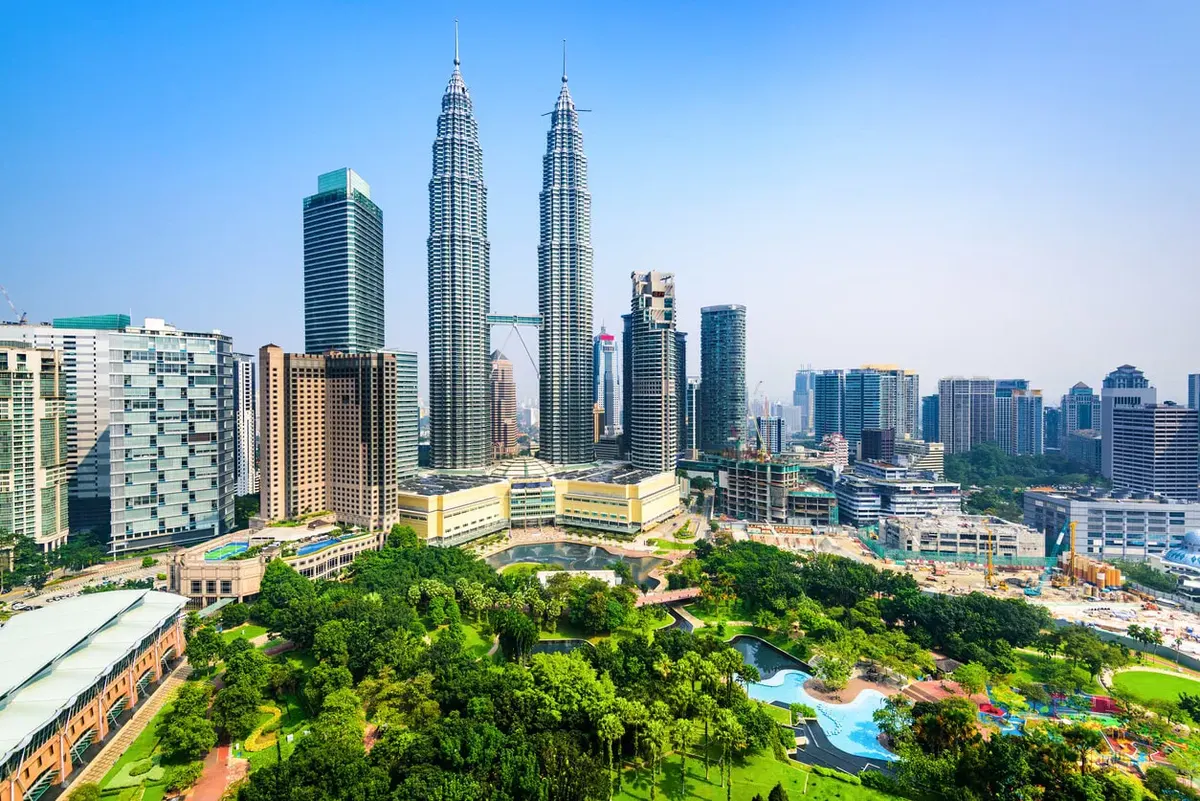
Twin spires of steel and glass climb 88 storeys above KLCC Park while, a few streets away, hawkers fan satay over charcoal as the evening call to prayer drifts across the rooftops. Kuala Lumpur runs on that contrast: monorails and mega-malls overhead, kopitiams and wet markets at street level, and actual rainforest surviving in the middle of it all.
Kuala Lumpur is a quieter alternative. It's ready to explore in the Nuvoha app: set your budget and see complete Kuala Lumpur trips.
Why visit Kuala Lumpur
Few capitals let you move so easily between worlds. In a single afternoon you can watch pilgrims climb the 272 rainbow-painted steps of Batu Caves, walk a canopy bridge through the KL Forest Eco Park, then eat banana leaf rice in Brickfields with your hands. Malay, Chinese and Indian traditions have shared these streets for generations, which is why the city's mosques, temples and food stalls sit shoulder to shoulder. Add efficient trains and some of Southeast Asia's best street food, and Kuala Lumpur rewards far more than a stopover.
What to see in Kuala Lumpur
- Petronas Twin Towers: The 88-storey twin towers are joined by a double-decker skybridge and anchor the KLCC district, with a landscaped park at their feet.
- Batu Caves: A vast limestone cave temple north of the city, reached by 272 rainbow-painted steps beneath a giant golden statue of Lord Murugan.
- KL Forest Eco Park: A pocket of genuine rainforest in the city centre, crossed by a canopy walkway at the foot of KL Tower.
- Merdeka Square: The padang where Malaysian independence was declared in 1957, faced by the Moorish-style Sultan Abdul Samad Building.
- Thean Hou Temple: A six-tiered Chinese temple on a hill south of the centre, strung with hundreds of red lanterns.
- Central Market: An art deco market hall near Chinatown given over to Malaysian crafts, batik and local snacks.
Neighbourhoods to know
- Bukit Bintang: KL's shopping and entertainment heart, home to the mega-malls of Jalan Bukit Bintang and the open-air food street of Jalan Alor.
- Chinatown: Centred on Petaling Street's covered market, with the Sri Mahamariamman Temple, old shophouses and the mural-lined Kwai Chai Hong laneway.
- Kampung Baru: A traditional Malay enclave of stilted wooden houses that has held its ground beneath the towers, best known for its evening food stalls.
- Brickfields: KL's Little India beside KL Sentral station, all colour-washed streets, garland sellers and banana leaf restaurants.
- Bangsar: A leafy residential area west of the centre known for cafés, small galleries and a lively weekend market culture.
Eating your way through KL
Eating is Kuala Lumpur's true civic activity, and the classics cross every culture in the city. Start with nasi lemak (coconut rice, sambal, anchovies and egg) sold from morning stalls wrapped in banana leaf. Mamak restaurants serve flaky roti canai around the clock, Chinese hawkers char kway teow over roaring flames, and Brickfields does banana leaf rice the proper way, eaten by hand. Finish with a bowl of iced cendol.
- Nasi lemak
- Roti canai
- Char kway teow
- Banana leaf rice
- Cendol
What Kuala Lumpur feels like
KL is humid, unhurried and sociable. Days build towards a late-afternoon thunderstorm that empties the pavements into air-conditioned malls and coffee shops, then evenings spill back outdoors, when Jalan Alor fills with plastic stools and the smell of grilled chicken wings. The city moves at eating pace: people plan their day around meals, and the question "sudah makan?" (have you eaten?) doubles as a greeting.
Moving around the city
The rail network (LRT, MRT and monorail) covers most visitor territory, and a stored-value Touch 'n Go card works across all of it. KL Sentral is the interchange hub, linked to the airport by the KLIA Ekspres train. Ride-hailing apps are cheap and universal for gaps in the network, while walking between districts is possible but sweaty; covered walkways link KLCC to Bukit Bintang. Kuala Lumpur International Airport (KLIA) lies well south of the city, connected to KL Sentral by the non-stop KLIA Ekspres train in about half an hour.
Good to know before you go
- Remove your shoes before entering homes, mosques and many temples; robes are lent to visitors at the National Mosque.
- Use your right hand when giving, receiving or eating: the left is considered unclean.
- Dress modestly at religious sites, covering shoulders and knees.
- Tipping is not customary; many restaurants add a service charge to the bill instead.
- Carry a compact umbrella: afternoon thunderstorms are brief but drenching, especially between March and May and October to December.
- Visit Batu Caves early in the morning to beat both the heat and the crowds on the steps.
- Bring a light layer indoors: malls, trains and cinemas are air-conditioned to arctic settings.
- The free GoKL city buses loop through the central districts and are handy for short hops.
- Mind the monkeys at Batu Caves: keep food and loose sunglasses out of reach.
- Friday lunchtime prayers mean mosques close to visitors and nearby streets get busy; plan sightseeing around it.
Best for
- City breaks
- Quieter travel
Key facts
| Country | Malaysia |
|---|---|
| Region | Asia |
| Airports | KUL |
| Trip length fit | Short-trip friendly |
Kuala Lumpur essentials
| Currency | Malaysian Ringgit (MYR) |
|---|---|
| Language | Malay (Bahasa Malaysia); English is widely spoken, especially in cities and on the tourist trail |
| Time zone | Malaysia Time, UTC+8, no daylight saving |
| Emergency number | 999 (112 from mobile phones) |
| Driving side | Left |
| Tap water | Treated, but locals generally boil or filter it; visitors usually stick to bottled or filtered water |
Climate & seasons
| Month | Typical range | Season |
|---|---|---|
| January | 23°C to 32°C | Warm humid season |
| April | 24°C to 33°C | Hot wet season |
| July | 23°C to 32°C | Warm humid season |
| October | 23°C to 32°C | Rainier season |
Typical stay
- Weekend-friendly
- Short break (2–5 days)
Kuala Lumpur works as a weekend break just as well as a longer stay.
Getting there
Kuala Lumpur is served via KUL.
- KUL
Is it your kind of trip?
Ideal if…
- you like walkable city energy
- you like places before everyone else finds them
Maybe not if…
- a beach-first holiday is the priority
Pairs well with
Compare with
More in Asia
Near Kuala Lumpur
Travel style
- Short-trip friendly
- City
Frequently asked questions
Which airports serve Kuala Lumpur?
Kuala Lumpur is served via KUL.
Is Kuala Lumpur good for a weekend trip?
Yes, Kuala Lumpur works for a weekend as well as a longer stay.
What kind of trip is Kuala Lumpur best for?
Kuala Lumpur is best for city trips.
Which destinations pair well with Kuala Lumpur?
Within multi-city range: Singapore (297 km), Phuket (705 km), Koh Samui (778 km).
Is Kuala Lumpur walkable?
Within districts, yes, and an air-conditioned covered walkway links KLCC to Bukit Bintang. Between districts the heat, traffic and patchy pavements make the LRT, MRT or a ride-hailing car the better choice.
Do I need cash in Kuala Lumpur?
Cards and e-wallets are accepted almost everywhere, but keep small ringgit notes for hawker stalls, street markets and older kopitiams, which often remain cash-only.
Will I get by with English?
Easily. English is widely spoken across the city, signage is bilingual, and menus at most restaurants are printed in English alongside Malay.