
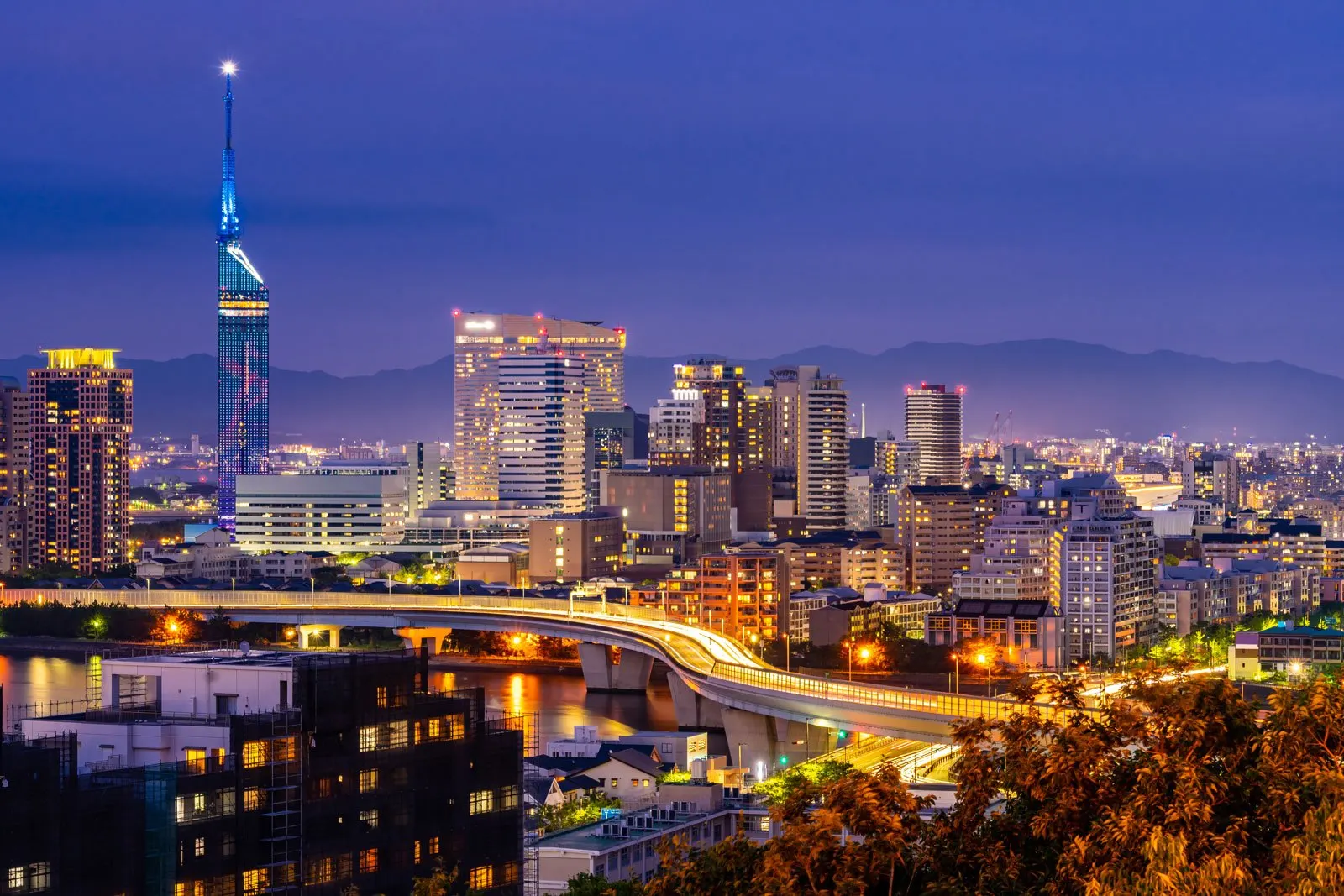
When dusk settles over the Naka River, Fukuoka's yatai flick on their lamps: dozens of tiny mobile food stalls, each seating eight or so strangers shoulder to shoulder over steaming tonkotsu broth. No other Japanese city kept its street-stall culture like this, and none wears big-city life so lightly: airport, beach and centre sit minutes apart.
Fukuoka is a quieter alternative. It's ready to explore in the Nuvoha app: set your budget and see complete Fukuoka trips.
Why visit Fukuoka
Fukuoka delivers Japan's pleasures at a compact scale: a food scene famous nationwide for Hakata tonkotsu ramen and motsunabe, an evening ritual of yatai stalls found almost nowhere else, and a seaside setting where Momochi's beach and Ohori Park's lake sit minutes from downtown Tenjin. Kyushu unfolds from Hakata Station (Nagasaki, Kumamoto and the hot-spring towns are direct by train) and Busan in South Korea is close enough for a ferry crossing. Few cities of 1.6 million feel this easy to be in.
Top experiences
- Yatai stalls: Around a hundred open-air food stalls set up nightly in Nakasu, Tenjin and Nagahama: a tradition unmatched at this scale in urban Japan.
- Ohori Park: A landscaped lake with a two-kilometre walking circuit, a traditional Japanese garden and the neighbouring ruins of Fukuoka Castle.
- Kushida Shrine: The city's guardian shrine since 757 and home of the Hakata Gion Yamakasa float race, with a giant decorated float displayed year-round.
- Fukuoka Tower and Momochi: A 234-metre seaside tower above Momochihama's curved artificial beach, with views across Hakata Bay.
- Dazaifu Tenmangū: A shrine to the deity of scholarship about half an hour away by Nishitetsu train, approached along an avenue of plum trees and mochi shops.
Wards and waterfronts
- Hakata: The historic merchant side of the city around Hakata Station, with quiet temple lanes and the machiya folk-culture museum.
- Tenjin: Downtown Fukuoka: department stores, an underground shopping arcade and the city's densest concentration of bars and cafés.
- Nakasu: An island between the Naka and Hakata rivers, known for its neon entertainment quarter and riverside line of yatai.
- Daimyo: A tight weave of backstreets west of Tenjin filled with independent fashion shops, coffee roasters and standing bars.
- Momochi: A planned seaside district of museums, Fukuoka Tower and a curved artificial beach on Hakata Bay.
Hakata's food story
Hakata tonkotsu ramen (cloudy pork-bone broth, thin straight noodles) was born here, and the kaedama system lets you order an extra serving of noodles for the broth you have left. Motsunabe, an offal hotpot with garlic and chives, and mizutaki, a delicate chicken hotpot, are winter's twin pillars, while spicy mentaiko, cured pollock roe, tops everything from rice to pasta. Udon, locals will tell you firmly, was invented here too.
- Hakata tonkotsu ramen
- Motsunabe
- Mizutaki
- Mentaiko
- Hakata udon
What Fukuoka feels like
Fukuoka feels young and unhurried at once. Runners circle Ohori Park's lakeside path at dawn; office workers loosen ties at yatai counters by night, where talking to your neighbour is half the point. The Hakata dialect softens sentence endings, July brings the Hakata Gion Yamakasa, when teams race one-tonne floats through the streets before sunrise, and sea breezes off Hakata Bay keep the city's pace easy.
Subway, buses and ferries
The Fukuoka City Subway's Kūkō Line strings together the airport, Hakata Station, Tenjin and Ohori Park in a matter of minutes. The local IC card is Hayakaken, with nimoca on Nishitetsu buses and trains and SUGOCA on JR, all interchangeable with Suica. Nishitetsu buses blanket the wider city, and the compact centre means Tenjin, Nakasu and Hakata are easy walks from one another along the riverbanks. Fukuoka Airport is famously close to town: the subway reaches Hakata Station in about five minutes, making it one of the world's most convenient big-city airports.
Handy tips
- Tipping is not customary in Japan, and yatai are no exception: pay what the board says and thank the cook.
- Yatai seats are scarce: order promptly, keep belongings on your lap and free your stool once you have finished eating.
- Conversation is welcome at a yatai counter (they are sociable places) but follow the stallholder's lead.
- Carry your rubbish with you; public bins are rare, and stalls take back only what they served.
- Yatai generally open from early evening and many shut by midnight; they thin out noticeably in heavy rain.
- Carry some cash: a number of yatai and small izakaya still take no cards.
- Dazaifu Tenmangū and the Kyushu National Museum sit side by side, linked by an escalator tunnel from the shrine grounds.
- Nokonoshima island's flower meadows are a ten-minute ferry ride from Meinohama, an easy half-day out on the bay.
- For the Yamakasa in July, the climactic race starts before dawn on the 15th; claim a spot near Kushida Shrine the evening before.
Best for
- City breaks
- Quieter travel
Key facts
| Country | Japan |
|---|---|
| Region | Asia |
| Airports | FUK |
| Trip length fit | Short-trip friendly |
Fukuoka essentials
| Currency | Japanese Yen (JPY) |
|---|---|
| Language | Japanese; English signage is good in cities and on transport, though spoken English is patchier |
| Time zone | Japan Standard Time (UTC+9), no daylight saving |
| Emergency number | 110 (police), 119 (fire and ambulance) |
| Driving side | Left |
| Tap water | Safe to drink nationwide, including from public fountains |
Climate & seasons
| Month | Typical range | Season |
|---|---|---|
| January | 3°C to 10°C | Cool winter |
| April | 10°C to 20°C | Mild spring |
| July | 24°C to 32°C | Hot humid summer |
| October | 15°C to 24°C | Mild autumn |
Typical stay
- Weekend-friendly
- Short break (2–5 days)
Fukuoka works as a weekend break just as well as a longer stay.
Getting there
Fukuoka is served via FUK.
- FUK
Is it your kind of trip?
Ideal if…
- you like walkable city energy
- you like places before everyone else finds them
Maybe not if…
- a beach-first holiday is the priority
Pairs well with
Compare with
More in Asia
Near Fukuoka
Travel style
- Short-trip friendly
- City
Frequently asked questions
Which airports serve Fukuoka?
Fukuoka is served via FUK.
Is Fukuoka good for a weekend trip?
Yes, Fukuoka works for a weekend as well as a longer stay.
What kind of trip is Fukuoka best for?
Fukuoka is best for city trips.
Which destinations pair well with Fukuoka?
Within multi-city range: Osaka (481 km), Seoul (563 km), Tokyo (883 km).
How do yatai stalls actually work?
Squeeze onto a free stool, order a dish and a drink to start, and pay when you leave, usually in cash. Most stalls seat about eight people, so eat, chat and move on rather than settling in for the night.
Is Fukuoka a walkable city?
The centre is. Tenjin, Nakasu and Hakata sit within about half an hour's walk of one another along the rivers, and the subway or a bus covers longer hops to Momochi and Ohori Park.
What day trips work well from Fukuoka?
Dazaifu's great shrine is about thirty minutes by Nishitetsu train, Yanagawa offers canal punting a little further down the same line, and Nagasaki and Kumamoto are both under two hours away by rail.