
Bengaluru sits high on the Deccan plateau, and you feel it in the air: mild, often breezy, kinder than the plains below. This is the garden city, laid out around great parks and avenues of rain trees, and it is also India's technology capital, a young and cosmopolitan place of tech parks, craft-beer bars and filter-coffee tiffin rooms. Old cantonment streets and traditional temple neighbourhoods sit beside glassy office corridors. It makes fewer grand claims than Delhi or Mumbai, and rewards you in quieter, everyday ways.
Bengaluru is a quieter alternative. It's ready to explore in the Nuvoha app: set your budget and see complete Bengaluru trips.
Why visit Bengaluru
Bengaluru's chief pleasure is livability rather than blockbuster sights. The climate is mild the year round thanks to the altitude; the parks, Lalbagh and Cubbon, are genuinely lovely; and the food-and-drink scene, from century-old dosa houses to a long-running pub culture, is among the best in the country. There are palaces and temples too, and the city makes an excellent base for Mysore, the coffee hills of Coorg and the sunrise viewpoint at Nandi Hills. The honest caveat is traffic: the city has grown fast and sprawls widely, so journeys across it can be slow, and the marquee monuments of the north are absent.
Sights to plan around
- Lalbagh Botanical Garden: A historic botanical garden begun under Hyder Ali and Tipu Sultan, with a Victorian glasshouse modelled on London's Crystal Palace and an outcrop of rock some three billion years old.
- Cubbon Park: A large green space at the city's heart, dotted with red Gothic public buildings, statues and museums, and a favourite for morning walkers.
- Bangalore Palace: A Tudor-revival palace of 1878, inspired by Windsor Castle, with fortified towers and wooden interiors, still held by the Mysore royal family.
- Tipu Sultan's Summer Palace: An elegant two-storey teak palace completed in 1791, its carved balconies and painted ceilings a survival of the eighteenth-century ruler's Bengaluru.
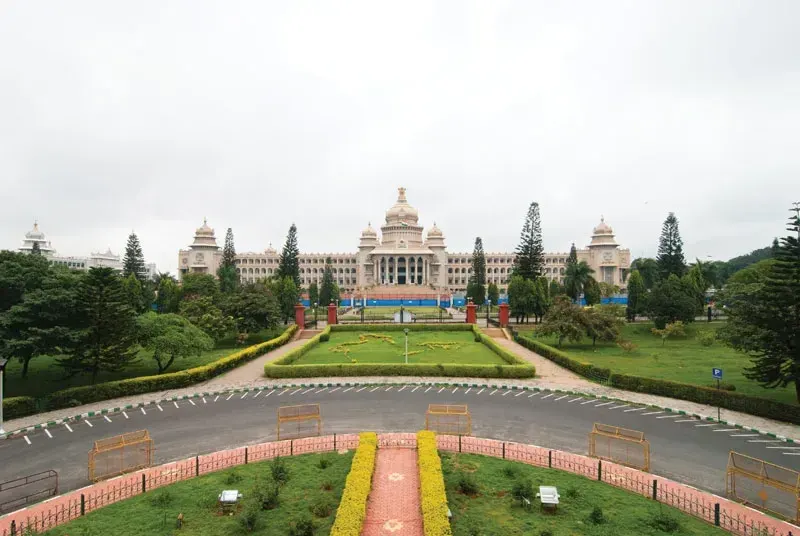
- Vidhana Soudha: The vast granite seat of Karnataka's legislature, built in the 1950s in a Neo-Dravidian style and floodlit on holidays; admired from the outside.
- Bull Temple (Dodda Basavana Gudi): A sixteenth-century temple in Basavanagudi sheltering a large monolithic Nandi, the sacred bull of Shiva, carved from a single boulder.
Around the city
- MG Road and Brigade Road: The commercial heart of the old cantonment, with shopping, cafes and the bars and bookshops of Church Street.
- Indiranagar: A fashionable eastern district of restaurants, boutiques and craft-beer bars along and around 100 Feet Road.
- Koramangala: A youthful hub of startups, cafes and restaurants in the city's south-east.
- Malleshwaram: An older, traditional neighbourhood of temples, filter-coffee tiffin rooms and the bustling Sampige Road market.
- Basavanagudi: A leafy old quarter of south Bengaluru around the Bull Temple and the flower and produce stalls of Gandhi Bazaar.
- Whitefield and Electronic City: The technology corridors on the city's edges, where sprawling tech parks anchor the software industry.
The Bengaluru table
Bengaluru runs on filter coffee and the South Indian tiffin. Century-old eating houses serve crisp masala dosas, feather-light idlis and vadas from dawn, poured strong kaapi alongside. Karnataka's own dishes appear too: the rice-and-lentil bisi bele bath, ragi mudde with spicy saaru, and the leaf-wrapped donne biryani of the city's military hotels. Layered over all this is one of India's most adventurous modern scenes, from global bistros to the microbreweries that have made the city a byword for craft beer.
- Masala dosa
- Idli
- Filter coffee (kaapi)
- Bisi bele bath
- Ragi mudde
- Donne biryani
What Bengaluru feels like
The tempo is easier than in India's bigger cities, softened by all that greenery and the temperate air. Mornings begin with filter coffee and crisp dosas in old tiffin rooms; afternoons pass under the rain trees of Cubbon Park; and evenings fill the microbreweries and rooftop cafes of Indiranagar and Koramangala. The mix is unusually cosmopolitan, with Kannada, Tamil, Hindi and English overlapping, and engineers from across the country sharing the pavements with flower-sellers and temple-goers. Traffic aside, it is a comfortable, liberal, low-drama city, more about the daily texture of life than about any single spectacle.
Getting from A to B
Bengaluru's Namma Metro, with its Purple and Green lines, covers some of the main corridors and keeps growing, and it is often the quickest way across town. Elsewhere you will rely on autorickshaws, app-based cabs and city buses, including air-conditioned services. The city is large and its traffic notoriously heavy, so point-to-point trips can take longer than the map suggests; plan for it, and enjoy each neighbourhood on foot once you arrive. Kempegowda International Airport lies well to the north of the city, around forty kilometres out at Devanahalli, so transfers take time. Air-conditioned airport buses and taxis make the run, and a metro line to the airport is under construction.
Practical pointers
- Remove your shoes before entering temples, and dress modestly at places of worship.
- The city is relaxed and cosmopolitan, but a word or two of Kannada in greeting is always appreciated.
- Use your right hand for eating and for giving or receiving, as is customary across India.
- Pubs and cafes are relaxed and cosmopolitan, though modest dress is still expected at temples and older neighbourhoods.
- The plateau keeps the climate mild all year; October to February is the most pleasant, and even summer stays gentler than on the plains.
- Allow plenty of time for the airport run, which is a long way north of the centre.
- Traffic is heavy, so use the metro where it goes and plan journeys around the peaks.
- Bengaluru is an easy base for Mysore, the coffee hills of Coorg and sunrise at Nandi Hills.
- Drink sealed bottled or filtered water rather than tap.
Best for
- City breaks
- Quieter travel
Key facts
| Country | India |
|---|---|
| Region | Asia |
| Airports | BLR |
| Trip length fit | Short-trip friendly |
Bengaluru essentials
| Currency | Indian rupee (INR) |
|---|---|
| Language | Hindi and English are the union-level official languages, alongside twenty-two scheduled languages and hundreds of others; English is widely used in cities, business and tourism. |
| Time zone | IST (UTC+5:30), a single time zone across the whole country |
| Emergency number | 112 |
| Driving side | Left |
| Tap water | Not reliably safe to drink; choose sealed bottled water, or water that has been filtered or boiled. |
Climate & seasons
| Month | Typical range | Season |
|---|---|---|
| January | 15°C to 28°C | Dry mild season |
| April | 21°C to 34°C | Warm pre-monsoon |
| July | 20°C to 28°C | Cloudy monsoon |
| October | 19°C to 28°C | Post-monsoon mildness |
Typical stay
- Weekend-friendly
- Short break (2–5 days)
Bengaluru works as a weekend break just as well as a longer stay.
Getting there
Bengaluru is served via BLR.
- BLR
Is it your kind of trip?
Ideal if…
- you like walkable city energy
- you like places before everyone else finds them
Maybe not if…
- a beach-first holiday is the priority
Pairs well with
Compare with
More in Asia
Near Bengaluru
Travel style
- Short-trip friendly
- City
Frequently asked questions
Which airports serve Bengaluru?
Bengaluru is served via BLR.
Is Bengaluru good for a weekend trip?
Yes, Bengaluru works for a weekend as well as a longer stay.
What kind of trip is Bengaluru best for?
Bengaluru is best for city trips.
Which destinations pair well with Bengaluru?
Within multi-city range: Chennai (278 km), Kochi (367 km), Hyderabad (456 km).
Is it called Bengaluru or Bangalore?
Both refer to the same city. Bengaluru is the official name adopted in 2014, reflecting the Kannada pronunciation, while Bangalore is the older anglicised form still widely used in everyday speech.
When is the best time to visit Bengaluru?
The plateau climate is mild for most of the year, so there is no harsh season. October to February is the most pleasant, with cool evenings, while June to September brings the monsoon's showers.
Is Bengaluru a good base for exploring Karnataka?
Yes. Mysore and its palace are around three to four hours away by road or train, the coffee hills of Coorg lie to the south-west, and Nandi Hills is close enough for a sunrise trip. Hampi's ruins are a longer journey north.
Why is Bengaluru called the Silicon Valley of India?
It is the country's leading technology hub, home to major software companies and startups clustered around districts such as Whitefield and Electronic City. That industry has drawn a young, cosmopolitan population and a lively cafe and craft-beer scene.