
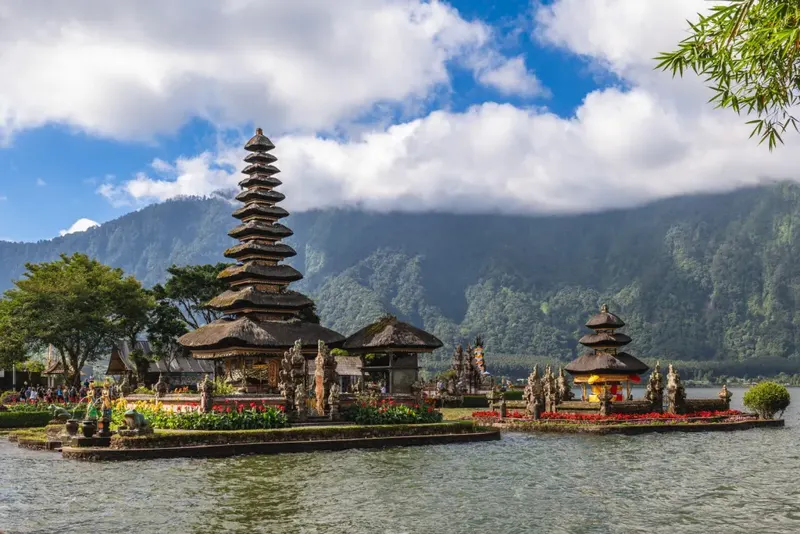
Bali is Indonesia's fabled island of the gods, a tropical world of surf beaches, emerald rice terraces and temples wreathed in incense and frangipani. Set east of Java, it draws surfers to its swells, sun-seekers to the sands of the south, and travellers of every kind to the artistic hill town of Ubud. What sets it apart is its living Hindu culture, unique in Muslim-majority Indonesia, felt in daily offerings, temple festivals and gamelan music. This is the tropics at their most seductive.
Bali is made for unwinding. It's ready to explore in the Nuvoha app: set your budget and see complete Bali trips.
Why visit Bali
Few islands pack in as much variety as Bali. The south holds the beaches: the surf and sunsets of Uluwatu on its dramatic clifftops, the fashionable sands of Seminyak and Canggu, and the calmer shores of Sanur and Nusa Dua. Inland, Ubud is the cultural heart, surrounded by the terraced rice fields of Tegallalang and the sacred Monkey Forest. The island's temples are unforgettable, from Tanah Lot marooned on its offshore rock to clifftop Uluwatu and the lakeside Ulun Danu Bratan. Volcanoes invite dawn hikes, waterfalls hide in the jungle, and the neighbouring Nusa islands beckon offshore. Yoga retreats and spas abound. The trade-off is that the popular south can be crowded and its roads congested.
What Bali feels like
Bali runs on a gentle, spiritual rhythm that survives even the busiest resort strip. Each morning, small palm-leaf offerings of flowers and incense appear on doorsteps, pavements and shrines, a daily act of devotion that sets the island's tone. Days follow the sun and the surf: dawn sessions in the waves, long lunches over rice fields, and evenings when temple silhouettes and clifftop bars catch the sunset over the Indian Ocean. The south around Kuta and Seminyak buzzes with traffic, cafes and nightlife, while Ubud and the north keep a slower, greener calm of paddies, jungle and volcanic ridges. Warm, fragrant and unmistakably sacred, Bali gets under the skin.
Sights to plan around
- Uluwatu Temple (Pura Luhur Uluwatu): A sea temple perched on a sheer cliff above the Indian Ocean on the Bukit Peninsula, famous for its sunsets and its nightly Kecak fire dance.
- Tanah Lot: The island's most photographed temple, set on a rock just offshore and cut off by the tide, silhouetted against the sunset on the west coast.
- Tegallalang Rice Terraces: The classic sweep of emerald paddies stepped down a valley north of Ubud, worked by the traditional Balinese subak irrigation system.
- Ubud Monkey Forest: A sacred forest sanctuary in the heart of Ubud, home to long-tailed macaques and moss-covered temples among towering trees.
- Mount Batur: An active volcano in the northeast whose crater and lake reward a pre-dawn hike to watch the sunrise from the summit.
- Nusa Penida: A rugged island off the southeast coast, reached by fast boat, known for its dramatic cliffs, the Kelingking headland and clear snorkelling waters.
Around the island
- Kuta, Legian and Seminyak: The busy southern beach strip, from the surf and nightlife of Kuta to the boutiques, beach clubs and restaurants of Seminyak.
- Canggu: A former surf village turned hub of cafes, co-working spaces and beach breaks northwest of Seminyak, a magnet for a young, laid-back crowd.
- The Bukit Peninsula (Uluwatu): The southern clifftop peninsula of world-class surf, tucked-away coves such as Padang Padang, clifftop bars and the Uluwatu temple.
- Ubud: The island's cultural and artistic centre in the central hills, surrounded by rice terraces, temples, galleries, spas and yoga studios.
- Sanur and Nusa Dua: Calmer, family-friendly resort areas on the southeast coast, with gentle beaches, seafront paths and the boats to the Nusa islands.
- East and North Bali: Quieter regions of Amed, Candidasa, Sidemen and Lovina, with black-sand beaches, diving, terraced valleys and far fewer crowds.
The Balinese table
Balinese cooking is fragrant and complex, built on a spice paste called base genep of turmeric, ginger, galangal, chilli and shrimp paste. The island's feast dish is babi guling, spit-roasted suckling pig, while betutu sees duck or chicken slow-cooked in banana leaf. Everyday meals centre on nasi campur, a plate of rice with a little of many things, and satay lilit wraps minced, spiced seafood around lemongrass skewers. Jimbaran is famous for grilled seafood on the sand at sunset, and the south's cafes turn out smoothie bowls and global dishes for the visiting crowd. Tropical fruit is everywhere.
- Babi guling
- Bebek betutu
- Nasi campur
- Sate lilit
- Lawar
- Jimbaran grilled seafood
Getting from A to B
Bali has no trains and limited public transport, so most visitors get around by road. Metered taxis from reputable firms and ride-hailing apps work in the south, though app pickups are restricted in some areas by local drivers. Hiring a private driver for the day is a popular, comfortable way to see the sights, given the distances and traffic. Many travellers rent a scooter for freedom, but the roads are busy and accidents common, so ride with care, a helmet and the right licence. Journeys often take longer than the map suggests. Ngurah Rai International Airport (DPS), also called Denpasar, sits between Kuta and Jimbaran in the south, close to the main beach resorts. Metered taxis, official airport transport and hotel pickups all serve the terminals; ride-hailing is available but subject to local restrictions at the airport itself.
Practical pointers
- At temples, wear a sarong and sash, both usually available to borrow at the entrance, and cover your shoulders.
- Never step on or over the small daily offerings placed on the ground, and walk around them instead.
- Dress modestly away from the beach, and keep beachwear for the sand and pool.
- Behave respectfully around ceremonies and processions, which take priority on the roads, and do not walk in front of people praying.
- The head is considered sacred, so avoid touching people on the head, and use your right hand for giving and receiving.
- During Nyepi, the day of silence for the Balinese new year, the whole island shuts down, including the airport, so plan around it.
- The dry season from April to October is the best time for beaches and surf; the wet season from November to March brings humid days and afternoon downpours.
- Distances are short on the map but slow on the ground, so base yourself near the experiences you want rather than trying to see it all.
- The south around Kuta, Seminyak and Canggu is busiest; Ubud, the east and the north are greener and calmer.
- Fast boats link the mainland with the Nusa and Gili islands for snorkelling and diving trips.
- Carry a sarong for temple visits, and check whether any festivals or Nyepi fall during your stay.
- Drink sealed bottled or filtered water rather than tap, and take care with strong surf and rip currents.
Best for
- Beach time
- Unwinding
Key facts
| Country | Indonesia |
|---|---|
| Region | Asia |
| Airports | DPS |
| Trip length fit | Short-trip friendly |
Bali essentials
| Currency | Indonesian Rupiah (IDR) |
|---|---|
| Language | Indonesian (Bahasa Indonesia) is the national language, spoken alongside hundreds of regional tongues; English is common in tourist areas |
| Time zone | Three zones: Western (UTC+7) covering Sumatra and Java, Central (UTC+8) covering Bali and Sulawesi, and Eastern (UTC+9) covering Papua; no daylight saving |
| Emergency number | 112 (national emergency line) |
| Driving side | Left |
| Tap water | Not safe from the tap; bottled and boiled water are the norm |
Climate & seasons
| Month | Typical range | Season |
|---|---|---|
| January | 24°C to 31°C | Wet season |
| April | 24°C to 31°C | Humid transition |
| July | 23°C to 29°C | Drier season |
| October | 24°C to 31°C | Warmer transition |
Bali is one of Nuvoha's winter-sun picks.
Typical stay
- Weekend-friendly
- Short break (2–5 days)
Bali works as a weekend break just as well as a longer stay.
Getting there
Bali is served via DPS.
- DPS
Is it your kind of trip?
Ideal if…
- time on the coast is the point of the trip
- you want to slow down and reset
Maybe not if…
- you want big-city energy around the clock
Pairs well with
Compare with
More in Asia
Near Bali
Travel style
- Winter sun
- Short-trip friendly
- Beach
Frequently asked questions
Which airports serve Bali?
Bali is served via DPS.
Is Bali good for a weekend trip?
Yes, Bali works for a weekend as well as a longer stay.
What kind of trip is Bali best for?
Bali is best for beach trips, popular for unwinding.
Which destinations pair well with Bali?
Within multi-city range: Jakarta (960 km).
When is the best time to visit Bali?
The dry season, roughly April to October, offers the best weather for beaches, surfing and sightseeing, with July and August the busiest. The wet season from November to March is greener and quieter but brings humidity and heavy afternoon showers.
Where should I base myself in Bali?
It depends on your plans. The south, from Kuta and Seminyak to Canggu, suits beaches and nightlife; Ubud is best for culture, rice terraces and jungle; and Sanur, Nusa Dua or the quieter east and north suit a more relaxed stay. Many visitors split their time.
Do I need to cover up to visit Bali's temples?
Yes. Temples require a sarong and often a sash around the waist, and covered shoulders. These are usually available to borrow or hire at the entrance, and visitors are asked to dress and behave respectfully, especially during ceremonies.
How is Bali different from the rest of Indonesia?
Bali is a small tropical island with a distinct, predominantly Hindu culture, unlike the mostly Muslim rest of Indonesia. That heritage shapes its temples, festivals, art and daily offerings, and combines with beaches, rice terraces and volcanoes to give the island its singular character.