
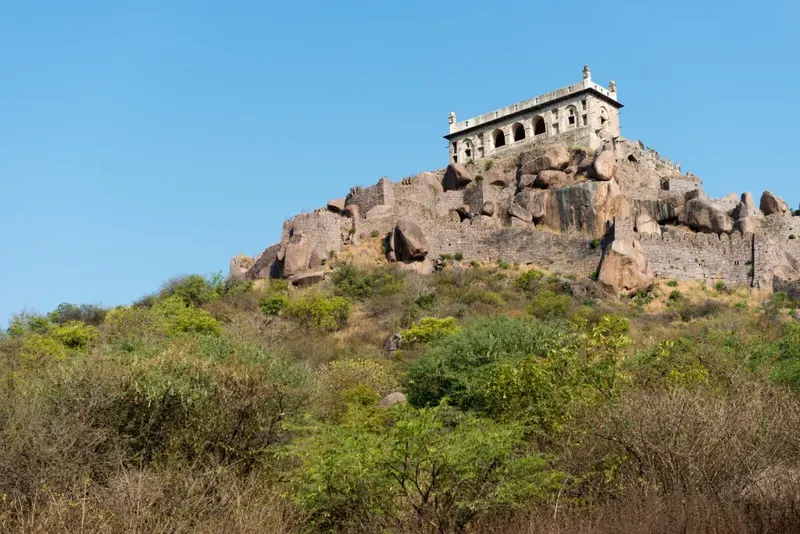
Hyderabad wears four centuries of Deccan history with easy confidence. Founded by the Qutb Shahi sultans and later ruled by the fabulously wealthy Nizams, it grew rich on diamonds and pearls, leaving behind the Charminar, the ramparts of Golconda and palaces full of chandeliers. Today the old city of bazaars and Irani cafes sits beside the glass towers of HITEC City, and the two Hyderabads meet over a plate of biryani. Few Indian cities balance past and present so comfortably.
Hyderabad is a quieter alternative. It's ready to explore in the Nuvoha app: set your budget and see complete Hyderabad trips.
Why visit Hyderabad
Hyderabad offers a distinct, Persian-inflected culture that sets it apart from the rest of the south. The Charminar of 1591 still presides over a warren of markets selling bangles, pearls and attar, while the hilltop fort of Golconda, once the world's diamond capital, tells the story of the dynasty that built it. The Nizams' legacy survives in the Chowmahalla and Falaknuma palaces and in the Salar Jung Museum's vast collection. Then there is the food, above all the layered dum biryani that carries the city's name across India. For newer visitors, the lake at Hussain Sagar and the tech district round out the picture.
Highlights
- Charminar: The four-arched, four-minaret monument of 1591 at the centre of the old city, ringed by the bangle stalls of Laad Bazaar.
- Golconda Fort: A vast hilltop citadel of the Qutb Shahi kings, famous for its acoustics and for the diamond trade that once passed through its gates.
- Qutb Shahi Tombs: A garden necropolis of domed sandstone tombs where the sultans of Golconda lie, recently restored to their former grandeur.
- Chowmahalla Palace: The ceremonial seat of the Nizams, a courtyard complex of durbar halls, vintage cars and a celebrated clock tower.
- Salar Jung Museum: One of the world's largest collections assembled by a single family, spanning sculpture, textiles, arms and the crowd-drawing Veiled Rebecca.
- Hussain Sagar: The sixteenth-century lake dividing Hyderabad from Secunderabad, with a monolithic Buddha rising from an island at its centre.
Areas to know
- Charminar and the Old City: The historic core south of the Musi, a dense grid of bazaars for pearls, bangles and perfume around the Charminar and Mecca Masjid.
- Banjara Hills and Jubilee Hills: The upmarket western heights, thick with restaurants, boutiques, galleries and film-industry homes.
- HITEC City and Gachibowli: The gleaming technology corridor of office parks and towers that made Hyderabad a global software hub, sometimes called Cyberabad.
- Secunderabad: The twin city and old British cantonment across Hussain Sagar, centred on a major railway junction and a more military, orderly feel.
- Abids and Koti: The colonial-era commercial centre between old and new, home to older shops, the GPO and a long-running Sunday book market.
Food & drink
Hyderabadi cooking is the meeting of Mughlai richness and southern spice, and biryani is its crown. The city's dum biryani layers marinated meat with saffron rice, sealed and slow-cooked, and arrives with a tangy mirchi ka salan and cooling raita. During Ramadan, cauldrons of haleem, a pounded wheat-and-meat paste, appear across the old city. The Irani cafes pour strong milky chai with Osmania biscuits, and dessert leans to the apricot qubani ka meetha and bread-based double ka meetha.
- Hyderabadi dum biryani
- Haleem
- Mirchi ka salan
- Qubani ka meetha
- Double ka meetha
- Irani chai with Osmania biscuits
What Hyderabad feels like
Two cities coexist here. South of the Musi River, the old city keeps a slower, courtlier tempo of narrow lanes, mosque calls and Irani cafes where sweet chai comes with Osmania biscuits; the Charminar quarter is at its liveliest in the evenings and during Ramadan, when the streets fill with the smell of haleem. North and west, Banjara Hills, Jubilee Hills and the tech corridor run to boutiques, restaurants and traffic. The Hyderabadi manner is famously courteous, its Dakhni Urdu soft and unhurried. Sitting on the Deccan plateau, the city stays a touch drier and cooler than the coast.
Getting around
The Hyderabad Metro runs three modern lines across the newer city and is the quickest way to skip the traffic. Autorickshaws and app cabs fill the gaps, and are the practical choice for the old city, where lanes are narrow and parking scarce. Distances between the old city, Hussain Sagar and the tech corridor are considerable, so it helps to group sights by area and travel outside peak hours. Rajiv Gandhi International Airport stands at Shamshabad, around 30 kilometres south of the city, and is well connected by a fast expressway. Airport taxis, app cabs and a coach service run into the centre.
Good to know
- Dress modestly around the Charminar and its mosques; Mecca Masjid, like other active mosques, may restrict access during prayer times and for women in certain areas.
- Bargaining is expected in the old-city bazaars for bangles, pearls and perfume, done with good humour rather than pressure.
- Remove your shoes before entering mosques and temples, and cover your head and shoulders at Mecca Masjid.
- During Ramadan, be discreet about eating and drinking in the old city by day, when many are fasting.
- November to February is the pleasantest time, with warm days and cool evenings on the plateau.
- Ramadan transforms the old city after dark, when haleem and night markets come alive around the Charminar.
- Golconda's evening sound-and-light show tells the fort's history; check the schedule and the language of the session.
- The old-city bazaars are best explored on foot, with an autorickshaw to reach them and small notes for purchases.
- Give yourself a full morning for Golconda, as the climb to the summit pavilion is long and exposed.
Best for
- City breaks
- Quieter travel
Key facts
| Country | India |
|---|---|
| Region | Asia |
| Airports | HYD |
| Trip length fit | Short-trip friendly |
Hyderabad essentials
| Currency | Indian rupee (INR) |
|---|---|
| Language | Hindi and English are the union-level official languages, alongside twenty-two scheduled languages and hundreds of others; English is widely used in cities, business and tourism. |
| Time zone | IST (UTC+5:30), a single time zone across the whole country |
| Emergency number | 112 |
| Driving side | Left |
| Tap water | Not reliably safe to drink; choose sealed bottled water, or water that has been filtered or boiled. |
Climate & seasons
| Month | Typical range | Season |
|---|---|---|
| January | 15°C to 29°C | Dry mild season |
| April | 24°C to 39°C | Very hot pre-monsoon |
| July | 22°C to 31°C | Monsoon season |
| October | 20°C to 31°C | Post-monsoon warmth |
Typical stay
- Weekend-friendly
- Short break (2–5 days)
Hyderabad works as a weekend break just as well as a longer stay.
Getting there
Hyderabad is served via HYD.
- HYD
Is it your kind of trip?
Ideal if…
- you like walkable city energy
- you like places before everyone else finds them
Maybe not if…
- a beach-first holiday is the priority
Pairs well with
Compare with
More in Asia
Near Hyderabad
Travel style
- Short-trip friendly
- City
Frequently asked questions
Which airports serve Hyderabad?
Hyderabad is served via HYD.
Is Hyderabad good for a weekend trip?
Yes, Hyderabad works for a weekend as well as a longer stay.
What kind of trip is Hyderabad best for?
Hyderabad is best for city trips.
Which destinations pair well with Hyderabad?
Within multi-city range: Bengaluru (456 km), Pune (500 km), Chennai (503 km).
What is Hyderabad best known for?
The Charminar, Golconda Fort and the Nizams' palaces speak to its royal past, while Hyderabadi biryani and the pearl trade give it a lasting reputation for food and fine things. In recent decades it has also become a major technology centre.
How much time do you need in Hyderabad?
Two to three days covers the old city, Golconda and the main museums at a comfortable pace. Add more if you plan to see the Qutb Shahi tombs, Ramoji Film City or take day trips onto the Deccan.
Is Hyderabadi biryani very spicy?
It is aromatic and rich rather than searing, though the accompanying mirchi ka salan adds real heat. Vegetarian versions exist, but the classic is made with meat, slow-cooked under a sealed lid.
What languages are spoken in Hyderabad?
Telugu is the state language, and a distinctive local Urdu known as Dakhni is widely spoken, especially in the old city. English and Hindi are broadly understood.