
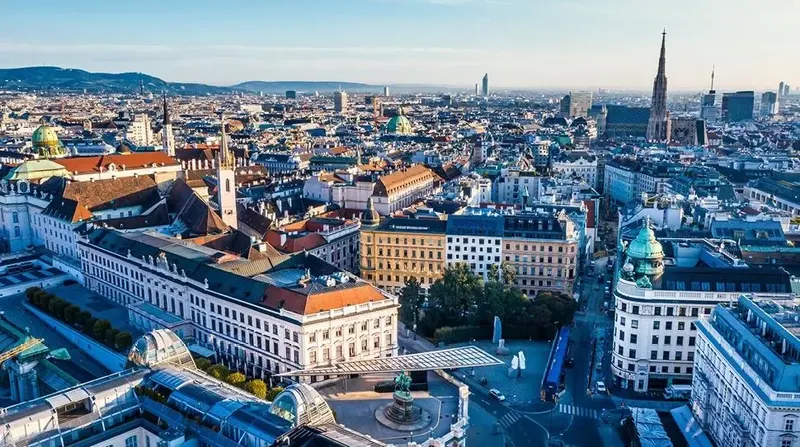
Vienna wears six centuries of Habsburg rule with unshakeable poise. The Ringstrasse loops the old city past opera house, parliament and palace, all built to impress, while the Gothic spire of St Stephen's needles up from the medieval core at the centre. This is a capital of marble staircases and gilded concert halls, where the imperial past is not a museum piece but the everyday backdrop.
Vienna is a favourite for couples. It's ready to explore in the Nuvoha app: set your budget and see complete Vienna trips.
Why visit Vienna
Vienna concentrates imperial spectacle into a walkable centre. The Hofburg and Schonbrunn palaces open their state rooms and formal gardens, the Kunsthistorisches Museum holds the world's largest Bruegel collection, and the Belvedere guards Klimt's The Kiss. Music runs through everything: Mozart, Beethoven and Schubert all worked here, and the State Opera and Musikverein still perform most nights of the season. Between sights, the coffee houses invite you to linger for hours over a single melange, and the Naschmarkt lays out food from across the old empire. Add grand boulevards, riverside parkland and a Christmas-market winter, and few capitals feel this composed.
Imperial landmarks not to miss
- St Stephen's Cathedral: The Gothic cathedral at the city's heart, its steep roof patterned in glazed tiles and its south tower climbed by 343 steps.
- Schonbrunn Palace: The Habsburgs' baroque summer residence of 1,441 rooms, its formal gardens rising to the Gloriette above the world's oldest zoo.
- The Hofburg: The sprawling imperial winter palace, now holding the state apartments, the Sisi Museum and the Spanish Riding School.
- Belvedere: Two baroque palaces with formal gardens between them, home to Gustav Klimt's The Kiss and a strong Austrian art collection.
- Vienna State Opera: One of the world's foremost opera houses, performing a different work almost every evening of the season.
- The Prater and Riesenrad: A vast public park on former imperial hunting ground, with the giant Ferris wheel of 1897 turning at its edge.
The city by district
- Innere Stadt: The first district, the UNESCO-listed old city of the cathedral, the Hofburg and the smart shopping lanes of Graben and Kohlmarkt.
- Leopoldstadt: Across the Danube Canal, holding the green expanse of the Prater and an increasingly lively cafe, market and gallery scene.
- Neubau: The seventh district, the city's creative quarter of boutiques, design studios and the courtyards of the Spittelberg.
- Landstrasse: The third district, home to the Belvedere and the wonky, colourful facade of the Hundertwasserhaus.
- Wieden and Mariahilf: Straddling the Naschmarkt, with the Karlskirche, antique stalls and the long shopping run of Mariahilfer Strasse.
- Josefstadt: The smallest district, quiet and elegant, known for its theatre and villagey side streets just beyond the Ring.
At the Viennese table
Viennese cooking is the hearty legacy of a vast empire, drawing in Hungarian, Bohemian and Balkan influences. The Wiener Schnitzel, a wafer-thin veal cutlet fried golden, is the emblem, though Tafelspitz, boiled beef with horseradish, was the emperor's own favourite. The city has a serious sweet tooth: Sachertorte, apple strudel and fluffy Kaiserschmarrn belong to the coffee house as much as the kitchen. Sausage stands feed the small hours, and the wine taverns of the outer hills pour young local white by the jug.
- Wiener Schnitzel
- Tafelspitz
- Sachertorte
- Apfelstrudel
- Kaiserschmarrn
What Vienna feels like
Vienna carries itself formally, and it suits the city. People dress for the opera, greet each other with a courteous Gruss Gott, and treat the coffee house as a second living room, where a waiter in a bow tie brings water alongside your coffee and never hurries you along. The mood is measured and a little reserved, warming over Sachertorte and conversation. Trams glide along the Ringstrasse past floodlit palaces, buskers play Mozart near the cathedral, and the whole place runs with quiet precision. It can feel stately to the point of stiffness, then a heuriger wine tavern on the edge of town loosens the collar entirely.
Getting around the capital
The compact old city is best on foot, and much of it is pedestrianised. Beyond it, Wiener Linien runs one of Europe's most comprehensive networks: five underground lines, an extensive tram system among the largest anywhere, and buses, all on a single ticket. The Ring tram traces the grand boulevard for an easy orientation loop. Services are punctual, spotless and run through the night at weekends, so a weekly pass quickly pays off. Vienna International Airport (VIE) lies about eighteen kilometres southeast at Schwechat. The City Airport Train reaches Wien Mitte in sixteen minutes, and the S7 suburban line and Railjet trains cover the same route a little more slowly. Taxis and ride-hailing complete the run in around half an hour.
Before you visit
- Greet shopkeepers and waiters with a polite Gruss Gott or Guten Tag; formality is the norm and a little goes a long way.
- In a coffee house, take your time: a single cup buys a seat for as long as you like, and the waiter will not rush the bill.
- Tip for good service by rounding up and telling the waiter the total as you pay, rather than leaving coins on the table.
- Dress a little smartly for the opera or a concert; Viennese audiences still make an occasion of it.
- Late spring and early autumn bring the kindest weather; winters are cold and grey, but the Christmas markets are a genuine draw.
- Standing places at the State Opera are sold shortly before each performance, a fine way to hear a world-class house without planning far ahead.
- The Ring tram, or any tram loop of the boulevard, makes an easy sightseeing circuit in its own right.
- Vienna's tap water flows straight from Alpine springs and is excellent, so carry a bottle to refill.
- Many museums close one day a week, often Monday, so check before you set out.
- Sundays are quiet, with most shops shut; plan around markets, museums and cafes instead.
Best for
- City breaks
- Couples
Key facts
| Country | Austria |
|---|---|
| Region | Europe |
| Airports | VIE |
| Trip length fit | Short-trip friendly |
Vienna essentials
| Currency | Euro (EUR) |
|---|---|
| Language | German (Austrian German); English is common in cities and tourist areas |
| Time zone | Central European Time (UTC+1, UTC+2 in summer) |
| Emergency number | 112 (general emergency); 140 for Alpine rescue |
| Driving side | Right |
| Tap water | Safe to drink; much of it is pristine Alpine spring water |
Climate & seasons
| Month | Typical range | Season |
|---|---|---|
| January | -2°C to 4°C | Cold winter |
| April | 8°C to 17°C | Mild spring |
| July | 17°C to 28°C | Warm summer |
| October | 9°C to 16°C | Cool autumn |
Typical stay
- Weekend-friendly
- Short break (2–5 days)
Vienna works as a weekend break just as well as a longer stay.
Getting there
Vienna is served via VIE.
- VIE
Is it your kind of trip?
Ideal if…
- you like walkable city energy
- you're planning a trip for two
Maybe not if…
- a beach-first holiday is the priority
Pairs well with
Compare with
More in Europe
Near Vienna
Travel style
- Short-trip friendly
- City
Frequently asked questions
Which airports serve Vienna?
Vienna is served via VIE.
Is Vienna good for a weekend trip?
Yes, Vienna works for a weekend as well as a longer stay.
What kind of trip is Vienna best for?
Vienna is best for city trips, popular for trips for two.
Which destinations pair well with Vienna?
Within multi-city range: Budapest (214 km), Zagreb (266 km), Prague (278 km).
How many days do you need in Vienna?
Three days is enough for the cathedral, the Hofburg, Schonbrunn and a couple of great museums at an unhurried pace. A fourth lets you add the Belvedere, a concert and time to settle into the coffee houses, which is really the point of the city.
Is Vienna a good city for classical music?
Few cities rival it. Mozart, Beethoven, Schubert and Brahms all lived and worked here, and the State Opera, Musikverein and Konzerthaus perform almost nightly through the season. Standing tickets make even the grandest venues accessible.
What is Viennese coffee house culture?
It is a way of lingering, recognised by UNESCO as intangible heritage. You order a specific style, most famously a melange, then settle in for as long as you wish with newspapers and a glass of water, treating the marble-topped table as your own for the afternoon.
When is the best time to visit Vienna?
Late spring and early autumn offer mild weather and thinner crowds. Summer is warm and busy, while winter is cold but wraps the city in Christmas markets and, from January, the famous ball season.