
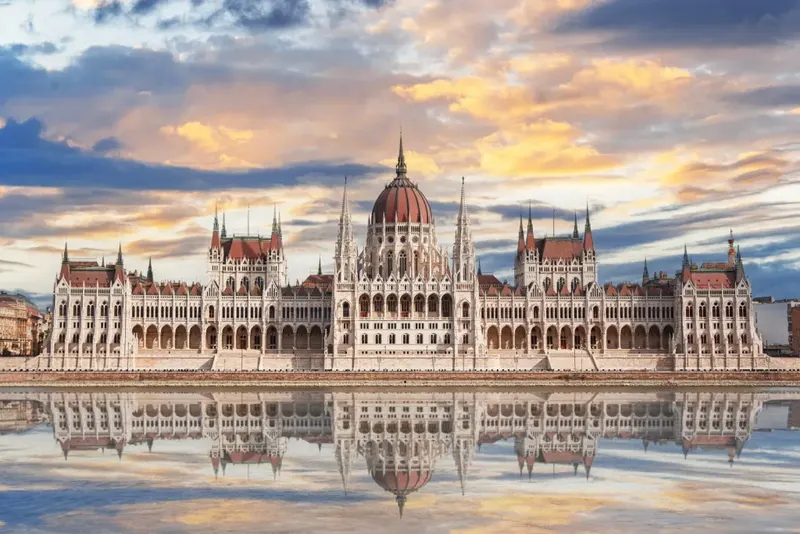
The Danube cuts Budapest cleanly in two. On the west bank, hilly Buda rises through cobbled castle streets and wooded lookouts; on the east, flat Pest spreads out in grand boulevards, cafes and the great riverside Parliament. Between them run the bridges, most famously the Chain Bridge, and beneath the whole city bubble the thermal springs that fill its bathhouses. Two cities in temperament, joined into one.
Budapest is a favourite for couples. It's ready to explore in the Nuvoha app: set your budget and see complete Budapest trips.
Why visit Budapest
Budapest offers grandeur with the edges left rough, which is much of its appeal. The Parliament and the Fisherman's Bastion supply the sweeping riverside views, Buda Castle and Andrassy Avenue the imperial polish, yet the city never feels buttoned-up. Its defining ritual is the thermal bath: you can soak outdoors at the neo-baroque Szechenyi even in the snow, a chessboard floating between the players. Come nightfall, the ruin bars of the old Jewish Quarter fill derelict courtyards with mismatched furniture and music. Add a serious cafe and cake tradition, the largest synagogue in Europe and a lived-in, unpolished energy, and Budapest feels both magnificent and refreshingly down to earth.
Landmarks across Buda and Pest
- Hungarian Parliament: A vast neo-Gothic palace on the Pest riverbank, among the largest legislative buildings in the world and dazzling when floodlit.
- Buda Castle and Castle Hill: The hilltop royal palace and its cobbled old town, reached on foot or by the historic funicular from the Chain Bridge.
- Fisherman's Bastion: A fairytale neo-Romanesque terrace of white turrets beside Matthias Church, giving the postcard view across to Parliament.
- Szechenyi Thermal Baths: A grand neo-baroque bathing palace in the City Park, its steaming outdoor pools kept warm and open even in winter.
- Chain Bridge: The elegant suspension bridge of 1849, the first permanent crossing to link Buda with Pest, guarded by four stone lions.
- Dohany Street Synagogue: The largest synagogue in Europe, at the edge of the old Jewish Quarter, with a memorial garden to the wartime dead.
The city district by district
- District V (Belvaros and Lipotvaros): Downtown Pest, holding Parliament, St Stephen's Basilica, the Danube promenade and the shopping street of Vaci utca.
- District VII (Erzsebetvaros): The historic Jewish Quarter and the heart of the ruin-bar scene, dense with courtyards, street art and late-night life.
- District I (the Castle District): The cobbled crown of Buda, taking in the royal palace, Matthias Church and the turrets of Fisherman's Bastion.
- District VI (Terezvaros): Built around the grand sweep of Andrassy Avenue, with the Opera House and the cafes ringing the Oktogon.
- Jozsefvaros and Ferencvaros: Inner-Pest quarters (districts VIII and IX) shedding a rough past for studios, galleries and student bars.
- Gellert Hill: The wooded Buda height crowned by the Liberty Statue and Citadella, with the art nouveau Gellert baths at its foot.
The Hungarian table
Hungarian food is generous and paprika-warmed. Gulyas, the national dish, is a soup here rather than a stew, ladled with beef, potato and a deep red spicing, while chicken paprikash comes smothered in a soured-cream sauce. Street corners and market halls sell langos, a plate-sized round of fried dough heaped with sour cream and grated cheese. The coffee-house tradition runs deep, from strong espresso to layered Dobos torte, and the sweet, spit-roasted kurtoskalacs perfumes the winter markets. Wash it down with Tokaji from the northeast or a shot of fruit palinka.
- Gulyas
- Paprikas csirke
- Langos
- Toltott kaposzta
- Halaszle
- Kurtoskalacs
What Budapest feels like
Budapest feels grander than it is polished, and that gives it an easy, slightly worn charm. Faded belle epoque facades line the Pest boulevards, their ground floors hiding coffee houses, wine bars and the ruin pubs that made the city's night-time name. There is a melancholy streak here, a Central European soulfulness, offset by genuine warmth once conversation starts. Life slows in the baths, where all ages sit for hours in the steaming water, and picks up after dark in the seventh district. Compared with its imperial neighbours the mood is looser and more down to earth, and the city wears its history openly rather than tidying it away.
Crossing the river and beyond
Budapest is bridged and bath-dotted but easily managed. Four metro lines cross the city, among them the little yellow M1, the oldest underground on the European mainland and a UNESCO site in its own right. Trams are the scenic option, with line 2 tracing the Pest bank past Parliament, and the network runs to trolleybuses, buses and a funicular up to Buda Castle. One BKK ticket or a travelcard covers the lot. Central Pest is flat and walkable; Buda calls for the funicular or a climb. Budapest Ferenc Liszt International Airport (BUD) lies about sixteen kilometres southeast of the centre. The 100E Airport Express bus runs directly to Deak Ferenc ter, where the three older metro lines meet, in around forty minutes. Official taxis wait at a managed rank outside arrivals.
Good to know first
- A handshake and a polite jo napot is the standard greeting; Hungarians can seem reserved at first but warm quickly.
- In the thermal baths, follow the posted rules: many pools require a swim cap, and some hours or pools may be single-sex, especially at the older Ottoman baths.
- Tip around ten per cent in restaurants, telling the server the total rather than leaving it on the table, and check whether service is already added.
- Do not clink beer glasses: an old tradition ties the gesture to the mourning of executed patriots, and many Hungarians still avoid it.
- Bring or hire a towel and flip-flops for the baths, and a swim cap where required; lockers and cabins are available on site.
- The neo-baroque Szechenyi baths stay open outdoors through winter, when soaking in the steam amid the snow is unforgettable.
- Spring and early autumn are the most comfortable; summers are hot and the baths busiest at weekends.
- Use the official airport taxi rank or a booked car rather than accepting rides touted inside the terminal.
- Validate single tickets and expect regular inspections on the metro and trams.
- The ruin bars cluster in the seventh district and get busy late; wander a few before settling in, as each has its own character.
Best for
- City breaks
- Couples
Key facts
| Country | Hungary |
|---|---|
| Region | Europe |
| Airports | BUD |
| Trip length fit | Short-trip friendly |
Budapest essentials
| Currency | Hungarian Forint (HUF) |
|---|---|
| Language | Hungarian (Magyar); English and German are spoken in Budapest and tourist areas |
| Time zone | Central European Time (UTC+1, UTC+2 in summer) |
| Emergency number | 112 (general emergency) |
| Driving side | Right |
| Tap water | Safe to drink, including in Budapest |
Climate & seasons
| Month | Typical range | Season |
|---|---|---|
| January | -2°C to 4°C | Cold winter |
| April | 7°C to 18°C | Fresh spring |
| July | 17°C to 29°C | Warm summer |
| October | 8°C to 16°C | Cool autumn |
Typical stay
- Weekend-friendly
- Short break (2–5 days)
Budapest works as a weekend break just as well as a longer stay.
Getting there
Budapest is served via BUD.
- BUD
Is it your kind of trip?
Ideal if…
- you like walkable city energy
- you're planning a trip for two
Maybe not if…
- a beach-first holiday is the priority
Pairs well with
Compare with
More in Europe
Near Budapest
Travel style
- Short-trip friendly
- City
Frequently asked questions
Which airports serve Budapest?
Budapest is served via BUD.
Is Budapest good for a weekend trip?
Yes, Budapest works for a weekend as well as a longer stay.
What kind of trip is Budapest best for?
Budapest is best for city trips, popular for trips for two.
Which destinations pair well with Budapest?
Within multi-city range: Vienna (214 km), Zagreb (308 km), Prague (471 km).
How many days do you need in Budapest?
Three days lets you cover Buda's castle hill, the Pest landmarks, at least one long soak in a thermal bath and an evening among the ruin bars. A fourth is easily filled with the City Park, Margaret Island or a day trip up the Danube Bend.
Are the thermal baths worth it in Budapest?
They are central to the city and well worth a visit. The grand Szechenyi and art nouveau Gellert are the best known, with outdoor pools kept warm year-round. Bring a towel, flip-flops and a swim cap where signs require one, and allow a few unhurried hours.
What are ruin bars?
Ruin bars are drinking spots set up in the courtyards and rooms of derelict pre-war buildings in the old Jewish Quarter, furnished with salvaged junk and mismatched chairs. Szimpla Kert was the first and remains the most famous. They are the centre of Budapest's night-time character.
When is the best time to visit Budapest?
Late spring and early autumn bring warm days and manageable crowds. Summer is hot and lively, with festivals and busy baths, while winter is cold but rewards a visit with steaming outdoor pools and Christmas markets on the main squares.