
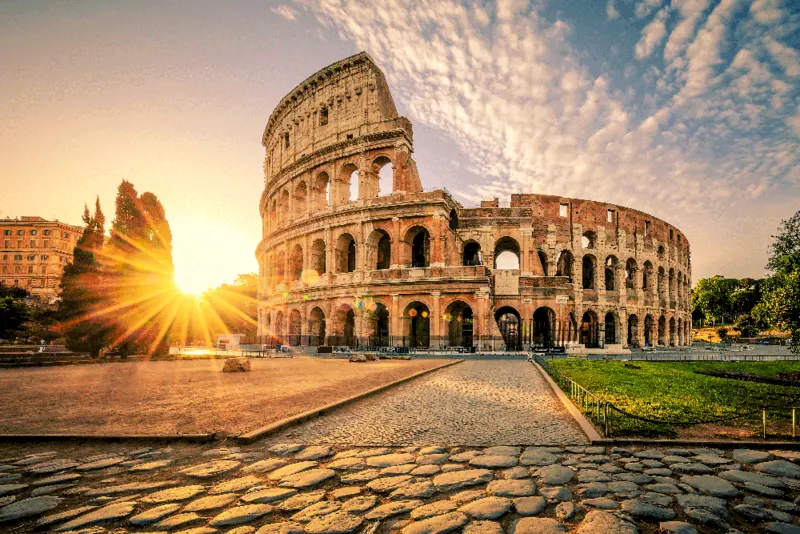
Umbrella pines lean over the Roman Forum, and the cobbles underfoot (sampietrini, Romans call them) have carried traffic for centuries. This is a city that never demolished its past, only built on top of it, so the walk to dinner can pass a Baroque fountain, a medieval church and a temple twenty centuries old.
Rome is a favourite for couples. It's ready to explore in the Nuvoha app: set your budget and see complete Rome trips.
Why visit Rome
Rome holds more layered history per street than anywhere on earth. The Colosseum and Forum anchor the ancient city, the Vatican holds Michelangelo's ceiling and Renaissance art in overwhelming quantity, and between the set pieces runs the real pleasure: fountain-cooled piazzas, churches hiding Caravaggios, and a food culture fierce about doing a few dishes perfectly. The centre is compact enough to cross on foot, which is how the city insists on being seen: every shortcut turns up something built before your country existed.
Where the centuries show
- Colosseum: The largest amphitheatre ever built once seated tens of thousands for games and spectacles.
- Pantheon: Nearly nineteen centuries old, its unreinforced concrete dome remains the world's largest, lit by a single oculus.
- Vatican Museums and Sistine Chapel: Kilometres of galleries culminate in Michelangelo's frescoed ceiling and Last Judgement.
- Roman Forum and Palatine Hill: The political heart of the ancient world, walkable among temples, arches and the hill where Rome began.
- Trevi Fountain: Nicola Salvi's Baroque cascade fills an entire small piazza; the coin-over-the-shoulder ritual promises a return to Rome.
- Piazza Navona: Built over an ancient stadium, its long oval holds Bernini's Fountain of the Four Rivers.
The lie of the land
- Centro Storico: The tangle between the Pantheon, Piazza Navona and Campo de' Fiori: Baroque Rome at its densest.
- Trastevere: Across the river, ivy-hung lanes and small piazzas around the mosaicked basilica of Santa Maria in Trastevere.
- Monti: Rome's oldest rione, a village of artisan workshops and wine bars in the shadow of the Colosseum.
- Testaccio: The old slaughterhouse quarter that shaped Roman cooking, with a covered market that remains the city's larder.
- Prati: Orderly nineteenth-century avenues beside the Vatican, known for shopping streets and old-school delis.
What Romans actually eat
Roman cooking is a short menu executed with conviction: four canonical pastas, crisp-fried artichokes, offal dishes born in Testaccio's butchering yards, pizza al taglio sold by weight. Trattorias guard their versions of cacio e pepe and carbonara jealously, and breakfast is a cornetto and espresso taken standing at the bar. Order the daily specials and drink what the house pours.
- Cacio e pepe
- Carbonara
- Supplì
- Carciofi alla giudia
- Maritozzo
What Rome feels like
Ochre and burnt-orange walls, scooters threading traffic, church bells arguing across the rooftops. Rome runs warm and theatrical: waiters debating football with regulars, the evening passeggiata filling the lanes around Piazza Navona, the splash of the nasoni fountains on quiet backstreets. It is unhurried by conviction: lunch matters, August empties the city, and nothing truly urgent has happened in two thousand years.
Covering the ground
Walking is the main event: most of the centre is closer together than the map suggests. The metro's three lines (A, B and C) skirt rather than cross the ancient core, since every tunnel hits archaeology, but they serve the Vatican, Termini and the Colosseum well. Trams and buses fill the gaps; validate paper tickets on board or tap a contactless card. Taxis wait at official ranks rather than being hailed. The Leonardo Express runs nonstop from Fiumicino to Termini station in about half an hour, while Ciampino, closer to town, is covered by frequent coach services and a bus-rail combination.
Wisdom for the cobbles
- Cover shoulders and knees to enter churches, including St Peter's Basilica. The rule is enforced.
- A cover or service line on the bill is normal; any tipping beyond it is a modest, optional gesture.
- Greet with 'buongiorno' or 'buonasera' when entering shops and restaurants.
- Cappuccino is a morning drink to Italians; after lunch, order espresso and you will drink like a local.
- Drink from the nasoni: the cast-iron street fountains run continuously with cold, excellent water.
- Reserve the Colosseum, Vatican Museums and Galleria Borghese well ahead; the Borghese admits by timed slot only.
- April, May and October offer warm days without the August heat and thinner crowds than midsummer.
- Wear proper walking shoes: sampietrini cobbles punish thin soles and heels.
- Cards are widely accepted, but small trattorias and market stalls still appreciate cash.
- Agree taxi arrangements at official ranks or by app rather than accepting kerbside offers.
Best for
- City breaks
- Couples
Key facts
| Country | Italy |
|---|---|
| Region | Europe |
| Airports | FCO |
| Trip length fit | Short-trip friendly |
Rome essentials
| Currency | Euro (EUR) |
|---|---|
| Language | Italian; English is common in tourist cities, less so in the countryside |
| Time zone | Central European Time (UTC+1, UTC+2 in summer) |
| Emergency number | 112 (general emergency) |
| Driving side | Right |
| Tap water | Safe to drink; Rome's public 'nasoni' fountains run continuously with drinkable water |
Climate & seasons
| Month | Typical range | Season |
|---|---|---|
| January | 4°C to 12°C | Cool winter |
| April | 9°C to 19°C | Mild spring |
| July | 20°C to 32°C | Hot dry summer |
| October | 13°C to 22°C | Mild autumn |
Typical stay
- Weekend-friendly
- Short break (2–5 days)
Rome works as a weekend break just as well as a longer stay.
Getting there
Rome is served via FCO.
- FCO
Is it your kind of trip?
Ideal if…
- you like walkable city energy
- you're planning a trip for two
Maybe not if…
- a beach-first holiday is the priority
Pairs well with
Compare with
More in Europe
Near Rome
Travel style
- Short-trip friendly
- City
Frequently asked questions
Which airports serve Rome?
Rome is served via FCO.
Is Rome good for a weekend trip?
Yes, Rome works for a weekend as well as a longer stay.
What kind of trip is Rome best for?
Rome is best for city trips, popular for trips for two.
Which destinations pair well with Rome?
Within multi-city range: Split (384 km), Venice (412 km), Dubrovnik (503 km).
Can you drink from Rome's street fountains?
Yes. The nasoni (some 2,500 cast-iron drinking fountains around the city) run with cold, safe, continuously flowing water. Carry a bottle and refill as you walk; Romans have done it for generations.
Do I need to reserve Rome's major sights in advance?
For the big three, yes: the Colosseum, the Vatican Museums and the Galleria Borghese all sell timed entries that regularly sell out days ahead, and the Borghese cannot be visited without one.
Is Rome a cash or card city?
Both. Cards and contactless are accepted almost everywhere now, including taxis, but a reserve of cash smooths visits to market stalls, tiny coffee bars and the occasional old-school trattoria.