
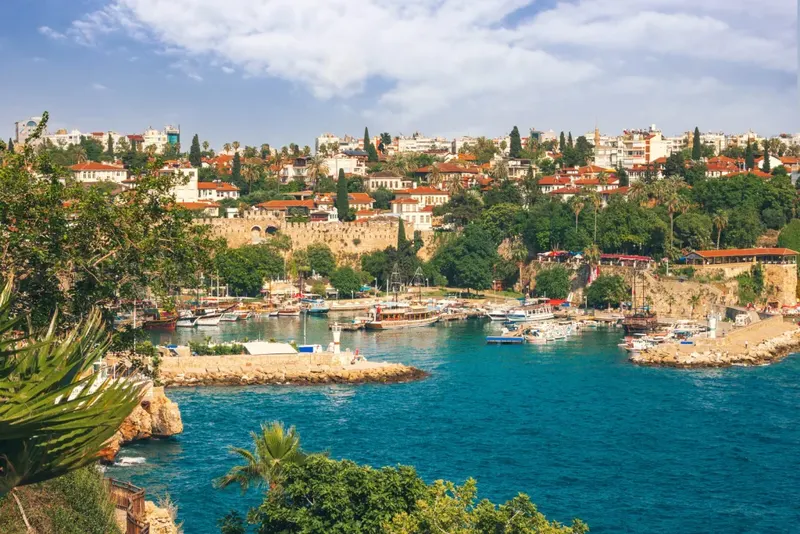
Antalya sits on a shelf of limestone cliffs above the Mediterranean, its old quarter of Kaleici tumbling in red-tiled roofs and Ottoman timber houses down to a small round harbour. Behind the city, the Beydaglari mountains of the Taurus range rise steeply, often still capped with snow while the coast below is warm. This is the working capital of the Turkish Riviera, part ancient city, part beach resort, part gateway to the ruins strung along the coast.
Antalya is made for unwinding. It's ready to explore in the Nuvoha app: set your budget and see complete Antalya trips.
Why visit Antalya
Few coastal cities in Turkey combine so much in one place. Kaleici is a lived-in old town of guesthouses, courtyards and Roman gates rather than a museum piece, and it opens straight onto a yacht harbour. West of the centre the long pebble sweep of Konyaalti runs beneath the mountains, while sandy Lara stretches east past the large hotels. Within an hour lie some of the best-preserved Roman sites on the coast: the theatre at Aspendos, the streets of Perge and the seaside temples of Side. Museums, waterfalls and mountain villages fill the gaps.
What Antalya feels like
The mood shifts with the seasons. Spring brings orange blossom, wildflowers and snow still bright on the peaks, and the ancient sites are quiet. Summer is hot and dry, the harbour cafes fill after dark, and the beaches run busy from June to September when the sea is at its warmest. Autumn holds the heat in the water long after the numbers thin. Down in Kaleici the lanes stay cool between stone walls, cats doze in doorways, and the call to prayer from the Fluted Minaret carries over the rooftops. The Taurus mountains are never out of view.
Landmarks and ruins worth your time
- Kaleici and the old harbour: The walled old town of narrow lanes and restored Ottoman houses, dropping to a horseshoe harbour that was the city's Roman port.
- Hadrian's Gate: A three-arched marble gateway built to mark the emperor Hadrian's visit in the second century, still the grand entrance to the old town.
- The Fluted Minaret (Yivli Minare): A Seljuk-era brick minaret with fluted sides, the emblem of Antalya, rising beside a former mosque near the harbour.
- Duden Waterfalls: Two sets of falls: the upper ones in a shaded park where you can walk behind the water, the lower plunging off a cliff straight into the sea.
- Antalya Museum: One of Turkey's major archaeological collections, rich in Roman statuary recovered from Perge and the surrounding coast.
- Aspendos and the ancient coast: Inland and east of the city lie the well-preserved Roman theatre at Aspendos, the ruined streets of Perge and the seaside temples of Side.
Around the city and coast
- Kaleici: The historic core above the harbour, pedestrian and hilly, full of guesthouses, craft shops and courtyard restaurants.
- Konyaalti: The city's western beach, a long pebble shore beneath the mountains, backed by parks, cafes and the Antalya Museum.
- Lara: The sandy coast east of the centre, lined with large resort hotels and closest to the airport and the lower Duden falls.
- Kemer: Southwest along the gulf where the pine-clad Taurus meets the sea in a string of pebble coves and marina towns.
- Belek: East of the city, a planned resort zone of golf courses and pine forest set behind broad sandy beaches.
The Antalya table
Antalya cooks in a southern, Mediterranean key. Its signature is piyaz, a white bean salad that here comes dressed with tahini and vinegar rather than plain oil. Meze plates lean on hibes, a smooth tahini and cumin dip, alongside grilled sea bass and bream from the gulf. Slow-roasted tandir lamb and skewered kofte come off the coals, and meals often end with kunefe, warm shredded pastry over melting cheese in syrup. Citrus groves ring the plain, so fresh orange juice is everywhere.
- Antalya piyazi (white beans with tahini)
- Hibes (tahini and cumin dip)
- Tandir (slow-roasted lamb)
- Grilled sea bass
- Kunefe (cheese-filled pastry in syrup)
Getting along the coast
The old town is best on foot, its lanes too steep and narrow for cars. A tram runs along the seafront and a modern light-rail line, the AntRay, crosses the wider city, while dolmus minibuses and taxis fill the gaps. The coast is long, so reaching Konyaalti in the west and Lara in the east means a tram or taxi ride. For the ancient sites and the resort towns of Kemer, Side and Belek, intercity coaches leave from the main bus station, though a hire car gives the most freedom. Antalya Airport lies east of the city, one of the busiest holiday gateways in Turkey, with separate international and domestic terminals. Transfers to the Lara hotels are short; reaching Kemer to the southwest or Side and Belek to the east takes longer along the coast road.
Practical pointers
- Cover shoulders and knees to enter mosques, remove your shoes, and women should carry a scarf for the head.
- Keep beachwear to the beach; the old town and its restaurants expect ordinary clothes.
- Tea is a gesture of welcome in shops and workshops, and accepting a glass carries no obligation to buy.
- Tipping is customary in restaurants, usually rounding up or leaving a small percentage for good service.
- Konyaalti is pebble rather than sand, so water shoes make the shoreline kinder underfoot.
- The lower Duden falls are best seen from a short boat trip along the cliffs, or from the clifftop park.
- Aspendos, Perge and Side sit close enough to combine, and the Aspendos theatre still stages summer performances.
- Snow lingers on the Taurus into spring, so you can sometimes swim and see the peaks white on the same day.
- Summer heat peaks in July and August, while spring and autumn are gentler for walking the old town and the ruins.
- The old harbour is the departure point for boat trips along the coast and beneath the waterfalls.
Best for
- Beach time
- Unwinding
Key facts
| Country | Turkey |
|---|---|
| Region | Europe |
| Airports | AYT |
| Trip length fit | Short-trip friendly |
Antalya essentials
| Currency | Turkish Lira (TRY) |
|---|---|
| Language | Turkish; English is common in Istanbul and the coastal resorts |
| Time zone | Turkey Time (UTC+3), no daylight saving |
| Emergency number | 112 (all emergencies) |
| Driving side | Right |
| Tap water | Officially treated, but most locals and visitors drink bottled water |
Climate & seasons
| Month | Typical range | Season |
|---|---|---|
| January | 6°C to 15°C | Mild coastal winter |
| April | 11°C to 22°C | Warm spring |
| July | 23°C to 34°C | Hot dry summer |
| October | 15°C to 27°C | Warm autumn |
Typical stay
- Weekend-friendly
- Short break (2–5 days)
Antalya works as a weekend break just as well as a longer stay.
Getting there
Antalya is served via AYT.
- AYT
Is it your kind of trip?
Ideal if…
- time on the coast is the point of the trip
- you want to slow down and reset
Maybe not if…
- you want big-city energy around the clock
Pairs well with
Compare with
More in Europe
Near Antalya
Travel style
- Short-trip friendly
- Beach
Frequently asked questions
Which airports serve Antalya?
Antalya is served via AYT.
Is Antalya good for a weekend trip?
Yes, Antalya works for a weekend as well as a longer stay.
What kind of trip is Antalya best for?
Antalya is best for beach trips, popular for unwinding.
Which destinations pair well with Antalya?
Within multi-city range: Dalaman (180 km), Bodrum (281 km), Santorini (480 km).
When is the best time to visit Antalya?
Spring and autumn are the most comfortable for sightseeing, with warm days and quieter ruins. The main beach season runs from June to September when it is hot and dry, and the sea stays warm into October.
Is Antalya only a beach destination?
No. Alongside the beaches at Konyaalti and Lara, the walled old town of Kaleici and the Roman sites at Aspendos, Perge and Side make it as much a historical destination as a coastal one.
How far are the ancient sites from the city?
Perge is on the eastern edge of the city, while Aspendos and Side lie within about an hour by road to the east. Coaches or a hire car reach all three easily as day trips.
What is the difference between Konyaalti and Lara beaches?
Konyaalti, west of the centre, is a long pebble beach beneath the mountains. Lara, to the east, is sandy and lined with large resort hotels near the airport.