
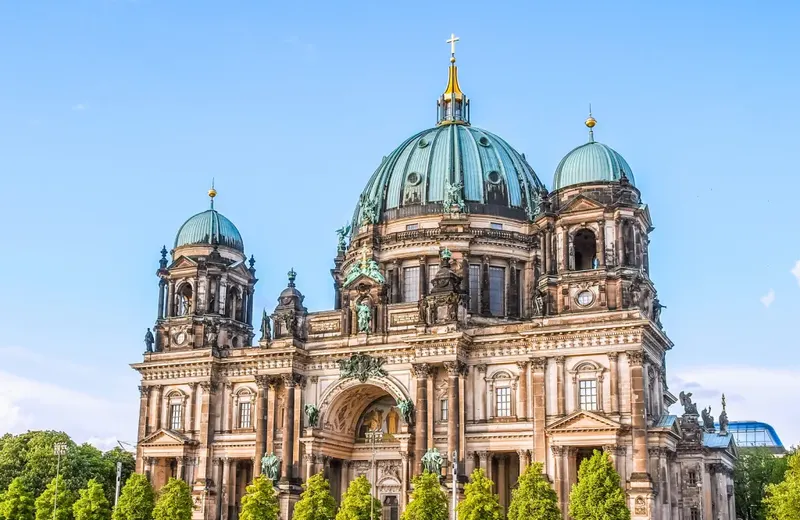
Berlin wears its history in the open, from bullet-scarred facades to the double line of cobbles that traces where the Wall once stood. Germany's capital is vast, flat and green, spread across former east and west along the river Spree. It is a city of reinvention, where grand Prussian boulevards meet raw industrial spaces turned into galleries and clubs. Sober about its past and restless in the present, Berlin favours substance and freedom over polish.
Berlin is a quieter alternative. It's ready to explore in the Nuvoha app: set your budget and see complete Berlin trips.
Why visit Berlin
No city tells the story of the twentieth century so directly. The Brandenburg Gate, the Reichstag with its walkable glass dome, the East Side Gallery and the Memorial to the Murdered Jews of Europe stand within easy reach of one another, while Museum Island gathers five great collections on a single UNESCO-listed islet in the Spree. Yet Berlin is far from a museum piece. Its arts scene is world-class, its nightlife legendary and famously unhurried, and its food has grown from currywurst stalls into one of Europe's most varied street tables. Add sprawling parks, lakes on the edge of town and living costs gentler than most Western capitals, and the pull is obvious.
Landmarks that tell the story
- Brandenburg Gate: The neoclassical arch at the head of Unter den Linden, once stranded in the Wall's death strip and now the emblem of a reunited city.
- Reichstag: Germany's parliament, crowned by Norman Foster's walkable glass dome; entry is free but must be booked ahead with identification.
- East Side Gallery: The longest surviving stretch of the Berlin Wall, over a kilometre of the former border painted by artists after 1989.
- Museum Island: A UNESCO-listed ensemble of five museums on an islet in the Spree, their collections spanning antiquity to the nineteenth century, including the famous bust of Nefertiti.
- Memorial to the Murdered Jews of Europe: Peter Eisenman's field of 2,711 concrete slabs near the Brandenburg Gate, with an underground information centre documenting the Holocaust.
- Checkpoint Charlie: The most famous of the Cold War crossing points, best paired with the Bernauer Strasse memorial, which preserves a complete section of the border and its death strip.
How Berlin is laid out
- Mitte: The historic heart, holding Museum Island, the Brandenburg Gate, Unter den Linden and the buzzing courtyards around Hackescher Markt.
- Kreuzberg: A famously alternative quarter of Turkish markets, street art, canal-side greenery and some of the city's densest nightlife.
- Friedrichshain: An east Berlin district of grand socialist boulevards, the East Side Gallery and warehouse clubs clustered around the old railway lands.
- Prenzlauer Berg: Once bohemian, now leafy and gentrified, with handsome nineteenth-century tenements, weekend markets and the Mauerpark flea market and karaoke.
- Charlottenburg: The elegant heart of the former West, home to the Kurfurstendamm shopping boulevard, the baroque Charlottenburg Palace and old-money calm.
- Neukolln: A diverse, fast-changing southern district, its once-rough streets now thick with bars, galleries and kitchens from every corner of the world.
Eating around Berlin
Berlin eats fast, cheaply and from every direction. The city claims the currywurst, a sliced sausage under curried ketchup, and made the doner kebab in its modern German form, sold from Turkish counters across town. Traditional Berlin cooking is hearty and pork-heavy, running to Eisbein and the meatball-like Buletten, while the jam-filled Berliner Pfannkuchen is the local doughnut. Decades of immigration have made the city a street-food capital, with Vietnamese, Lebanese and Turkish food especially strong, best grazed at the Turkish market along the Maybachufer canal.
- Currywurst
- Doner kebab
- Eisbein
- Buletten
- Berliner Pfannkuchen
- Konigsberger Klopse
What Berlin feels like
Berlin is scruffy, spacious and proudly unfinished. Graffiti covers half the city, courtyards open into unexpected bars and studios, and the pace is slower and more improvised than in richer German cities. It is deeply international and famously tolerant, a magnet for artists, students and anyone drawn to living cheaply and freely. The scars of division are never far, treated with real solemnity, yet the mood is forward-looking and a little anarchic. Nightlife runs from Friday into Monday, spread across converted power stations and railway arches, and summers empty the flats for the parks, canal banks and lakes. This is a capital that rewards the curious over the comfortable.
Crossing a sprawling city
Berlin is large and flat, so the excellent transit network does the heavy lifting. A dense web of U-Bahn and S-Bahn lines, trams in the east and buses is run by the BVG on a single ticket across zones A, B and C, with the main airport in zone C. Validate paper tickets before boarding. The flat terrain also makes cycling a genuine option, with wide bike lanes on many roads, and the compact core around Mitte is walkable. Berlin Brandenburg Airport (BER) lies south-east of the city and opened in 2020, replacing the old Tegel and Schonefeld airports. The Airport Express, along with regional and S-Bahn trains, connects it to the centre in around thirty to forty-five minutes. Taxis and ride-hailing serve the terminals too.
Good to know first
- Germans take rules seriously; wait for the green pedestrian signal even on an empty street, as jaywalking draws disapproval.
- Carry some cash, as many bars, cafes and even restaurants still decline cards despite the city's modern feel.
- Treat sites of Nazi and Cold War history with quiet respect, as solemn conduct is expected at memorials.
- Tipping runs to around five to ten per cent, given by telling the server the total rather than leaving coins on the table.
- Buy the right BVG ticket for your zones and validate it in the machine before you travel, or risk a fine.
- Book a free Reichstag dome slot online in advance and bring photo identification for entry.
- Many museums close on Mondays, so check opening days before planning a visit to Museum Island.
- Berlin is a summer city of lakes and beer gardens; winters are long, grey and cold, so pack accordingly.
- Club entry is selective and unpredictable, phones are often taped over inside, and queues can be long.
- The double row of cobbles set into the streets marks the former line of the Berlin Wall, worth following on foot.
Best for
- City breaks
- Quieter travel
Key facts
| Country | Germany |
|---|---|
| Region | Europe |
| Airports | BER |
| Trip length fit | Short-trip friendly |
Berlin essentials
| Currency | Euro (EUR) |
|---|---|
| Language | German; English is widely spoken in cities and among younger people |
| Time zone | Central European Time (UTC+1, UTC+2 in summer) |
| Emergency number | 112 (general emergency); 110 for police |
| Driving side | Right |
| Tap water | Safe to drink; tap water is reliably potable nationwide |
Climate & seasons
| Month | Typical range | Season |
|---|---|---|
| January | -2°C to 4°C | Cold winter |
| April | 5°C to 15°C | Fresh spring |
| July | 15°C to 25°C | Warm summer |
| October | 7°C to 14°C | Cool autumn |
Typical stay
- Weekend-friendly
- Short break (2–5 days)
Berlin works as a weekend break just as well as a longer stay.
Getting there
Berlin is served via BER.
- BER
Is it your kind of trip?
Ideal if…
- you like walkable city energy
- you like places before everyone else finds them
Maybe not if…
- a beach-first holiday is the priority
Pairs well with
Compare with
| Berlin | Munich | Copenhagen | |
|---|---|---|---|
| Country | Germany | Germany | Denmark |
| Region | Europe | Europe | Europe |
| Styles | City | City | City |
| Trip length fit | Weekend-friendly | Weekend-friendly | Weekend-friendly |
| Airports | 1 | 1 | 1 |
More in Europe
Near Berlin
Travel style
- Short-trip friendly
- City
Frequently asked questions
Which airports serve Berlin?
Berlin is served via BER.
Is Berlin good for a weekend trip?
Yes, Berlin works for a weekend as well as a longer stay.
What kind of trip is Berlin best for?
Berlin is best for city trips.
Which destinations pair well with Berlin?
Within multi-city range: Prague (257 km), Copenhagen (366 km), Munich (463 km).
How many days do you need in Berlin?
Three to four days allows for the central history sites, a couple of museums and time to feel out a neighbourhood or two. The city is large and spread out, so building in slower days pays off more than rushing between landmarks.
Is Berlin an expensive city?
Berlin is generally more affordable than Munich, Zurich or most Western European capitals, particularly for eating out and going out. Museums, transport and casual food are reasonable, though rents have risen sharply in recent years.
What is the best time to visit Berlin?
Late spring through early autumn brings warm days, open-air bars and lake swimming, and is the most enjoyable time to walk the city. Winter is cold and grey but atmospheric, with Christmas markets and a busy indoor cultural season.
Is Berlin a walkable city?
The central district of Mitte is very walkable, but Berlin is huge and its sights are spread widely, so you will rely on the U-Bahn and S-Bahn. The flat streets and broad bike lanes also make cycling between neighbourhoods easy.