
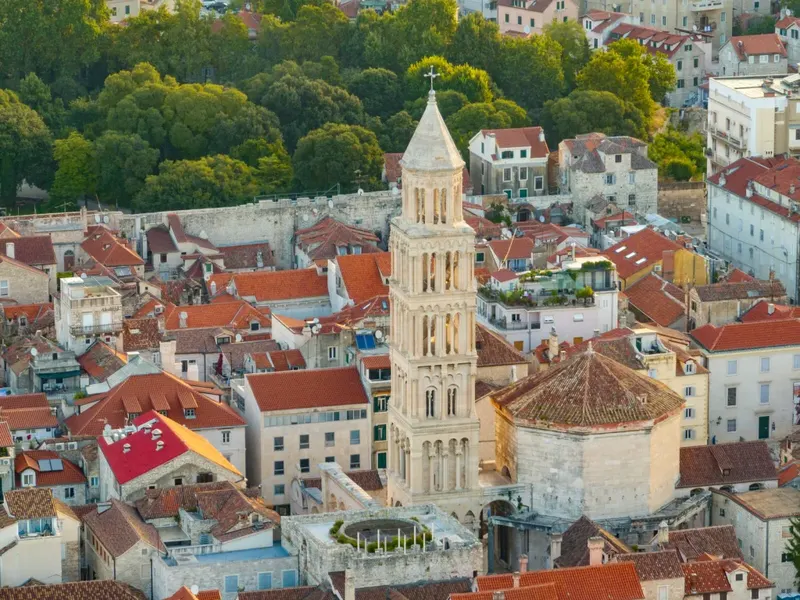
Split is the largest city on the Dalmatian coast and the liveliest, built around and inside the walls of a Roman palace. The emperor Diocletian retired here in the fourth century, and his vast seafront palace never became a ruin; instead, homes, shops, bars and churches filled its halls and courtyards, and people still live within them today. The result is a working old town of Roman stone, Venetian shutters and marble lanes. Split is also Croatia's main ferry hub to the Adriatic islands.
Split is a quieter alternative. It's ready to explore in the Nuvoha app: set your budget and see complete Split trips.
Why visit Split
Split's great draw is Diocletian's Palace, not as a museum but as a lived-in quarter you wander freely. At its centre, the colonnaded Peristyle square opens onto the emperor's mausoleum, now the Cathedral of St Domnius, whose bell tower can be climbed for rooftop views. Cellars, gates and temple fragments survive among the cafes. Beyond the walls, the palm-lined Riva promenade faces the harbour, and the forested Marjan hill offers trails, chapels and swimming spots. From the ferry port, fast boats fan out to Hvar, Brac, Vis and beyond, while Roman Salona and the hilltop Klis Fortress lie just inland.
Highlights
- Diocletian's Palace: A sprawling Roman palace turned living old town, where you can walk the Peristyle, descend into the cellars and pass through the original gates.
- Cathedral of St Domnius: The emperor's former mausoleum, now a cathedral, with an ornate interior and a tall bell tower giving rooftop and harbour views.
- The Riva: Split's palm-lined seafront promenade, the focus of daily life, cafe culture and the evening stroll along the water.
- Marjan Hill: A forested park peninsula rising above the old town, laced with walking and cycling paths, viewpoints, old chapels and quiet swimming coves.
- Bacvice Beach: The city's sandy bay, shallow and family-friendly, and the traditional home of picigin, a splashy local ball game.
- Klis Fortress: A commanding medieval hilltop fortress just inland, guarding the pass behind the city, with far-reaching views to the coast and islands.
Areas to know
- Diocletian's Palace (Grad): The walled Roman core and heart of the old town, a warren of marble lanes, squares, shops and homes built into ancient walls.
- Varos: The old fishermen's quarter climbing the slope west of the palace, with narrow stone streets, steps and small stone houses.
- Bacvice: The lively bay district east of the centre, known for its beach, seafront bars and nightlife.
- Meje: A leafy, upmarket residential area on the way to Marjan, with grand villas and the Mestrovic Gallery.
- Gripe and Lucac: Older neighbourhoods east of the palace, more residential and everyday, set around a historic fortress and market streets.
Food & drink
Split eats in the Dalmatian way, with the sea, the garden and the grill at the centre. Fresh fish, squid and shellfish come simply grilled with olive oil, garlic and parsley, while brodet stew and black cuttlefish risotto appear on many menus. From the Dalmatian hinterland come heartier dishes: pasticada, beef slowly braised in sweet wine and prunes, served with gnocchi, and meat or octopus cooked under a peka. Cured Dalmatian ham, sheep's cheese from the islands, seasonal greens known as blitva, and local wines and olive oil complete a relaxed, produce-led table.
- Grilled fish and squid
- Pasticada (braised beef with gnocchi)
- Crni rizot (black risotto)
- Peka (meat or octopus under a bell)
- Dalmatian prsut (cured ham)
- Blitva (chard with potato)
What Split feels like
Split feels lived-in and Mediterranean rather than preserved, a real port city that happens to have a Roman palace at its core. Locals cross the Peristyle on their daily errands, cafe tables spill into ancient courtyards, and the sound of klapa singers sometimes echoes off the stone. The Riva is the city's living room, filling each evening with a slow parade of walkers, coffee-drinkers and ice-cream in hand. Down at Bacvice, players leap through the shallows at the local ball game of picigin. Warm, sociable and open to the sea, Split carries its history lightly, blending everyday city life with the pull of the islands offshore.
Getting around
Split's old town is compact and pedestrian, so most sightseeing is done on foot over its marble streets and steps. City buses run to the beaches, Marjan and the outer districts, and taxis and ride-hailing apps operate across town. The ferry port, bus station and train station cluster together just east of the old town, making onward travel to the islands or up and down the coast straightforward. For Marjan or Bacvice, it is an easy walk from the centre. Split Airport sits about twenty-five kilometres north-west of the city, near the town of Kastela and close to Trogir. An airport bus links it to Split's main bus station and waterfront, and city buses and taxis also serve it. The drive takes around thirty to forty minutes, depending on traffic along the coast. Many travellers pair a Split arrival with a first or last night in nearby, walkable Trogir.
Good to know
- Cover shoulders and knees when entering the cathedral and other churches, and remember the palace area is home to residents as well as visitors.
- Keep swimwear for the beaches; walking through the old town in just a bikini or trunks is frowned upon.
- Keep noise down in the narrow palace lanes late at night, where people live above the bars and cafes.
- Respect the peace of Marjan's chapels and viewpoints, and take your litter with you.
- Explore the palace early or late in the day, when the Peristyle and the narrow lanes are quieter and cooler.
- Climb the cathedral bell tower for the best overview of the old town and harbour, but note the stairs are steep and open.
- Walk up Marjan at the start or end of the day for cooler air and wide views over the city and islands.
- Check ferry timetables in advance if you plan island day trips, as sailings are less frequent outside summer.
- Wear shoes with grip for the polished, often slippery Roman stone.
Best for
- City breaks
- Quieter travel
Key facts
| Country | Croatia |
|---|---|
| Region | Europe |
| Airports | SPU |
| Trip length fit | Short-trip friendly |
Split essentials
| Currency | Euro (EUR) |
|---|---|
| Language | Croatian, with English widely spoken in tourist areas |
| Time zone | Central European Time (UTC+1), with summer daylight saving |
| Emergency number | 112 for all emergencies |
| Driving side | Right |
| Tap water | Safe to drink |
Climate & seasons
| Month | Typical range | Season |
|---|---|---|
| January | 6°C to 12°C | Cool coastal winter |
| April | 11°C to 19°C | Mild spring |
| July | 22°C to 31°C | Hot dry summer |
| October | 15°C to 22°C | Mild autumn |
Typical stay
- Weekend-friendly
- Short break (2–5 days)
Split works as a weekend break just as well as a longer stay.
Getting there
Split is served via SPU.
- SPU
Is it your kind of trip?
Ideal if…
- you like walkable city energy
- you like places before everyone else finds them
Maybe not if…
- a beach-first holiday is the priority
Pairs well with
Compare with
More in Europe
Near Split
Travel style
- Short-trip friendly
- City
Frequently asked questions
Which airports serve Split?
Split is served via SPU.
Is Split good for a weekend trip?
Yes, Split works for a weekend as well as a longer stay.
What kind of trip is Split best for?
Split is best for city trips.
Which destinations pair well with Split?
Within multi-city range: Dubrovnik (193 km), Zagreb (246 km), Venice (382 km).
How many days do you need in Split?
One full day covers Diocletian's Palace, the cathedral, the Riva and Marjan at a relaxed pace. A second day allows a beach afternoon or a day trip to Trogir, Klis or the Roman ruins at Salona. Many travellers use Split as a base for exploring the nearby islands over several days.
Is Split just a ferry port, or worth staying in?
Although it is Croatia's main island ferry hub, Split is very much worth staying in for its own sake. The living Roman old town, waterfront and hilltop park make it one of the most characterful cities on the coast, not merely a gateway to Hvar and Brac.
Which islands can you reach from Split?
Regular ferries and catamarans link Split with Brac, Hvar, Vis, Solta, Korcula and Lastovo, among others. Some are quick catamaran hops, while car ferries take longer. Hvar and Brac are the most popular for day trips, though longer stays let you slow to island pace.
When is the best time to visit Split?
Late spring and early autumn, around May to June and September, bring warm weather, a swimmable sea and fewer crowds than the July and August peak. Summer is hot and lively, with the most ferries and events, while winter is quiet and mild, with reduced island sailings.