
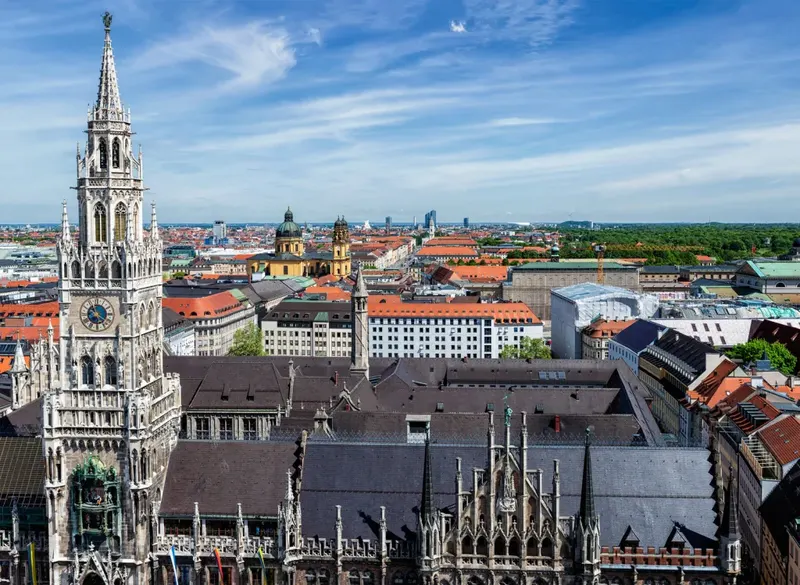
Munich is the prosperous, self-assured capital of Bavaria, set on the river Isar within sight of the Alps on a clear day. It is a city of baroque churches, ordered squares and green parkland, where medieval traditions are kept up with evident pride. Beer is close to a civic institution, poured in vast halls and leafy gardens, and the mountains, lakes and castles of southern Germany begin just beyond the suburbs. Munich feels ordered, wealthy and comfortable in its own skin.
Munich is a quieter alternative. It's ready to explore in the Nuvoha app: set your budget and see complete Munich trips.
Why visit Munich
Munich balances big-city culture with an almost small-town ease. The pedestrian old town runs from the twin-domed Frauenkirche to Marienplatz, where the New Town Hall's Glockenspiel chimes and dances above the crowds each day. World-class art fills the three Pinakothek museums, the Residenz recalls centuries of Bavarian royalty, and the Deutsches Museum ranks among the finest science collections anywhere. Above all there is the Englischer Garten, a park larger than many in London, complete with river surfers and beer gardens under the chestnut trees. Add Oktoberfest each autumn and quick trains to the Alps, castles and lakes, and Munich is both a destination and a gateway.
What to build a visit around
- Marienplatz and the Glockenspiel: Munich's central square, dominated by the neo-Gothic New Town Hall, whose Glockenspiel sends painted figures spinning at set times each day.
- Frauenkirche: The city's brick cathedral, its twin onion-domed towers the tallest structures in an old town where height limits keep the skyline low.
- Englischer Garten: One of the world's largest urban parks, with beer gardens, meadows and a permanent standing wave on the Eisbach where surfers ride year-round.
- Viktualienmarkt: A permanent open-air food market just off Marienplatz, part grocer and part beer garden, gathered around a traditional maypole.
- Nymphenburg Palace: The Wittelsbach dynasty's baroque summer residence west of the centre, set among vast formal gardens, canals and parkland.
- Deutsches Museum: One of the oldest and largest science and technology museums in the world, spread over an island in the Isar.
Munich neighbourhood by neighbourhood
- Altstadt (Old Town): The pedestrianised historic core around Marienplatz, taking in the Residenz palace, the main shopping streets and most of the landmark churches.
- Maxvorstadt: The university and museum quarter north of the centre, home to the three Pinakothek galleries and a studenty cafe culture.
- Schwabing: A one-time bohemian district, now elegant and desirable, of leafy streets, cafes and bars along the edge of the Englischer Garten.
- Haidhausen: A charming quarter east of the Isar, sometimes called the French Quarter for its street names, with a village feel and good restaurants.
- Isarvorstadt (Glockenbachviertel): A lively neighbourhood south of the old town, the centre of Munich nightlife and the heart of its gay scene.
- Lehel: A genteel, well-heeled district between the old town and the river, close to the major art museums and the English Garden.
The Bavarian table
Bavarian cooking is rich, meaty and made for beer. The morning ritual is Weisswurst, a mild veal sausage traditionally eaten before noon with sweet mustard, a pretzel and a wheat beer. Later come Schweinshaxe, the crackling roast pork knuckle, Leberkase meatloaf in a bread roll, and Obatzda, a paprika-spiked cheese spread for the beer garden. Puddings run to the shredded, sugar-dusted pancake called Kaiserschmarrn. Six great breweries supply the halls and gardens, and the beer-garden custom of bringing your own food to the plain wooden tables still holds.
- Weisswurst
- Brezn
- Schweinshaxe
- Obatzda
- Leberkase
- Kaiserschmarrn
What Munich feels like
Where Berlin is raw, Munich is polished and composed. This is Germany's most traditional big city, prosperous and conservative, where locals still wear dirndl and lederhosen to festivals without a trace of irony. Life is orderly and clean, the crime rate low and the mood contentedly comfortable, yet there is warmth in the beer gardens, where strangers share long benches under the trees. The Catholic calendar and Bavarian custom shape the year, from Lent's strong beers to the giant folk festival of Oktoberfest. On clear days the Alps hover on the southern horizon, and the whole city seems poised between cosmopolitan wealth and mountain village at once. The local greeting is not hallo but Gruss Gott.
Getting about the city
Munich is compact enough to explore the centre on foot, with a dense transit network for everything further out. The MVV runs U-Bahn and S-Bahn trains, trams and buses on a shared, zone-based ticket, and the same S-Bahn lines reach the airport and the surrounding lakes and mountains. The flat inner city is easy to cycle, and day trips to the Alps, Neuschwanstein and Salzburg are all straightforward by regional train from the Hauptbahnhof. Munich Airport (MUC) lies to the north-east of the city, a little farther out than most. S-Bahn lines S1 and S8 connect it to the centre in around forty to forty-five minutes, and the Lufthansa Express Bus runs to the main station. Taxis are available but slower and costlier.
Practical notes
- The Bavarian greeting is Gruss Gott rather than the northern hallo, and a little formality is welcomed.
- Weisswurst is traditionally eaten only before noon, peeled from its skin and, by purists, never cut with a knife.
- In beer gardens you may bring your own food to the plain, unclothed tables, but not to those laid for table service.
- Shops close on Sundays and public holidays, so stock up on a Saturday if you need supplies.
- Oktoberfest fills the city from mid-September into early October, so book a room months ahead and reserve tent tables early.
- The Marienplatz Glockenspiel performs at set times, usually late morning and, in summer, again in the afternoon.
- Buy an MVV day ticket for the zones you need, and remember the airport lies in an outer zone.
- The Eisbach standing wave in the Englischer Garten draws surfers all year and is a fine, free spectacle.
- Use Munich as a base for day trips to Neuschwanstein Castle, the Alpine lakes and Salzburg, all reachable by train.
- On a clear day with a warm foehn wind, the Alps appear startlingly close on the southern skyline.
Best for
- City breaks
- Quieter travel
Key facts
| Country | Germany |
|---|---|
| Region | Europe |
| Airports | MUC |
| Trip length fit | Short-trip friendly |
Munich essentials
| Currency | Euro (EUR) |
|---|---|
| Language | German; English is widely spoken in cities and among younger people |
| Time zone | Central European Time (UTC+1, UTC+2 in summer) |
| Emergency number | 112 (general emergency); 110 for police |
| Driving side | Right |
| Tap water | Safe to drink; tap water is reliably potable nationwide |
Climate & seasons
| Month | Typical range | Season |
|---|---|---|
| January | -4°C to 3°C | Cold winter |
| April | 4°C to 15°C | Fresh spring |
| July | 14°C to 25°C | Warm summer |
| October | 6°C to 14°C | Cool autumn |
Typical stay
- Weekend-friendly
- Short break (2–5 days)
Munich works as a weekend break just as well as a longer stay.
Getting there
Munich is served via MUC.
- MUC
Is it your kind of trip?
Ideal if…
- you like walkable city energy
- you like places before everyone else finds them
Maybe not if…
- a beach-first holiday is the priority
Pairs well with
Compare with
More in Europe
Near Munich
Travel style
- Short-trip friendly
- City
Frequently asked questions
Which airports serve Munich?
Munich is served via MUC.
Is Munich good for a weekend trip?
Yes, Munich works for a weekend as well as a longer stay.
What kind of trip is Munich best for?
Munich is best for city trips.
Which destinations pair well with Munich?
Within multi-city range: Zurich (261 km), Prague (265 km), Venice (320 km).
How many days do you need in Munich?
Two to three days covers the old town, a museum or two and a proper afternoon in a beer garden. A longer stay lets you add day trips to Neuschwanstein, the Alps or Salzburg, all within easy reach by train.
Do I need to visit during Oktoberfest?
Not at all. Oktoberfest is a spectacle, but it fills the city and its hotels. Munich's beer gardens and halls run all year, and many visitors prefer the calmer months for exploring the sights.
What is the best time to visit Munich?
Late spring and summer bring beer-garden weather and the clearest Alpine views, while autumn adds Oktoberfest. December fills the squares with Christmas markets, and the ski resorts and castles of the foothills are within easy reach in winter.
Is Munich a good base for the Alps?
Excellent. Regional trains reach the Bavarian Alps, the lakes and the castle at Neuschwanstein within one to two hours, and Salzburg and Innsbruck are close too. Many visitors pair a few city days with a mountain excursion.