
Zagreb is Croatia's capital and largest city, set inland in the country's continental north, well away from the coast and its crowds. It falls into two halves: the medieval Upper Town on the hill, with its churches, towers and cobbles, and the nineteenth-century Lower Town below, laid out with grand Austro-Hungarian squares, parks and museums. Between them runs one of the world's shortest funiculars. Unhurried, walkable and green, Zagreb is a city of pavement cafes, markets and gentle daily rituals rather than headline sights.
Zagreb is a quieter alternative. It's ready to explore in the Nuvoha app: set your budget and see complete Zagreb trips.
Why visit Zagreb
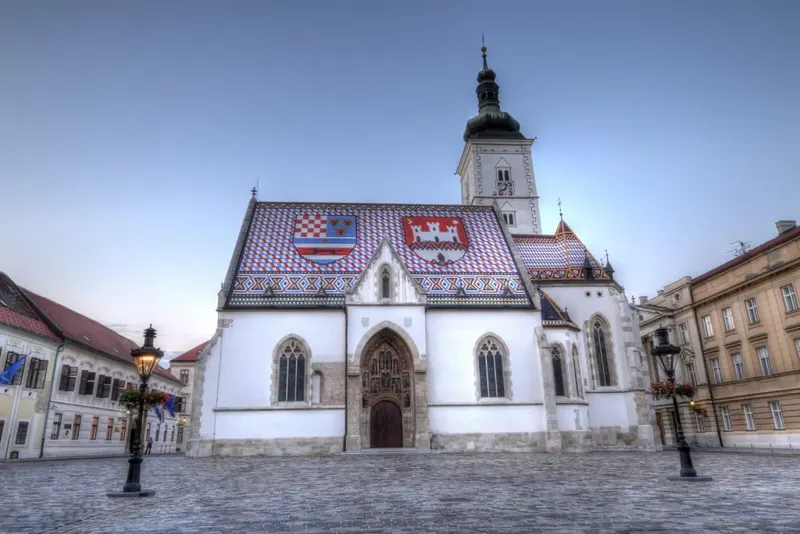
Zagreb rewards those who enjoy a city for its rhythm rather than a checklist. In the Upper Town, St Mark's Church shows off its famous tiled roof of coats of arms, the Lotrscak Tower fires its noon cannon, and small, quirky collections like the Museum of Broken Relationships repay a visit. The Lower Town strings together museums, galleries and leafy squares in a horseshoe of parks. Dolac, the roofed market above the main square, sells produce, flowers and cheese beneath red umbrellas. Above all, Zagreb is made for its cafe culture, the long, sociable coffee that fills its terraces, and easy strolls between the two towns.
Highlights
- St Mark's Church: A small Upper Town church famous for its steep tiled roof, patterned with the coats of arms of Zagreb and of the Croatian lands.
- Ban Jelacic Square: The broad central square where the city gathers, ringed by cafes and shops and served by a constant flow of blue trams.
- Dolac Market: Zagreb's main market just above the main square, a sea of red parasols selling fruit, vegetables, flowers, cheese and local produce.
- The Funicular and Lotrscak Tower: A short, historic funicular linking the Lower and Upper Towns, arriving beside the tower whose cannon marks noon each day.
- Zagreb Cathedral: The neo-Gothic cathedral in Kaptol, the country's tallest building, known for its soaring spires and, in recent years, extensive earthquake restoration.
- Mirogoj Cemetery: A monumental cemetery on the city's edge, its long ivy-clad arcades and domes considered among Europe's most beautiful.
Areas to know
- Gornji Grad (Upper Town): The historic hilltop core of Gradec, holding St Mark's Church, the old towers and gates, and many of the city's museums and government buildings.
- Donji Grad (Lower Town): The elegant nineteenth-century district of grand avenues, museums, theatres and the green horseshoe of landscaped squares.
- Kaptol: The old ecclesiastical quarter around the cathedral, historically the seat of the church, next to the Dolac market.
- Tkalciceva: A pedestrian street on the old stream bed between the two hills, packed with bars, cafes and restaurants and busy day and night.
- Novi Zagreb: The planned modern district south of the Sava river, with wide blocks, parks and the Museum of Contemporary Art.
- Maksimir: A leafy eastern district built around the large Maksimir park and the city zoo, a favourite for weekend walks.
Food & drink
Zagreb's cooking is continental and central-European, closer to Austria and Hungary than to the Adriatic. Hearty dishes lead: strukli, sheets of dough baked or boiled with fresh cottage cheese, is the city's comfort-food signature, served savoury or sweet. Roast meats, sausages, freshwater fish and rich stews feature strongly, alongside Zagreb's own crumbed veal cutlet stuffed with ham and cheese. The Dolac and surrounding markets supply seasonal produce, cheeses and cured meats, and the whole is bound together by that essential local institution, the long and unhurried cup of coffee.
- Strukli (baked cheese pastry)
- Zagrebacki odrezak (stuffed veal cutlet)
- Purica s mlincima (turkey with baked pasta sheets)
- Kotlovina (grilled meat and sausage)
- Sausages and cured meats
- Freshwater fish
What Zagreb feels like
Zagreb has an easy, understated confidence and a distinctly central-European feel. Mornings begin with coffee, and weekends bring the spica, a leisurely ritual of seeing and being seen over drinks on the Lower Town terraces. The Upper Town keeps a village-like calm of gas lamps, quiet courtyards and church bells, while Ban Jelacic Square and Tkalciceva Street below buzz with trams, market traders and evening crowds. Parks and tree-lined avenues soften the whole, and the seasons are keenly felt: cafe-lined summers, golden autumns and an acclaimed Christmas market that wraps the centre in lights. It is a lived-in capital, more everyday than showy.
Getting around
Zagreb is compact and best explored on foot, especially the Upper Town's cobbled lanes and the Lower Town's grid of squares. A dense and much-loved tram network, run by ZET, covers the wider city, backed by buses, and a single ticket works across the system. The little funicular saves the climb between the two towns. The centre is flat apart from the Upper Town hill, and most sights sit within easy walking distance of Ban Jelacic Square. Franjo Tudman Airport, Zagreb's international gateway, lies about fifteen kilometres south-east of the centre, near Velika Gorica. A regular airport shuttle bus runs to the main bus station, and taxis and ride-hailing cars are readily available. The drive into the city usually takes around twenty-five to thirty minutes outside the busiest periods. As Croatia's capital airport, it has the country's widest range of year-round flights.
Good to know
- Coffee is a social ritual, not a quick stop; lingering over a single cup for an hour is entirely normal and never rushed.
- Dress respectfully inside the cathedral and other churches, covering shoulders and knees.
- Greet shopkeepers and cafe staff with a simple dobar dan, or good day, which is always appreciated.
- Croatians can be reserved with strangers at first but warm quickly; a little formality early on goes a long way.
- Time your visit to the Upper Town for noon to hear the Gric cannon fire from the Lotrscak Tower.
- Take the funicular up and the stepped lanes down to see both towns with less effort.
- Visit Dolac market in the morning, when it is busiest and best stocked, ideally before lunch.
- If you come in December, allow an evening or two for the city's celebrated Advent lights and market stalls.
- Base yourself near Ban Jelacic Square to have the markets, trams and both towns within walking distance.
Best for
- City breaks
- Quieter travel
Key facts
| Country | Croatia |
|---|---|
| Region | Europe |
| Airports | ZAG |
| Trip length fit | Short-trip friendly |
Zagreb essentials
| Currency | Euro (EUR) |
|---|---|
| Language | Croatian, with English widely spoken in tourist areas |
| Time zone | Central European Time (UTC+1), with summer daylight saving |
| Emergency number | 112 for all emergencies |
| Driving side | Right |
| Tap water | Safe to drink |
Climate & seasons
| Month | Typical range | Season |
|---|---|---|
| January | -2°C to 5°C | Cold winter |
| April | 7°C to 18°C | Mild spring |
| July | 17°C to 29°C | Warm summer |
| October | 8°C to 17°C | Cool autumn |
Typical stay
- Weekend-friendly
- Short break (2–5 days)
Zagreb works as a weekend break just as well as a longer stay.
Getting there
Zagreb is served via ZAG.
- ZAG
Is it your kind of trip?
Ideal if…
- you like walkable city energy
- you like places before everyone else finds them
Maybe not if…
- a beach-first holiday is the priority
Pairs well with
Compare with
More in Europe
Near Zagreb
Travel style
- Short-trip friendly
- City
Frequently asked questions
Which airports serve Zagreb?
Zagreb is served via ZAG.
Is Zagreb good for a weekend trip?
Yes, Zagreb works for a weekend as well as a longer stay.
What kind of trip is Zagreb best for?
Zagreb is best for city trips.
Which destinations pair well with Zagreb?
Within multi-city range: Split (246 km), Vienna (266 km), Venice (290 km).
Is Zagreb worth visiting?
Yes, particularly for those who enjoy museums, cafe culture and central-European city life away from the coast. It is less about famous sights than atmosphere, with an attractive old core, good galleries and a relaxed pace. Two days is enough to get a real feel for the city.
How many days do you need in Zagreb?
One to two days covers the Upper and Lower Towns, the main museums, the markets and time to enjoy the cafes. A third day allows a trip out to Plitvice Lakes or the Zagorje countryside with its castles, both within easy reach of the capital.
How do you get from Zagreb to the coast?
Zagreb is well connected to the Adriatic by motorway and bus. Buses run frequently to Split, Zadar and beyond, and the drive to the coast takes a few hours. Many people begin a Croatian trip in Zagreb before heading south to Dalmatia and its islands.
When is the best time to visit Zagreb?
Late spring and early autumn bring mild, pleasant weather ideal for walking and sitting outside. Summer is warm and a little quieter as locals head to the coast, while December is special for the city's acclaimed Advent celebrations, though it is cold and sometimes snowy.