
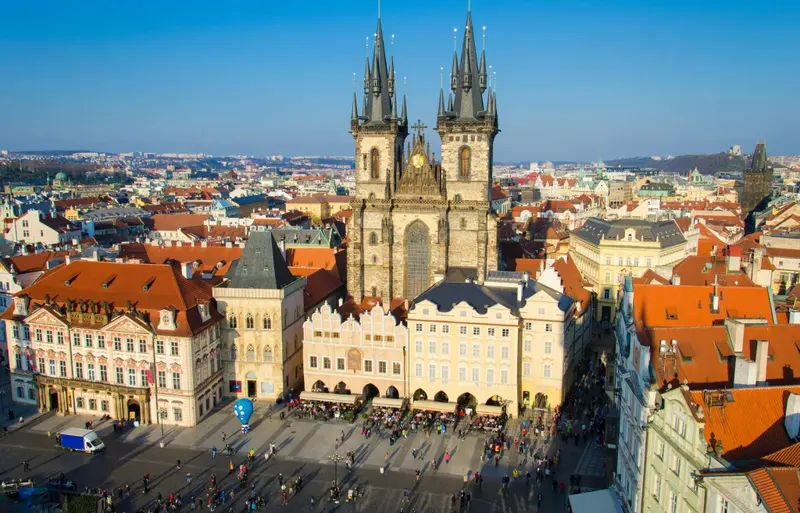
Prague looks assembled from a storybook. A thousand spires prick the skyline above a sea of terracotta roofs, the Vltava slides beneath the statue-lined Charles Bridge, and the largest castle complex in the world crowns the hill on the far bank. Little of the old core was flattened by the twentieth century, so its Gothic, baroque and art nouveau layers survive intact, cobbled and compact enough to cross on foot.
Prague is a favourite for couples. It's ready to explore in the Nuvoha app: set your budget and see complete Prague trips.
Why visit Prague
Prague rewards the wanderer more than the ticket-holder. The set pieces are unmissable, from the Astronomical Clock striking the hour on the Old Town Square to the dawn walk across an empty Charles Bridge and the climb through Prague Castle to St Vitus Cathedral, but the real pleasure is the maze between them, where every lane opens onto another baroque church or quiet courtyard. This is the home of the pilsner, and its pubs pour some of the finest and best-loved beer anywhere, served slow beneath a thick head. Add Kafka's old streets, the synagogues of Josefov, marionette theatres and a strong bohemian streak, and you have a compact capital that overdelivers on a short break.
The essential sights
- Charles Bridge: The fourteenth-century stone bridge lined with thirty baroque saints, framed by Gothic gate towers at each end above the Vltava.
- Prague Castle: The largest ancient castle complex in the world, enclosing St Vitus Cathedral, the Old Royal Palace and the tiny houses of Golden Lane.
- Old Town Square and the Astronomical Clock: The medieval heart, where the 1410 Orloj sends its apostles parading on the hour beneath the twin spires of the Tyn Church.
- St Vitus Cathedral: The soaring Gothic cathedral inside the castle walls, its stained glass including a luminous window designed by Alphonse Mucha.
- Josefov: The former Jewish Quarter, with its cluster of historic synagogues and the crowded, sunken tombstones of the Old Jewish Cemetery.
- Petrin Hill: A wooded rise above Mala Strana reached by funicular, topped by a lookout tower that echoes the Eiffel in miniature.
Getting to know the quarters
- Stare Mesto: The Old Town, a tangle of medieval lanes around the main square, taking in the Astronomical Clock and the Jewish Quarter of Josefov.
- Mala Strana: The baroque Lesser Town below the castle, of palace gardens, the domed St Nicholas Church, Kampa island and the Lennon Wall.
- Hradcany: The castle district on the hill, the seat of Czech power for a thousand years, and much quieter once the day-trippers leave.
- Nove Mesto: The New Town, founded in 1348 and centred on the broad sweep of Wenceslas Square, the city's commercial spine.
- Vinohrady: A graceful residential quarter of belle epoque apartment blocks, leafy squares and a strong cafe and wine-bar scene.
- Zizkov: A scruffy, spirited neighbourhood said to have more pubs per head than anywhere, watched over by its futuristic television tower.
Czech plates and pilsner
Czech cooking is built for the cold and for beer: rich, meaty and anchored by the dumpling. The national dish, svickova, sets braised beef in a smooth root-vegetable cream with a spoon of cranberry, while roast pork with sauerkraut and dumplings is the Sunday standard. Pubs turn out goulash, fried cheese and crisp potato pancakes to soak up the pilsner. Sweet stalls sell the spit-roasted trdelnik to visitors, though locals are likelier to end a meal with fruit dumplings or an apple strudel.
- Svickova
- Vepro-knedlo-zelo
- Gulas
- Smazeny syr
- Bramborak
What Prague feels like
Prague can feel almost too beautiful by day, when tour groups throng the bridge and the square. Slip into the early morning or late evening, though, and the fairytale returns: fog on the river, lamplight on wet cobbles, the castle floodlit above. The city has a bohemian, faintly mischievous spirit, equal parts Kafka gloom and beer-hall cheer. Locals retreat to smoky pubs and vaulted cellars where a glass of pilsner arrives almost before you ask, and the talk runs long. Beyond the centre, neighbourhoods like Zizkov and Vinohrady trade the postcard for something scruffier and more lived-in. It is a place of moods, best met on foot and after dark.
Getting around on foot and rail
The historic centre is small and walkable, though the cobbles and the climb to the castle test the legs. The three-line metro is quick for longer hops, but the tram network is the real joy: line 22 rattles up through Mala Strana to the castle gates, doubling as a sightseeing ride. A single ticket covers metro, tram and bus for a set time, and night trams keep running after the metro stops. Many visitors barely use transport at all. Vaclav Havel Airport Prague (PRG) sits about seventeen kilometres west of the centre, with no direct rail link. The simplest route is bus 119 to Nadrazi Veleslavin and metro line A into town, or the Airport Express coach straight to the main railway station. Taxis and ride-hailing take around half an hour outside rush hour.
Practical know-how
- Say dobry den on entering a shop or pub and na shledanou as you leave; a little Czech is warmly received.
- In a traditional pub you often share tables, and a beer mat left on the table signals you would like another; say when you are done.
- Tip around ten per cent, usually by stating the total you wish to pay as you hand over the money.
- Keep your voice down on trams and the metro, where loud conversation stands out; Czechs tend to travel quietly.
- Walk the Charles Bridge and the Old Town Square early or late to beat the crowds and catch the best light.
- Change money at banks or established exchange offices rather than street kiosks, which often advertise misleading rates.
- Order tap water or the local beer rather than imported drinks in pubs, where the pilsner is the whole point.
- Wear shoes with grip: the cobbles and the polished tram-track crossings turn slick in the rain.
- Spring and early autumn are loveliest; December brings Christmas markets and a cold, atmospheric hush.
- Validate your transport ticket in the yellow machine as you board, as inspectors do check and fine on the spot.
Best for
- City breaks
- Couples
Key facts
| Country | Czech Republic |
|---|---|
| Region | Europe |
| Airports | PRG |
| Trip length fit | Short-trip friendly |
Prague essentials
| Currency | Czech Koruna (CZK) |
|---|---|
| Language | Czech; English and German are understood in Prague and tourist areas |
| Time zone | Central European Time (UTC+1, UTC+2 in summer) |
| Emergency number | 112 (general emergency) |
| Driving side | Right |
| Tap water | Safe to drink across the country |
Climate & seasons
| Month | Typical range | Season |
|---|---|---|
| January | -3°C to 3°C | Cold winter |
| April | 5°C to 15°C | Fresh spring |
| July | 14°C to 26°C | Warm summer |
| October | 7°C to 14°C | Cool autumn |
Typical stay
- Weekend-friendly
- Short break (2–5 days)
Prague works as a weekend break just as well as a longer stay.
Getting there
Prague is served via PRG.
- PRG
Is it your kind of trip?
Ideal if…
- you like walkable city energy
- you're planning a trip for two
Maybe not if…
- a beach-first holiday is the priority
Pairs well with
Compare with
More in Europe
Near Prague
Travel style
- Short-trip friendly
- City
Frequently asked questions
Which airports serve Prague?
Prague is served via PRG.
Is Prague good for a weekend trip?
Yes, Prague works for a weekend as well as a longer stay.
What kind of trip is Prague best for?
Prague is best for city trips, popular for trips for two.
Which destinations pair well with Prague?
Within multi-city range: Berlin (257 km), Munich (265 km), Vienna (278 km).
How many days do you need in Prague?
Two to three days covers the castle, Charles Bridge, the Old Town and the Jewish Quarter comfortably. The compact centre means you see a great deal on foot, and a third day leaves room for the pubs of Zizkov or a wander through Vinohrady.
Is Prague a good city for beer?
Exceptional. The Czechs drink more beer per head than any nation, the pilsner style was born nearby in Plzen, and traditional pubs pour it fresh and unhurried, often straight from the tank. It is central to how the city socialises.
Do I need to speak Czech in Prague?
Not really. English is widely understood in the centre, in restaurants and at the main sights, and menus are usually translated. A few polite Czech words such as dobry den and dekuji are appreciated, but you will manage easily without the language.
When is the best time to visit Prague?
Late spring and early autumn bring mild weather and the clearest light for photographs. Summer is warm and busiest around the bridge and square, while winter is cold but magical, with Christmas markets filling the Old Town Square.