
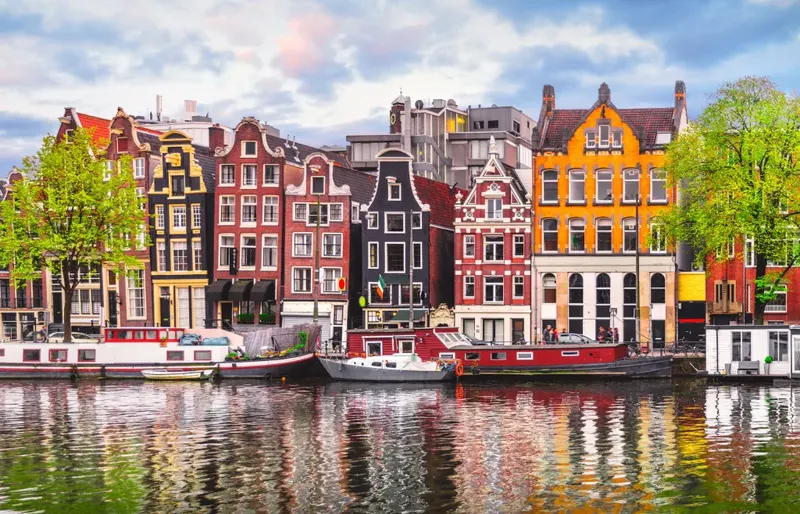
Amsterdam grew outward in rings, its seventeenth-century canal belt curving around a medieval core in three great arcs of water. The Dutch Golden Age left the city with gabled merchant houses, humpbacked bridges and a skyline of narrow brick facades leaning gently over the water. Bicycles outnumber residents, museums hold some of Europe's finest paintings, and the whole flat, walkable centre is laced together by canals and the wide river IJ to the north.
Amsterdam is a quieter alternative. It's ready to explore in the Nuvoha app: set your budget and see complete Amsterdam trips.
Why visit Amsterdam
Few cities pack so much into so small a space. The canal ring is a UNESCO-listed masterpiece of urban planning, best appreciated from a boat or a slow wander across its bridges, and the Museum Quarter holds the Rijksmuseum, the Van Gogh Museum and the Stedelijk within a short walk of one another. The Anne Frank House brings the war years close, the Jordaan charms with independent shops and brown cafes, and Vondelpark offers green respite. Beyond the art, Amsterdam rewards aimless cycling, canal-side terraces and day trips out to windmills, tulip fields and the coast. It is compact, cultured and endlessly photogenic.
Sights worth planning around
- Rijksmuseum: The national museum of the Netherlands, home to Rembrandt's vast Night Watch and a peerless collection of Dutch Golden Age painting.
- Van Gogh Museum: The world's largest holding of Van Gogh's work, tracing his short, turbulent career across two connected buildings on Museumplein.
- Anne Frank House: The canal-side house where the Frank family hid during the occupation, preserved as a moving museum entered by timed ticket only.
- The canal ring: The seventeenth-century grachtengordel of Herengracht, Keizersgracht and Prinsengracht, a UNESCO-listed belt of water, bridges and gabled houses.
- Vondelpark: The city's best-loved green space, a long landscaped park of ponds, lawns and cafes just beyond the Museum Quarter.
- A canal cruise: An hour on the water is the classic introduction to the city, threading beneath low bridges past leaning merchant houses and houseboats.
The city, quarter by quarter
- Centrum (Old Centre): The medieval core around Dam Square and the Royal Palace, taking in Nieuwmarkt, the old harbour front and the De Wallen red-light lanes.
- Jordaan: A former working-class quarter west of the ring, now a warren of narrow streets, courtyards, galleries and snug brown cafes.
- Canal Ring (Grachtengordel): The elegant horseshoe of seventeenth-century waterways, lined with grand houses and dotted with the boutiques of the Nine Streets.
- Museum Quarter (Oud-Zuid): A genteel southern district built around Museumplein, the Concertgebouw and Vondelpark, holding the city's grandest museums.
- De Pijp: A lively, densely packed neighbourhood south of the centre, known for the sprawling Albert Cuyp street market and a wealth of casual kitchens.
- Amsterdam-Noord: Reached by free ferry across the IJ, a former shipyard district now home to the EYE Film Museum, waterfront bars and creative studios.
At the Dutch table
Dutch cooking is honest and unshowy, built for a maritime, seafaring climate. Raw herring served with onions and pickles is eaten from street stalls, croquettes and bitterballen are pulled hot from cafe kitchens, and cheese from Gouda and Edam fills the market stalls. Sweet treats run to fresh stroopwafels, mini poffertjes pancakes and thick apple pie. The colonial link with Indonesia gave the city its beloved rijsttafel, a feast of many small spiced dishes, while brown cafes pour jenever, the juniper spirit that gave gin its name.
- Haring
- Bitterballen
- Stroopwafel
- Poffertjes
- Gouda cheese
- Rijsttafel
What Amsterdam feels like
Amsterdam feels tolerant, informal and quietly self-assured. Locals cycle in ordinary clothes whatever the weather, bells ringing as they weave past trams, and the city keeps a human scale that larger capitals have lost. Water is everywhere, so the light is soft and the mood shifts with it, from grey drizzle to long golden evenings on the terraces. There is an easy liberalism to daily life, and a clear line between the tourist churn of the old centre and the calm of residential canals a few streets away. Gezelligheid, that untranslatable Dutch sense of cosy conviviality, is the thing to chase, ideally in a candlelit brown cafe as the rain comes down.
Getting around on two wheels
Amsterdam is made for bicycles and feet, and the flat, compact centre is quickest on two wheels. Trams, buses and metro trains run by GVB and are paid with contactless cards or the OV-chipkaart. Free ferries slip across the IJ to Noord from behind Centraal station, and canal boats offer a slower view. Watch carefully when crossing the busy, clearly marked bike lanes, which have priority and move fast. Amsterdam Airport Schiphol (AMS) lies south-west of the city and is one of Europe's major hubs. Frequent direct trains reach Amsterdam Centraal in fifteen to twenty minutes, with taxis and ride-hailing also available. It is among the smoothest airport transfers in Europe.
Before you go
- The Dutch are famously direct; plain speaking is meant as honesty, not rudeness, and English is spoken almost universally.
- Never walk or stand in the red cycle lanes, and do not photograph people in the red-light district out of basic respect.
- Tipping is modest; rounding up or leaving a little for good service is customary rather than expected.
- Cards and contactless are the norm, and a number of shops and cafes no longer take cash at all.
- Book the Anne Frank House and the Van Gogh Museum well ahead, as both sell timed tickets that go quickly.
- The weather is changeable and often wet and windy, so pack a waterproof layer whatever the season.
- A canal cruise early in a trip is the easiest way to get your bearings on the ring.
- Distinguish coffeeshops, which sell cannabis, from ordinary cafes and koffiehuizen, which sell coffee.
- Late spring brings the tulip season, when the Keukenhof gardens and surrounding bulb fields are in bloom.
- If you are here on the 27th of April, King's Day turns the whole city orange and afloat.
Best for
- City breaks
- Quieter travel
Key facts
| Country | Netherlands |
|---|---|
| Region | Europe |
| Airports | AMS |
| Trip length fit | Short-trip friendly |
Amsterdam essentials
| Currency | Euro (EUR) |
|---|---|
| Language | Dutch; Frisian is co-official in Friesland, and English is spoken almost universally |
| Time zone | Central European Time (UTC+1, UTC+2 in summer) |
| Emergency number | 112 (all emergencies) |
| Driving side | Right |
| Tap water | Safe to drink, and among the best regarded in Europe |
Climate & seasons
| Month | Typical range | Season |
|---|---|---|
| January | 1°C to 7°C | Cold damp winter |
| April | 6°C to 14°C | Changeable spring |
| July | 14°C to 22°C | Mild summer |
| October | 8°C to 15°C | Cool autumn |
Typical stay
- Weekend-friendly
- Short break (2–5 days)
Amsterdam works as a weekend break just as well as a longer stay.
Getting there
Amsterdam is served via AMS.
- AMS
Is it your kind of trip?
Ideal if…
- you like walkable city energy
- you like places before everyone else finds them
Maybe not if…
- a beach-first holiday is the priority
Pairs well with
Compare with
More in Europe
Near Amsterdam
Travel style
- Short-trip friendly
- City
Frequently asked questions
Which airports serve Amsterdam?
Amsterdam is served via AMS.
Is Amsterdam good for a weekend trip?
Yes, Amsterdam works for a weekend as well as a longer stay.
What kind of trip is Amsterdam best for?
Amsterdam is best for city trips.
Which destinations pair well with Amsterdam?
Within multi-city range: London (370 km), Paris (399 km), Berlin (593 km).
How many days do you need in Amsterdam?
Two to three days covers the major museums, a canal cruise and time to wander the Jordaan and canal ring. A longer stay leaves room for day trips to the windmills at Zaanse Schans, the tulip fields or the coast.
Is Amsterdam a good city for cycling?
It is one of the most cycle-friendly cities in the world, with flat terrain and dedicated lanes everywhere. Rental bikes are easy to find, though newcomers should be confident in traffic and mindful of tram tracks.
When is the best time to visit Amsterdam?
Late spring and summer bring the warmest weather and the tulip season, though also the biggest crowds. Autumn and winter are quieter and atmospheric, if grey and wet, and the canals can freeze in a hard winter.
Do I need to speak Dutch in Amsterdam?
No. English is spoken almost universally, and menus, signs and transport information are widely available in English. A few words of Dutch are appreciated but rarely necessary.