
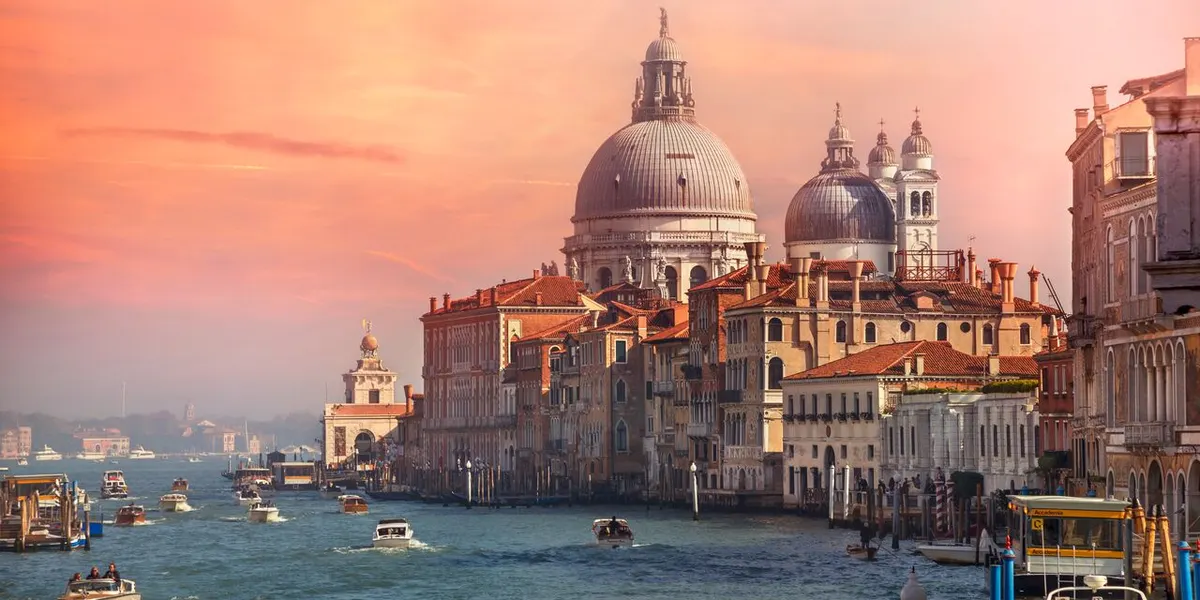
Water does the work of roads in Venice: the lagoon city's 118 islands are stitched together by around 400 bridges, and everything (post, groceries, ambulances) moves by boat. Step away from the Rialto to San Marco axis and the crowds thin fast, replaced by washing lines, boatyards and the slap of water on stone.
Venice is a favourite for couples. It's ready to explore in the Nuvoha app: set your budget and see complete Venice trips.
Why visit Venice
No other city is built like it, and none sounds like it: footsteps, bells and boat engines instead of traffic. San Marco holds the setpieces: the Basilica's golden mosaics, the Doge's Palace, the campanile. But Venice's deeper pleasure is the walk between them, through six sestieri where Gothic palaces lean gently into the canals. Add the outer islands (Murano's glass furnaces, Burano's painted houses, quiet Torcello) and you have a lagoon-wide city that rewards slow exploration over a rushed day.
Sights across the lagoon
- Basilica di San Marco: Byzantine mosaics covering some 8,000 square metres glow above the piazza; the bronze horses within were carried off from Constantinople in 1204.
- Doge's Palace: Seat of the Venetian Republic for centuries, connected to its prison by the enclosed Bridge of Sighs.
- Rialto Bridge and market: The oldest crossing of the Grand Canal, with a morning fish and produce market on the San Polo bank that has traded for centuries.
- Murano and Burano: Two lagoon islands: one blowing glass since 1291, the other known for lacework and boldly painted fishermen's houses.
- Gallerie dell'Accademia: The essential collection of Venetian painting (Bellini, Titian, Tintoretto, Veronese) on the Dorsoduro bank.
- A traghetto crossing: Standing gondola ferries shuttle across the Grand Canal at a handful of points where bridges are scarce.
The six sestieri and beyond
- Cannaregio: The northern sestiere, home to the world's original Ghetto of 1516 and long canal-side fondamente lined with everyday bacari.
- Dorsoduro: The southern arm between the Grand and Giudecca canals, with the Accademia, the Salute church and the Zattere promenade.
- Castello: Venice's largest sestiere, stretching east past the Arsenale shipyards to genuinely local squares and the Biennale gardens.
- San Polo and Santa Croce: The compact commercial heart around the Rialto market, dense with churches including the Frari and its Titian altarpieces.
What Venetians actually eat
Venetian eating is done standing as much as sitting: bacari counters pile up cicchetti (small bites of creamed salt cod, meatballs, marinated sardines) taken with a small glass of wine known as an ombra. Lagoon seafood defines the menus: sarde in saor, squid-ink risotto, soft-shell moeche crabs in their brief season. The spritz was poured here long before it went global.
- Cicchetti with an ombra of wine
- Sarde in saor (sweet-sour sardines)
- Baccala mantecato (creamed salt cod)
- Risotto al nero di seppia (squid ink)
- Bigoli in salsa (anchovy and onion pasta)
What Venice feels like
Venice runs on tides in every sense. Day-trip crowds compress into the Rialto to San Marco corridor between mid-morning and late afternoon; early and late, even the famous squares empty out. Cannaregio and Castello keep an everyday Venetian life of markets and bacari. In autumn and winter, acqua alta occasionally floods the lowest pavements (sirens warn the city hours ahead) and raised walkways appear, part nuisance, part spectacle.
Boats, bridges and your own two feet
Venice is walked, or it is sailed. ACTV vaporetti (the water buses) ply the Grand Canal and reach the outer islands, with lines 1 and 2 doing the heavy lifting; multi-day travel passes loaded onto a Venezia Unica card are the sensible way to use them. Traghetto gondolas cross the Grand Canal where bridges are absent. Cars stop at Piazzale Roma; beyond it, wheels are useless, so pack luggage you can carry over bridges. Marco Polo Airport sits on the mainland edge of the lagoon; Alilaguna water buses sail directly to stops around the city, while road buses run to Piazzale Roma. Some flights use Treviso, about an hour away.
Notes for first-timers
- Service is often included on Venetian bills; tipping beyond a round-up is a courtesy, not an expectation.
- The Basilica enforces covered shoulders and knees, and large bags must be deposited before entry.
- Keep right in the narrow calli, avoid stopping on bridge steps, and give loaded handcarts right of way: they are the city's delivery vans.
- Swimming in the canals and picnicking on monument steps are both prohibited and fined.
- An early start changes everything: Piazza San Marco before eight belongs to sweepers and photographers.
- Acqua alta peaks between October and January; walkways go up, life continues, and rubber overshoes solve most of it.
- Vaporetto line 1 along the Grand Canal at dusk doubles as the city's finest sightseeing ride.
- Wander deliberately into Castello or Cannaregio: yellow signs to Rialto and San Marco mean you can always find the way back.
- Give Murano and Burano a combined half day; Burano is about forty minutes out on line 12 from Fondamente Nove.
Best for
- City breaks
- Couples
Key facts
| Country | Italy |
|---|---|
| Region | Europe |
| Airports | VCE |
| Trip length fit | Short-trip friendly |
Venice essentials
| Currency | Euro (EUR) |
|---|---|
| Language | Italian; English is common in tourist cities, less so in the countryside |
| Time zone | Central European Time (UTC+1, UTC+2 in summer) |
| Emergency number | 112 (general emergency) |
| Driving side | Right |
| Tap water | Safe to drink; Rome's public 'nasoni' fountains run continuously with drinkable water |
Climate & seasons
| Month | Typical range | Season |
|---|---|---|
| January | 0°C to 7°C | Cold winter |
| April | 9°C to 17°C | Mild spring |
| July | 20°C to 29°C | Warm summer |
| October | 11°C to 19°C | Soft autumn |
Typical stay
- Weekend-friendly
- Short break (2–5 days)
Venice works as a weekend break just as well as a longer stay.
Getting there
Venice is served via VCE.
- VCE
Is it your kind of trip?
Ideal if…
- you like walkable city energy
- you're planning a trip for two
Maybe not if…
- a beach-first holiday is the priority
Pairs well with
Compare with
More in Europe
Near Venice
Travel style
- Short-trip friendly
- City
Frequently asked questions
Which airports serve Venice?
Venice is served via VCE.
Is Venice good for a weekend trip?
Yes, Venice works for a weekend as well as a longer stay.
What kind of trip is Venice best for?
Venice is best for city trips, popular for trips for two.
Which destinations pair well with Venice?
Within multi-city range: Milan (282 km), Zagreb (290 km), Munich (320 km).
What is acqua alta and should I worry?
Seasonal high tides, mostly October to January, that briefly flood the lowest areas, Piazza San Marco first. Sirens give hours of warning, raised walkways appear, and most of the city stays dry. It is an inconvenience, not a danger.
Can I manage Venice with luggage or limited mobility?
The city has more than four hundred stepped bridges, so wheeled cases are hard work. Vaporetti help enormously: plan routes along the Grand Canal, where boats substitute for many crossings, and check ACTV's accessible-stop information.
Are gondolas the normal way to get around?
No. A gondola ride is a scenic experience rather than transport. Venetians walk and use the vaporetti; the standing traghetto crossings of the Grand Canal are the one everyday gondola service left.