
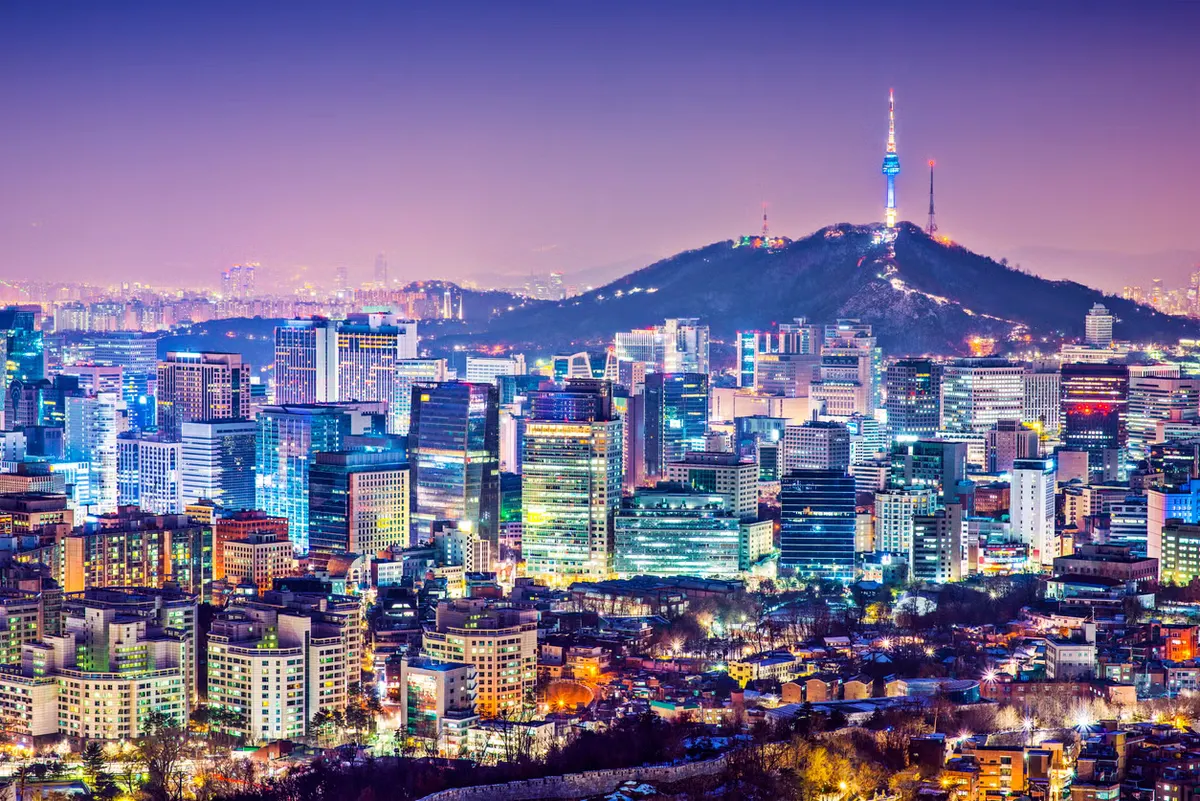
Drummers in Joseon-era robes still march the changing of the guard at Gyeongbokgung, and from the palace gate you can see glass towers, granite mountains and a 600-year-old city wall in the same glance. Seoul layers its centuries like this everywhere: hanok courtyards behind LED billboards, shamanist shrines up the hill from 24-hour barbecue joints.
Seoul is a quieter alternative. It's ready to explore in the Nuvoha app: set your budget and see complete Seoul trips.
Why visit Seoul
Seoul repays curiosity at any hour. Mornings belong to palace grounds and the tea houses of Insadong; afternoons to museums, mountain trails inside the city limits, and the market grandmothers of Gwangjang flipping mung-bean pancakes; nights to Hongdae's buskers, noraebang singing rooms and barbecue smoke drifting down side streets. The subway makes all of it effortless, the food scene runs from street stalls to some of Asia's most inventive kitchens, and Bukhansan National Park sits right on the metro map, a proper granite mountain range within city limits.
Seoul's essential sights
- Gyeongbokgung Palace: The grandest of Seoul's five Joseon palaces, with a twice-daily changing of the royal guard ceremony at Gwanghwamun Gate.
- Changdeokgung and the Secret Garden: A UNESCO-listed palace whose wooded Huwon garden of pavilions and lotus ponds is visited on guided entry.
- Bukchon Hanok Village: A hillside quarter of traditional tiled-roof hanok houses threaded by lanes between the two main palaces.
- N Seoul Tower on Namsan: The observation tower crowning Namsan mountain, reached by cable car or a wooded walk from the old city wall.
- Dongdaemun Design Plaza: Zaha Hadid's silver, curving culture complex, at its most striking after dark beside the night-market stalls.
- Gwangjang Market: A century-old covered market famous for bindaetteok mung-bean pancakes and raw-beef yukhoe alley.
Districts worth your time
- Hongdae: The university quarter around Hongik University, known for buskers, indie venues, vintage shops and late-night energy.
- Insadong: A calligraphy-and-craft district of tea houses, antique dealers and galleries along a mostly pedestrian main street.
- Gangnam: The glass-and-granite business district south of the river, where the COEX complex faces the ancient Bongeunsa temple.
- Seongsu: A former warehouse and shoe-factory district reinvented as a landscape of industrial cafés, showrooms and pop-up culture.
- Itaewon: Seoul's most international quarter, layered with global restaurants and nightlife on the slopes below Namsan.
What Seoul tastes like
Korean food is communal, fiery and built around banchan: the constellation of small side dishes that arrives unbidden with every meal. Grill samgyeopsal pork belly at the table and wrap it in lettuce; stir a stone-bowl dolsot bibimbap until the rice crackles; queue at a market stall for tteokbokki rice cakes in gochujang sauce. Cold buckwheat naengmyeon rescues the humid summer, and fried chicken with beer (chimaek) is a national institution.
- Samgyeopsal
- Dolsot bibimbap
- Tteokbokki
- Naengmyeon
- Kimchi jjigae
What Seoul feels like
The city moves fast (ppalli-ppalli, the hurry-up pace Koreans name in themselves) yet it is orderly, safe and unexpectedly green. Café culture borders on obsession, with themed coffee houses on every block, and the Han River parks fill on warm evenings with picnic blankets and delivery fried chicken. Winters are Siberian-crisp, summers humid and loud with cicadas, and autumn turns the palace ginkgos a shade of gold that stops pedestrian traffic.
Riding the metro and beyond
Seoul's subway is one of the world's best: clean, cheap, air-conditioned and fully signed in English, with numbered, colour-coded lines. A rechargeable T-money card works on subways, buses and taxis, and even in convenience stores. The AREX line links Incheon Airport to Seoul Station. One quirk: international map apps have limited functionality in Korea, so download Naver Map or Kakao Map for reliable walking and transit directions. Most international flights use Incheon International Airport, west of the city on Yeongjong Island; the AREX express and all-stop trains run to Seoul Station in under an hour. Gimpo Airport, closer in, handles mainly domestic and short-haul routes.
Traveller notes
- Give and receive items (cash, business cards, drinks) with two hands or with your right hand supported by the left.
- Never plant chopsticks upright in a bowl of rice; it echoes a funeral rite.
- Leave the marked priority seats on the subway empty, even when the carriage is crowded.
- Tipping is not practised anywhere in Korea and attempts can cause genuine confusion.
- Buy a T-money card at any convenience store on arrival and top it up with cash as you go.
- Palace entry is free if you rent and wear a hanbok, and photographers cluster at Gyeongbokgung for exactly this reason.
- Restaurants often specialise in a single dish: the shorter the menu, the better the food tends to be.
- Many small eateries and market stalls are cash-only or card-machine-temperamental; carry some won.
- Hiking Bukhansan or the Seoul City Wall trail is a local weekend ritual: trainers are fine on the easier routes.
- Summer monsoon rains in July can be torrential; late September to early November is the sweet spot.
Best for
- City breaks
- Quieter travel
Key facts
| Country | South Korea |
|---|---|
| Region | Asia |
| Airports | ICN |
| Trip length fit | Short-trip friendly |
Seoul essentials
| Currency | South Korean Won (KRW) |
|---|---|
| Language | Korean; English signage is widespread on transport and in Seoul, though spoken English varies outside tourist areas |
| Time zone | Korea Standard Time, UTC+9, no daylight saving |
| Emergency number | 112 (police); 119 (fire and ambulance) |
| Driving side | Right |
| Tap water | Safe to drink, though most locals prefer filtered or bottled water |
Climate & seasons
| Month | Typical range | Season |
|---|---|---|
| January | -6°C to 2°C | Cold dry winter |
| April | 7°C to 18°C | Mild spring |
| July | 22°C to 29°C | Humid monsoon summer |
| October | 10°C to 20°C | Crisp autumn |
Typical stay
- Weekend-friendly
- Short break (2–5 days)
Seoul works as a weekend break just as well as a longer stay.
Getting there
Seoul is served via ICN.
- ICN
Is it your kind of trip?
Ideal if…
- you like walkable city energy
- you like places before everyone else finds them
Maybe not if…
- a beach-first holiday is the priority
Pairs well with
Compare with
More in Asia
Near Seoul
Travel style
- Short-trip friendly
- City
Frequently asked questions
Which airports serve Seoul?
Seoul is served via ICN.
Is Seoul good for a weekend trip?
Yes, Seoul works for a weekend as well as a longer stay.
What kind of trip is Seoul best for?
Seoul is best for city trips.
Which destinations pair well with Seoul?
Within multi-city range: Fukuoka (563 km), Osaka (870 km), Tokyo (1,205 km).
Can I get around Seoul without speaking Korean?
Yes. Subway signage, ticket machines and announcements are in English, menus increasingly carry photos, and translation apps bridge the rest. Learning hello (annyeonghaseyo) and thank you (gamsahamnida) earns warm responses.
Why doesn't my usual map app work properly in Seoul?
Korean mapping regulations limit foreign map providers, so walking and driving directions are unreliable on them. Locals use Naver Map or Kakao Map, both of which have full English interfaces. Install one before you land.
Is the DMZ worth a day trip?
For many visitors, yes. It is one of the world's strangest borders, about an hour north of Seoul. Access is by authorised tour only with your passport, and itineraries typically include observation posts and an infiltration tunnel.