
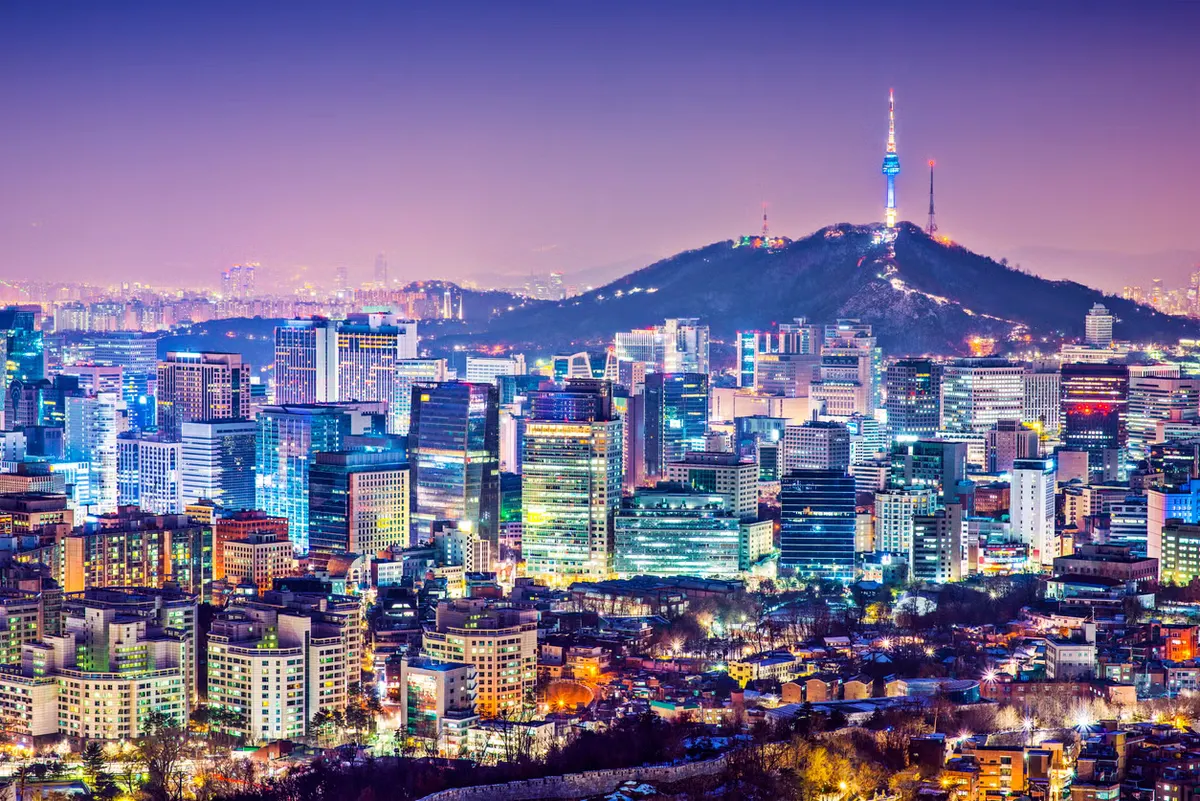
Gyeongbokgung's throne halls sit in the middle of Seoul with glass towers rising directly behind them: five Joseon-dynasty palaces embedded in one of the world's most wired cities. South Korea is mostly mountains; forested ridges cover around 70 per cent of the country, which is why hiking is close to a national pastime and why the KTX high-speed train, threading the valleys from Seoul to Busan in under three hours, feels miraculous. Food organises daily life: barbecue grilled at the table, kimchi with everything, market stalls selling tteokbokki late into the night. Beyond the capital lie Gyeongju's ancient Silla tombs, Busan's beaches and hillside villages, and the volcanic island of Jeju with its lava tubes and haenyeo free-divers.
Seoul is the South Korea destination on Nuvoha today. Set your budget and Nuvoha builds the complete trip: flights and hotels together.
Why visit South Korea
- Cities you can explore on foot, from headline sights to quiet neighbourhoods
- Quieter alternatives beyond the obvious stops
Best known for
- Seoul's Joseon palaces
- Korean barbecue and street food
- The KTX high-speed rail network
- Jeju's volcanic landscapes
- K-pop and screen culture
Beyond Seoul
- Seoul and Gyeonggi: The capital region holds the five royal palaces, the hanok lanes of Bukchon, Hongdae's youth culture and, an hour north, the DMZ on the border with North Korea.
- Busan and the southeast: Korea's second city has Haeundae and Gwangalli beaches, the painted hillside of Gamcheon Culture Village and Jagalchi fish market; Gyeongju's Silla-era tombs and temples are nearby.
- Jeju Island: A volcanic island off the south coast, centred on Hallasan, South Korea's highest peak, with lava-tube caves, waterfalls and the haenyeo women free-divers, all UNESCO-recognised.
- Gangwon: The mountainous north-east, home to Seoraksan National Park's granite ridges, east-coast beaches at Gangneung and the ski resorts that hosted the 2018 Winter Olympics.
- Jeolla: The agricultural south-west is Korea's food heartland; Jeonju's hanok village is the birthplace of bibimbap, and the tea fields of Boseong terrace the hills.
Where to go
South Korea essentials
| Currency | South Korean Won (KRW) |
|---|---|
| Language | Korean; English signage is widespread on transport and in Seoul, though spoken English varies outside tourist areas |
| Time zone | Korea Standard Time, UTC+9, no daylight saving |
| Emergency number | 112 (police); 119 (fire and ambulance) |
| Driving side | Right |
| Tap water | Safe to drink, though most locals prefer filtered or bottled water |
Seasons at a glance in Seoul
| Month | Typical range | Season |
|---|---|---|
| January | -6°C to 2°C | Cold dry winter |
| April | 7°C to 18°C | Mild spring |
| July | 22°C to 29°C | Humid monsoon summer |
| October | 10°C to 20°C | Crisp autumn |
Seasons vary across South Korea. Each destination page has its own climate table.
More in Asia
More Asia country guides
Frequently asked questions
Which South Korea destinations can I book with Nuvoha?
Seoul, with complete flight and hotel trips built around your budget.
What kind of trips suit South Korea?
South Korea works for city breaks.
How easy is intercity travel in South Korea?
Very easy. KTX trains run Seoul to Busan in about 2 hours 40 minutes, and express buses reach almost every town. A T-money card works on subways and buses nationwide, and stations have English signage.
Do credit cards work everywhere in South Korea?
Nearly: Korea is one of the most card-centric countries anywhere, and even market stalls often take cards. Foreign cards occasionally fail at small vendors, so carry a modest amount of won as backup.
What plug type does South Korea use?
European-style round two-pin sockets, Types C and F, at 220 volts. UK, North American and Japanese devices need an adapter; most hotel desks lend them.