
The Glico Running Man has been sprinting in neon above the Dōtonbori canal since 1935, cheered nightly by crowds armed with takoyaki skewers. Osaka earned the nickname tenka no daidokoro (the nation's kitchen) as the rice-trading hub of feudal Japan, and it has never stopped acting the part.
Osaka is a quieter alternative. It's ready to explore in the Nuvoha app: set your budget and see complete Osaka trips.
Why visit Osaka
Osaka is Japan at its most extroverted. The local creed of kuidaore (eat until you drop) turns whole districts into open-air dining rooms, from Dōtonbori's illuminated canalside to the fried-skewer dens of Shinsekai. Osaka Castle rises from its moats in a broad city-centre park; the Kansai region's merchant history gives the city a fast, funny, deal-making character all its own; and Kyoto, Nara and Kobe each sit within an hour by train, making this an ideal base for the whole region.
Sights worth the queue
- Dōtonbori: The canalside entertainment strip whose giant mechanical crab, blowfish lanterns and Glico sign are Osaka's unofficial emblems.
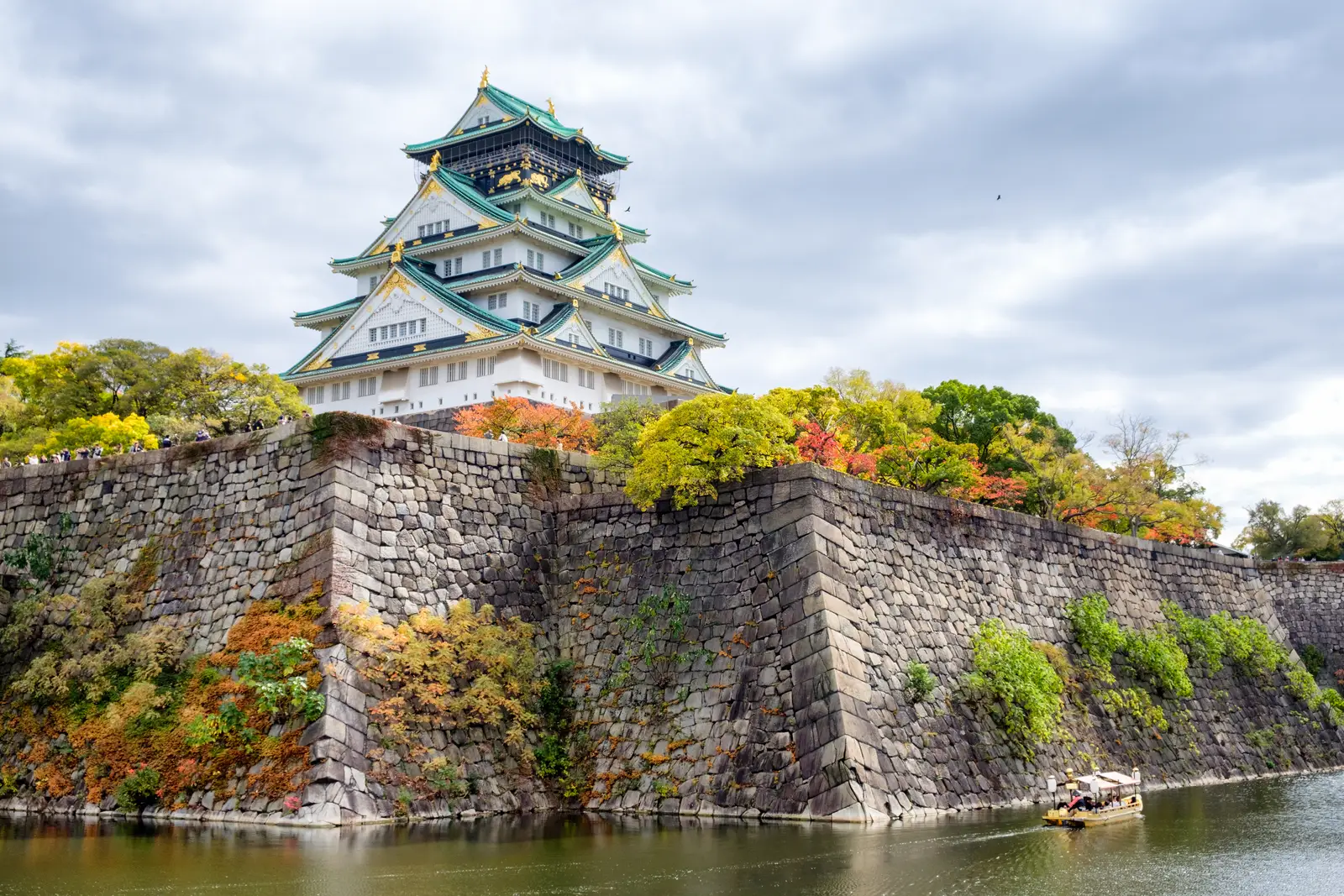
- Osaka Castle: A reconstructed keep on immense original stone ramparts, set in a moated park famous for plum and cherry blossom.
- Kuromon Ichiba Market: A covered market of roughly 150 stalls where scallops, wagyu skewers and sea urchin are grilled to order.
- Shinsekai: A retro quarter laid out in 1912 beneath the rebuilt Tsūtenkaku tower, famous for its kushikatsu skewer restaurants.
- Umeda Sky Building: Twin towers joined by the rooftop Floating Garden Observatory, with open-air views across the Yodo River plain.
- Shitennō-ji: Founded in 593, one of Japan's oldest Buddhist temples, still holding flea-market days in its precincts.
Neighbourhood by neighbourhood
- Minami (Namba): The southern entertainment heartland, taking in Dōtonbori, the Shinsaibashi-suji shopping arcade and the youth-fashion lanes of Amerikamura.
- Kita (Umeda): The northern business district around Osaka and Umeda stations, a three-dimensional maze of department stores and underground arcades.
- Tenma: Home of Tenjinbashi-suji, said to be Japan's longest shopping street, and a dense huddle of standing bars beloved of locals.
- Nakanoshima: A slender river island of museums, rose gardens and Meiji-era public buildings between the Dōjima and Tosabori rivers.
Kuidaore: eating till you drop
Kuidaore is the rule. Takoyaki (molten octopus dumplings turned with picks at street windows) and okonomiyaki, the layered savoury pancake, are the twin icons. Kushikatsu comes breaded and fried on skewers in Shinsekai, where double-dipping in the communal sauce is the one unforgivable sin. Kitsune udon, topped with sweet fried tofu, was born here, and Osaka's sushi tradition favours pressed hakozushi over hand-formed nigiri.
- Takoyaki
- Okonomiyaki
- Kushikatsu
- Kitsune udon
- Hakozushi
What Osaka feels like
People actually talk to strangers here, a small shock after Tokyo. Kansai dialect rattles along at speed, comedians are local royalty, and shopkeepers trade friendly banter across Kuromon Ichiba Market. Stand on the right of escalators, not the left; Osaka does things its own way. At night the Dōtonbori neon doubles itself in the canal, and the queues outside famous takoyaki stands become social events in their own right.
Riding the Osaka network
Osaka Metro's lines cover the city grid, with the red Midōsuji Line the workhorse between Umeda and Namba. Pick up an ICOCA card (JR West's IC card, interchangeable with Suica and PASMO) and tap through subways, JR's Osaka Loop Line and the private railways alike. Trains to Kyoto, Kobe and Nara leave every few minutes; note that the metro winds down around midnight. Kansai International Airport occupies an artificial island in Osaka Bay, linked to the city by Nankai trains to Namba and JR services to Tennōji and Osaka Station; many domestic flights use the closer Itami Airport.
Pointers from the nation's kitchen
- Tipping is not customary anywhere in Japan: good service is standard, and money left on the table will be politely returned.
- Stand on the right of escalators in Osaka, the reverse of Tokyo's habit.
- Never dip a kushikatsu skewer twice into the shared sauce; use the free cabbage to scoop more if you need it.
- Eating while strolling is tolerated around Dōtonbori's stalls, but finish food near where you bought it and carry your rubbish: public bins are rare.
- Kuromon Ichiba is at its best mid-morning, when stalls are fully stocked and the grills are firing.
- For blossom season, Osaka Castle's Nishinomaru Garden and the Kema Sakuranomiya riverside are the classic spots.
- Nara's deer park and Great Buddha are about 45 minutes away by Kintetsu train; central Kyoto is under half an hour by rail.
- Learn one phrase of Kansai dialect ('ookini' for thank you) and watch shopkeepers light up.
- The observation decks at Umeda Sky Building and Harukas 300 both reward a clear evening; pick one and time it for sunset.
Best for
- City breaks
- Quieter travel
Key facts
| Country | Japan |
|---|---|
| Region | Asia |
| Airports | KIX |
| Trip length fit | Short-trip friendly |
Osaka essentials
| Currency | Japanese Yen (JPY) |
|---|---|
| Language | Japanese; English signage is good in cities and on transport, though spoken English is patchier |
| Time zone | Japan Standard Time (UTC+9), no daylight saving |
| Emergency number | 110 (police), 119 (fire and ambulance) |
| Driving side | Left |
| Tap water | Safe to drink nationwide, including from public fountains |
Climate & seasons
| Month | Typical range | Season |
|---|---|---|
| January | 3°C to 10°C | Cool winter |
| April | 10°C to 20°C | Mild spring |
| July | 24°C to 32°C | Hot humid summer |
| October | 15°C to 23°C | Mild autumn |
Typical stay
- Weekend-friendly
- Short break (2–5 days)
Osaka works as a weekend break just as well as a longer stay.
Getting there
Osaka is served via Kansai (KIX).
- Kansai (KIX)
Is it your kind of trip?
Ideal if…
- you like walkable city energy
- you like places before everyone else finds them
Maybe not if…
- a beach-first holiday is the priority
Pairs well with
Compare with
More in Asia
Near Osaka
Travel style
- Short-trip friendly
- City
Frequently asked questions
Which airports serve Osaka?
Osaka is served via Kansai (KIX). Kansai (KIX).
Is Osaka good for a weekend trip?
Yes, Osaka works for a weekend as well as a longer stay.
What kind of trip is Osaka best for?
Osaka is best for city trips.
Which destinations pair well with Osaka?
Within multi-city range: Tokyo (402 km), Fukuoka (481 km), Seoul (870 km).
How is Osaka different from Tokyo?
Louder, warmer and prouder of its food. Kansai dialect and comedy set the tone, strangers chat at counters, and people stand on the right of escalators. The city centre is also more compact and easier to learn.
Will an IC card from Tokyo work in Osaka?
Yes. Suica and PASMO tap straight through Osaka's subways, JR lines and most private railways, and the local ICOCA card works in Tokyo in return. One card covers nearly all trains, buses and many shops.
What are the easiest day trips from Osaka?
Nara for temples and free-roaming deer, Kyoto for shrines and gardens, Kobe for its harbour and beef, and Himeji for Japan's finest original castle, all reachable in roughly 30 to 60 minutes by train.