
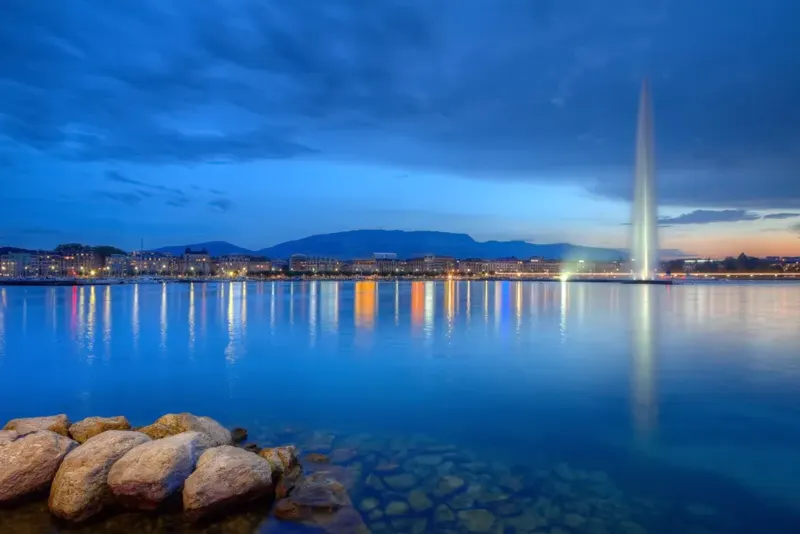
Geneva sits at the western tip of its crescent lake, where the Rhone flows out toward France and, on a clear day, Mont Blanc rises white to the south. French-speaking and intensely international, this small, wealthy city is a seat of world diplomacy, home to the United Nations in Europe and the Red Cross. Its emblem is the Jet d'Eau, a plume of water flung high above the harbour. Poised, cosmopolitan and framed by water and mountains, Geneva feels like a capital in miniature.
Geneva is a quieter alternative. It's ready to explore in the Nuvoha app: set your budget and see complete Geneva trips.
Why visit Geneva
Geneva punches far above its size. The lakefront is the great set piece, with the soaring Jet d'Eau, the Flower Clock and paddle steamers setting off across the water toward Lausanne and the vineyards of Lavaux. Above it climbs the largest old town in Switzerland, crowned by St. Pierre Cathedral, where a young Calvin once preached. On the far bank spreads the international quarter, where the United Nations, the Red Cross museum and dozens of world bodies can be toured. Watchmaking is a local art, celebrated at the Patek Philippe Museum, and the particle physics of CERN lies just outside town. With Mont Blanc and the Alps so close, Geneva is a springboard as much as a city.
The essential sights
- Jet d'Eau: Geneva's emblem, a jet of lake water thrown some 140 metres into the air off the harbour pier, visible across the whole city.
- Lake Geneva and the lakefront: The wide crescent lake at the city's heart, with promenades, the Flower Clock in the Jardin Anglais and paddle steamers to lakeside towns.
- Old Town and St. Pierre Cathedral: Switzerland's largest old town, a hilltop of cobbled lanes and antique shops around the cathedral where Calvin preached, whose tower can be climbed.
- Palais des Nations: The European headquarters of the United Nations, set in a lakeside park and open for guided tours; the Broken Chair sculpture stands opposite.
- Patek Philippe Museum: A refined museum tracing five centuries of watch and enamel craft, a fitting monument to Geneva's watchmaking tradition.
- CERN: The world's largest particle-physics laboratory, on the edge of town, whose free Science Gateway centre explains the work of the Large Hadron Collider.
Around the city's quarters
- Vieille Ville (Old Town): The historic hilltop core around St. Pierre Cathedral and Place du Bourg-de-Four, full of antique dealers, galleries and quiet fountains.
- Paquis: A dense, cosmopolitan quarter between the station and the lake, known for its lakeside baths, inexpensive kitchens from around the world and lively nightlife.
- Eaux-Vives: A smart residential district along the eastern shore, with the Parc La Grange, lakeside gardens and a newer public beach.
- Plainpalais: A studenty, bohemian area around a large open square that hosts a famous flea market, the university and a contemporary art museum.
- Les Nations (International Quarter): The district of the United Nations, embassies and international bodies north of the lake, with the Ariana ceramics museum and Botanical Gardens.
- Carouge: A distinctive quarter across the Arve, built by the kingdom of Sardinia in an Italianate style, now full of artisans, boutiques and pavement cafes.
At the Geneva table
Geneva's kitchen leans French with a Swiss accent. The lake supplies the classic dish, filets de perche, small perch fillets fried in butter and served with lemon, alongside other freshwater fish. Cheese is central in the cooler months, whether melted for fondue or scraped as raclette. Local specialities include the cumin-scented longeole sausage and, in the festive Escalade season, cardoon gratin and deep-fried malakoff cheese fritters from the surrounding countryside. Swiss chocolate and pastries are taken seriously, and crisp white wines come from the vineyards right at the city's edge.
- Filets de perche
- Cheese fondue
- Raclette
- Longeole
- Malakoff
- Cardon gratin
What Geneva feels like
Geneva feels less like a Swiss city than a small world capital. Flags line the avenues, motorcades slip between conference halls, and a large expatriate community lends the streets an international, multilingual air layered over the local French. It is discreet and formal, a place of private banks and luxury watch houses where wealth is worn quietly, and daily life is calmer and more buttoned-up than in livelier Zurich. The lake governs the mood, from morning swims off the Bains des Paquis to evening promenades with Mont Blanc glowing pink at sunset. Sundays are hushed, cafe terraces genteel, and the pace measured. For all its global weight, Geneva stays compact, poised and easy to cross on foot.
Getting around Geneva
Geneva is compact and walkable, with a tidy public network on top. Trams, buses and trolleybuses run by the TPG cover the city, and yellow water taxis called Mouettes shuttle across the harbour. Hotels and hostels give guests a free Geneva Transport Card covering local journeys, and the regional Leman Express rail links the suburbs and nearby France. The centre is easily crossed on foot, and much of the lakefront is a pleasure to walk. Geneva Airport (GVA) sits only about four kilometres from the centre, on the French border. A train reaches the main Cornavin station in roughly seven minutes, and arriving passengers can pick up a free public-transport ticket from a machine in the baggage hall. Taxis and buses are on hand too.
Practical pointers
- French is the language; open with a warm Bonjour and Madame or Monsieur, and a few words of French are appreciated.
- Switzerland uses the Swiss franc, though in border-hugging Geneva euros are more widely accepted than elsewhere.
- The city is formal and discreet; dress neatly and keep public behaviour restrained, especially near the many institutions.
- Service is included in bills, so tipping is modest, with locals rounding up rather than adding a set percentage.
- Pick up your free Geneva Transport Card at the airport or from your hotel to ride the trams, buses and boats at no cost.
- The Bains des Paquis on the lake offers swimming, a sauna and simple, well-priced meals with a view of the Jet d'Eau.
- Summer brings the clearest Mont Blanc views and lake life; pack a warm layer, as the Bise wind can chill the shore.
- Take a paddle steamer along the lake to Lausanne, Montreux or the Lavaux vineyards for a classic day out.
- Day trips to Chamonix and Mont Blanc, Annecy in France and the Alps are all within easy reach by train or road.
- The Escalade festival in December fills the old town with costumed processions and marks the city's great historical victory.
Best for
- City breaks
- Quieter travel
Key facts
| Country | Switzerland |
|---|---|
| Region | Europe |
| Airports | GVA |
| Trip length fit | Short-trip friendly |
Geneva essentials
| Currency | Swiss Franc (CHF) |
|---|---|
| Language | German, French, Italian and Romansh are all official; the language shifts by region, and English is widely spoken |
| Time zone | Central European Time (UTC+1, UTC+2 in summer) |
| Emergency number | 112 (general emergency); 1414 for Rega mountain air rescue |
| Driving side | Right |
| Tap water | Safe to drink; public fountains often run with drinkable spring water |
Climate & seasons
| Month | Typical range | Season |
|---|---|---|
| January | -1°C to 6°C | Cold winter |
| April | 6°C to 16°C | Mild spring |
| July | 15°C to 27°C | Warm summer |
| October | 8°C to 16°C | Cool autumn |
Typical stay
- Weekend-friendly
- Short break (2–5 days)
Geneva works as a weekend break just as well as a longer stay.
Getting there
Geneva is served via GVA.
- GVA
Is it your kind of trip?
Ideal if…
- you like walkable city energy
- you like places before everyone else finds them
Maybe not if…
- a beach-first holiday is the priority
Pairs well with
Compare with
More in Europe
Near Geneva
Travel style
- Short-trip friendly
- City
Frequently asked questions
Which airports serve Geneva?
Geneva is served via GVA.
Is Geneva good for a weekend trip?
Yes, Geneva works for a weekend as well as a longer stay.
What kind of trip is Geneva best for?
Geneva is best for city trips.
Which destinations pair well with Geneva?
Within multi-city range: Milan (214 km), Zurich (230 km), Paris (408 km).
How many days do you need in Geneva?
One to two days covers the lakefront, the old town and the international quarter at a relaxed pace. Geneva's real value is as a base, so many visitors add day trips to Chamonix, Lausanne or the Lavaux vineyards.
Is Geneva or Zurich better to visit?
Geneva is French-speaking, more international and formal, and better placed for Mont Blanc and the western lake. Zurich is German-speaking, larger and livelier after dark. Your language, interests and onward route usually decide it.
What language do they speak in Geneva?
French is the everyday language, reflecting the city's location in western Switzerland. Because of the huge international community, English is very widely spoken, and many residents move easily between several languages.
When is the best time to visit Geneva?
Late spring to early autumn brings warm days, lake swimming and the clearest views of Mont Blanc. Winter is cooler and quieter but pairs well with skiing in the nearby Alps and the December Escalade festival.