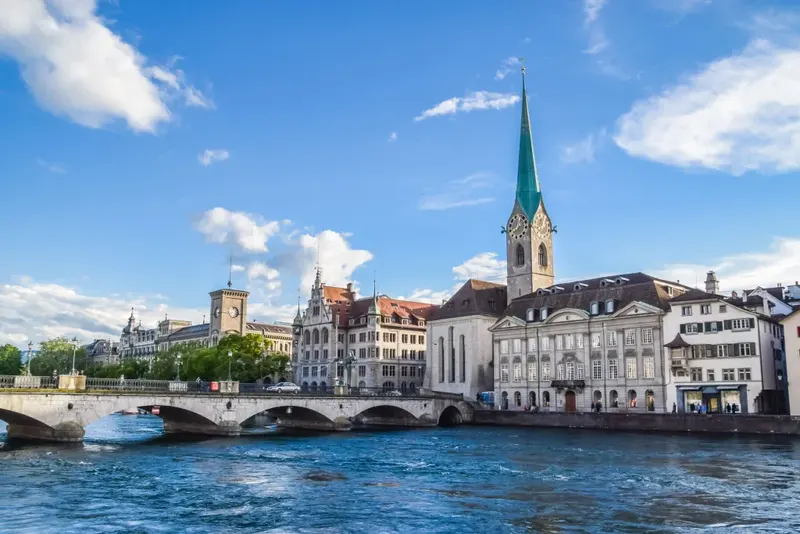
Zurich sits where its long, clear lake narrows into the river Limmat, framed by wooded hills and, on the horizon, the Alps. Switzerland's largest city is its financial capital, German-speaking and famously well-run, yet it is far livelier than that reputation suggests. A cobbled medieval old town, church towers, grand shopping streets and swimmable rivers give way after dark to one of the country's busiest bar and club scenes. Prosperous, spotless and easy to love.
Zurich is a quieter alternative. It's ready to explore in the Nuvoha app: set your budget and see complete Zurich trips.
Why visit Zurich
Zurich rewards visitors far more than its buttoned-up image implies. The medieval Altstadt straddles the Limmat, with the twin-towered Grossmunster and the Fraumunster, whose windows were designed by Marc Chagall, facing each other across the water. The Bahnhofstrasse runs from the station to the lake as one of Europe's grand shopping avenues, while the Kunsthaus holds a serious art collection. In summer the city takes to the water, swimming in lake and river from wooden bathing houses, and the hill of Uetliberg gives a sweeping Alpine panorama. Add a reinvented industrial west full of bars and clubs, and precise trains to the mountains, and Zurich is both refined and surprisingly playful.
Sights to plan around
- Grossmunster: The twin-towered Romanesque church where Huldrych Zwingli launched the Swiss Reformation; one tower can be climbed for a fine view over the rooftops.
- Fraumunster: A slender-spired church across the Limmat, celebrated for the five stained-glass windows designed by Marc Chagall in the 1970s.
- Lake Zurich: The long glacial lake reaching south from the city, ringed by promenades and lidos and plied by boats, with the Alps beyond on clear days.
- Bahnhofstrasse: One of Europe's grandest shopping avenues, running from the main station down to the lake, lined with watch and luxury houses.
- Old Town and Lindenhof: A maze of medieval lanes and guildhalls on both banks of the Limmat, crowned by the quiet hilltop terrace of Lindenhof.
- Uetliberg: The forested mountain on the city's edge, reached by train, with a lookout tower and a ridge walk giving panoramas of city, lake and Alps.
The city, district by district
- Altstadt (Old Town): The medieval core on both sides of the Limmat, split between the lanes of Niederdorf on the east bank and the Lindenhof quarter to the west.
- Zurich-West (Kreis 5): A former industrial district north-west of the centre, now the city's nightlife and design hub, with clubs under railway arches and the Prime Tower.
- Seefeld: A chic district along the eastern lakeshore, with lakeside bathing at Utoquai, smart cafes and easy access to the opera house.
- Enge and Wollishofen: Genteel, leafy neighbourhoods on the western shore of the lake, with parkland, villas and the Rieterpark museum grounds.
- Langstrasse (Kreis 4): The city's most multicultural and after-dark quarter, a lively strip of bars, kitchens and a small red-light district behind the station.
- Oberstrass and university hill: The slopes above the centre, home to the university, the federal institute of technology and terraces looking out over the old town.
At the Zurich table
Zurich's signature dish is Zurcher Geschnetzeltes, strips of veal in a creamy white-wine and mushroom sauce, served with a golden cake of fried grated potato called Rosti. Cheese comes into its own in the colder months, melted for fondue or scraped from the wheel as raclette. Breakfast tables show off Bircher muesli, the soaked-oat dish invented here by a Zurich doctor, and the city's confectioners are famous for delicate almond Luxemburgerli. Swiss chocolate is everywhere, and local white wines from the lake's slopes round out the table.
- Zurcher Geschnetzeltes
- Rosti
- Cheese fondue
- Raclette
- Bircher muesli
- Luxemburgerli
What Zurich feels like
Zurich runs like its famous trains: on time, spotless and quietly efficient. The wealth of a global banking centre shows in the discreet luxury of the Bahnhofstrasse and the calm of the lakeside promenades, yet the city keeps a youthful, unbuttoned side that outsiders rarely expect. Come summer, office workers swim in the Limmat on their lunch break and the lidos fill until late, while the old industrial west, Zurich-West, has become a district of clubs, street food and rooftop bars. German gives the city its order, but there is real pleasure here, drunk clear from one of more than a thousand public fountains. Reserved by day, it lets its hair down after dark.
Moving around Zurich
Zurich is compact and superbly connected. Trams and buses run by the VBZ crisscross the city with Swiss punctuality, backed by S-Bahn trains and boats on the lake and river, all covered by the ZVV network on a single ticket. The centre is easily walked, and the little Polybahn funicular hauls you up to the university terrace. Everything runs precisely to timetable, so a printed or app schedule can be trusted to the minute. Zurich Airport (ZRH), at Kloten north of the city, is Switzerland's largest. Direct trains reach Zurich main station in around ten to fifteen minutes, running very frequently, and trams also serve the centre. It is among the most effortless airport transfers in Europe.
Useful to know
- Switzerland uses the Swiss franc, not the euro; euros are sometimes taken, but change is given in francs at a poor rate.
- The local greeting is the Swiss German Gruezi, expected on entering a shop or approaching a counter.
- Punctuality and quiet are prized, with Sundays and night hours kept free of noise, laundry and recycling runs.
- Service is included, so tipping is modest; locals simply round up the bill for good service.
- Zurich is an expensive city, but its tap water is superb and free to drink from more than a thousand public fountains.
- In summer, join locals swimming at the lake and river lidos, from the Frauenbad to the Oberer Letten on the Limmat.
- Ride the train up Uetliberg for the finest overview of city, lake and mountains on a clear day.
- A ZVV day pass covers trams, buses, trains and lake boats across the city zones.
- Trains run to the minute, so aim to be on the platform before, not at, departure time.
- The city makes an easy base for day trips to Lucerne, the Rhine Falls and the high Alps.
Best for
- City breaks
- Quieter travel
Key facts
| Country | Switzerland |
|---|---|
| Region | Europe |
| Airports | ZRH |
| Trip length fit | Short-trip friendly |
Zurich essentials
| Currency | Swiss Franc (CHF) |
|---|---|
| Language | German, French, Italian and Romansh are all official; the language shifts by region, and English is widely spoken |
| Time zone | Central European Time (UTC+1, UTC+2 in summer) |
| Emergency number | 112 (general emergency); 1414 for Rega mountain air rescue |
| Driving side | Right |
| Tap water | Safe to drink; public fountains often run with drinkable spring water |
Climate & seasons
| Month | Typical range | Season |
|---|---|---|
| January | -2°C to 5°C | Cold winter |
| April | 5°C to 15°C | Fresh spring |
| July | 15°C to 26°C | Warm summer |
| October | 7°C to 15°C | Cool autumn |
Typical stay
- Weekend-friendly
- Short break (2–5 days)
Zurich works as a weekend break just as well as a longer stay.
Getting there
Zurich is served via ZRH.
- ZRH
Is it your kind of trip?
Ideal if…
- you like walkable city energy
- you like places before everyone else finds them
Maybe not if…
- a beach-first holiday is the priority
Pairs well with
Compare with
More in Europe
Near Zurich
Travel style
- Short-trip friendly
- City
Frequently asked questions
Which airports serve Zurich?
Zurich is served via ZRH.
Is Zurich good for a weekend trip?
Yes, Zurich works for a weekend as well as a longer stay.
What kind of trip is Zurich best for?
Zurich is best for city trips.
Which destinations pair well with Zurich?
Within multi-city range: Milan (204 km), Geneva (230 km), Munich (261 km).
How many days do you need in Zurich?
Two days is enough for the old town, the lake and a museum or two. A third day leaves room for swimming in summer, a night out in Zurich-West, or a train trip to Lucerne, the Rhine Falls or the mountains.
Is Zurich expensive?
Zurich is consistently ranked among the world's costliest cities, so eating out and drinking add up. Many of its pleasures, though, are free or cheap: swimming in the lake, drinking from the fountains, walking the old town and riding up Uetliberg.
Does Zurich or Geneva make a better base?
Zurich is German-speaking, larger and livelier after dark, with quicker access to central and eastern Switzerland. Geneva is French-speaking, more international and better placed for the Mont Blanc region and the western lake. The choice follows your language and route.
What language is spoken in Zurich?
The everyday language is Swiss German, a spoken dialect, while written German is standard. English is very widely understood, especially in the centre, in business and in hospitality, so visitors rarely have difficulty.