
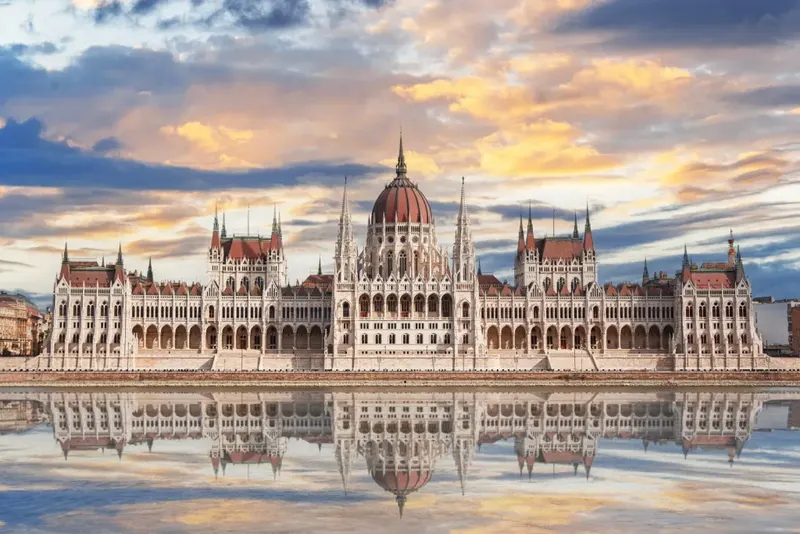
Hungarians speak a language unrelated to any of their neighbours', a reminder that their ancestors rode in from the east, and the country has felt a little singular ever since. Budapest straddles the Danube in two halves, hilly Buda and flat Pest, joined by grand bridges and floating on a bed of thermal springs that feed its famous bathhouses. Away from the capital, the Danube Bend curls past hillside towns and basilicas; Lake Balaton draws summer crowds to its beaches and wine slopes; and the Great Plain rolls east into big skies and horseman country. Hungarian cooking leans on paprika, from goulash to fish soup, and the north-east produces Tokaji, the golden dessert wine that once graced royal tables across Europe.
Budapest is the Hungary destination on Nuvoha today. Set your budget and Nuvoha builds the complete trip: flights and hotels together.
Why visit Hungary
- Cities you can explore on foot, from headline sights to quiet neighbourhoods
Best known for
- Budapest's thermal baths
- The Danube and its bridges
- Tokaji and Hungarian wine
- Paprika cooking and goulash
- Lake Balaton summers
Budapest and beyond
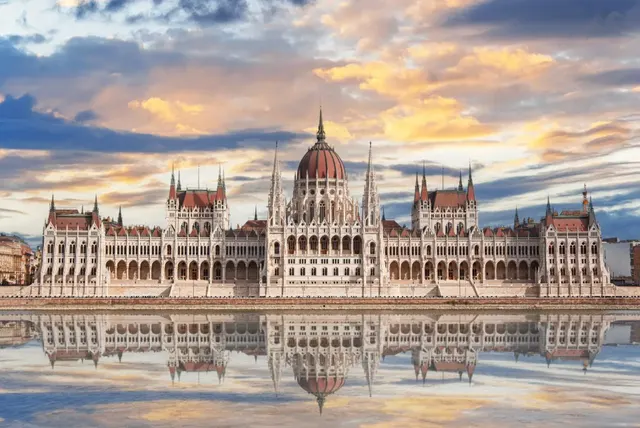
- Budapest: The capital astride the Danube: hilly Buda with its castle and the Fishermen's Bastion, flat Pest with the grand Parliament, all fed by thermal springs behind the Szechenyi and Gellert baths.
- The Danube Bend: North of Budapest the river swings through a wooded gorge past the artists' town of Szentendre, the hilltop ruins of Visegrad and the vast basilica of Esztergom.
- Lake Balaton: Central Europe's largest lake, with lively beach resorts on the south shore and the volcanic wine hills, lavender and the Tihany peninsula to the north.
- The northern hills: Baroque Eger and its Bull's Blood reds, the caves and forests of the Bukk, and the golden dessert wines of the Tokaj region, a UNESCO landscape.
- The Great Plain: The wide Puszta grassland east of the Danube, where the Hortobagy National Park keeps its horsemen and grey cattle, and Kecskemet and Szeged anchor the market towns.
- Pecs and the south: The mild, sun-warmed south-west, with the Roman and Ottoman heritage of Pecs and the bold red wines of Villany near the Croatian border.
Where to go
The practical part
| Currency | Hungarian Forint (HUF) |
|---|---|
| Language | Hungarian (Magyar); English and German are spoken in Budapest and tourist areas |
| Time zone | Central European Time (UTC+1, UTC+2 in summer) |
| Emergency number | 112 (general emergency) |
| Driving side | Right |
| Tap water | Safe to drink, including in Budapest |
Seasons at a glance in Budapest
| Month | Typical range | Season |
|---|---|---|
| January | -2°C to 4°C | Cold winter |
| April | 7°C to 18°C | Fresh spring |
| July | 17°C to 29°C | Warm summer |
| October | 8°C to 16°C | Cool autumn |
Seasons vary across Hungary. Each destination page has its own climate table.
More in Europe
More Europe country guides
Frequently asked questions
Which Hungary destinations can I book with Nuvoha?
Budapest, with complete flight and hotel trips built around your budget.
What kind of trips suit Hungary?
Hungary works for city breaks.
How do you get around Hungary?
Budapest is the hub, with trains and coaches radiating out to Lake Balaton, Eger, Pecs and beyond, plus direct summer services to the Balaton shore. The capital itself has one of the world's oldest metro lines, alongside trams and trolleybuses.
How do the thermal baths work?
Budapest's historic bathhouses, such as the Szechenyi and Gellert, are open to visitors as public baths. You buy an entry ticket, often with a locker or cabin, and bring or hire swimwear and a towel; the warm outdoor pools stay open even in winter.
Does Hungary use the euro?
No. Hungary is in the EU and the Schengen area but keeps its own currency, the forint. Cards are widely accepted in Budapest, though it helps to carry some forint for markets, small eateries and rural areas.
What plug type does Hungary use?
Types C and F, the round two-pin European sockets, at 230 volts. Visitors from the UK and North America need an adapter.