
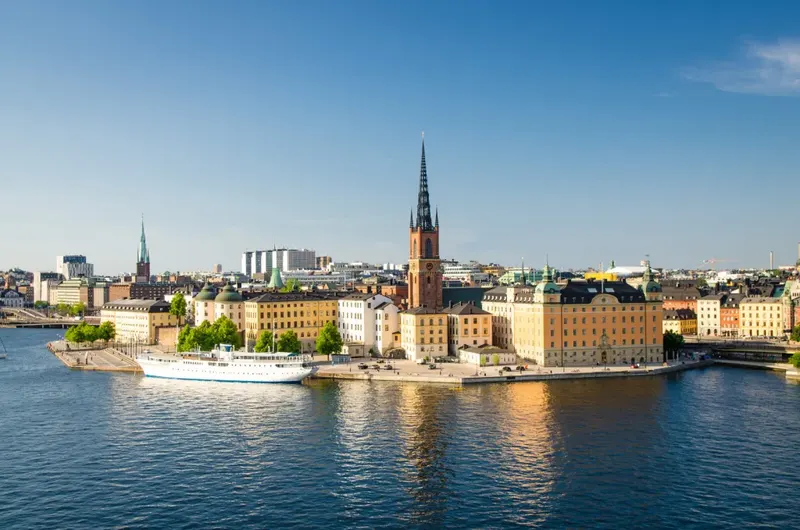
Stockholm floats. The Swedish capital is spread across fourteen islands where Lake Malaren meets the Baltic, its bridges and ferries stitching together a city that is a third water. At its centre sits Gamla Stan, one of Europe's best-preserved medieval old towns, all ochre facades and lantern-lit lanes. Beyond the quays the archipelago scatters into thousands of rocky, pine-clad islands. Clean, grand and unmistakably built on the sea.
Stockholm is a quieter alternative. It's ready to explore in the Nuvoha app: set your budget and see complete Stockholm trips.
Why visit Stockholm
Stockholm pairs a polished, spacious capital with wild nature on its doorstep. The medieval island of Gamla Stan holds the Royal Palace and a cathedral among its lanes, while grand Norrmalm and Ostermalm bring the shopping and food halls. The unmissable sight is the Vasa, a seventeenth-century warship raised almost whole from the harbour and now housed in its own museum, the most visited in the Nordic countries. The green island of Djurgarden gathers Skansen, the world's oldest open-air museum, and much more. Then there is the archipelago, thousands of islands reachable by ferry from the centre for a swim, a seafood lunch or a night in a red timber cottage.
Sights across the islands
- Gamla Stan: The medieval old-town island of narrow cobbled lanes, ochre houses and the main square of Stortorget, at the city's heart.
- Vasa Museum: A purpose-built hall on Djurgarden housing the Vasa, a royal warship that sank in 1628 and was raised almost intact in 1961.
- The Royal Palace: One of Europe's largest palaces, still the monarch's official residence, with state rooms, museums and a daily changing of the guard.
- Skansen: The world's first open-air museum, founded in 1891, gathering historic Nordic buildings and Scandinavian wildlife on Djurgarden.
- Stockholm City Hall: The red-brick waterfront landmark whose Blue Hall hosts the Nobel Prize banquet, with a tower open for climbing in summer.
- The archipelago: A scatter of thousands of islands off the city, from Fjaderholmarna minutes away to Sandhamn and Vaxholm further out, all served by ferry.
The islands and quarters
- Gamla Stan: The old town on its own island, medieval and compact, holding the Royal Palace, the cathedral and the Nobel Museum.
- Norrmalm: The modern downtown north of the water, with the central station, department stores and the shopping street of Drottninggatan.
- Ostermalm: The smart, moneyed quarter of grand apartments, designer boutiques and the historic Ostermalm food hall.
- Sodermalm: A hillier, artier island to the south, known for vintage shops, hilltop viewpoints, the Fotografiska gallery and a laid-back scene.
- Djurgarden: A green former royal hunting island given over to parkland and museums, among them the Vasa, Skansen and the Grona Lund funfair.
- Kungsholmen: A relaxed residential island west of the centre, ringed by a waterside walking path and home to the landmark City Hall.
The Swedish table and fika
Swedish cooking is seasonal, unfussy and rooted in the larder of forest and sea. Kottbullar, the small meatballs served with lingonberry, cream sauce and potato, are the comfort classic, while cured salmon and endless preparations of herring anchor the cold table, or smorgasbord, that Sweden gave the world. Toast Skagen heaps prawns in dill and mayonnaise on fried bread as a smart starter. No visit is complete without fika, the daily ritual of coffee with something sweet, most often a cardamom-scented cinnamon bun.
- Kottbullar
- Gravlax
- Toast Skagen
- Sill
- Kanelbulle
What Stockholm feels like
Stockholm carries itself with cool, understated poise. The scale is grander and airier than its Nordic neighbours: wide waterways, stately stone facades, clean lines and a lot of sky. There is money and design sense here, worn quietly, and a reserve that thaws over a fika, the sacred Swedish pause for coffee and a cinnamon bun. Life bends towards the water and the light, dramatically so, with dark, candlelit winters giving way to summers when the sun barely sets and the whole city decamps to the islands. It can feel a touch formal and buttoned-up, yet it is calm, green and effortlessly civilised, a capital that never seems to raise its voice.
Getting around by rail and boat
Stockholm's islands are linked by an efficient, spotless network run by SL, paid with a travel card or contactless. The tunnelbana metro is worth riding for itself, its stations blasted from bedrock and painted into what is often called the world's longest art gallery, and it is backed by commuter trains, trams and buses. Ferries and commuter boats add a scenic layer, crossing to Djurgarden and out into the archipelago. The central islands are compact and walkable, though the hills of Sodermalm reward good shoes. Stockholm Arlanda (ARN) lies about forty kilometres north of the city. The fastest link is the Arlanda Express, a dedicated train reaching the central station in around twenty minutes, with airport coaches and slower commuter trains as alternatives. Some flights use the smaller Bromma airport, closer to town, while Skavsta and Vasteras, sometimes marketed as Stockholm, lie much further out.
Know before you go
- Swedes value personal space and calm; keep your voice low on public transport and avoid pushing into queues.
- Take your shoes off when entering a Swedish home, unless your host says otherwise.
- Tipping is not expected, as service is included, though rounding up for good restaurant service is welcome.
- Embrace fika: pausing for coffee and a bun is a social institution, and turning down the invitation can seem standoffish.
- Summer brings long, luminous days ideal for the archipelago; winter is dark and cold but crisp and beautiful, often with snow.
- Ride the tunnelbana between the art stations, such as T-Centralen, Kungstradgarden and Solna centrum, as a sightseeing trip in itself.
- Book an archipelago boat trip a day or two ahead in summer, when sailings and island lunches fill up.
- The city is largely cashless; a contactless card or phone covers transport, cafes and museums.
- Many museums sit together on Djurgarden, an easy walk, tram or ferry from the centre, so group them into one day.
- Tap water is clean and cold straight from the tap, so refill rather than buy bottles.
Best for
- City breaks
- Quieter travel
Key facts
| Country | Sweden |
|---|---|
| Region | Europe |
| Airports | ARN |
| Trip length fit | Short-trip friendly |
Stockholm essentials
| Currency | Swedish Krona (SEK) |
|---|---|
| Language | Swedish; English is very widely spoken, and Sami languages are recognised in the north |
| Time zone | Central European Time (UTC+1, UTC+2 in summer) |
| Emergency number | 112 (all emergencies) |
| Driving side | Right |
| Tap water | Safe to drink straight from the tap nationwide |
Climate & seasons
| Month | Typical range | Season |
|---|---|---|
| January | -5°C to 1°C | Cold dark winter |
| April | 1°C to 10°C | Fresh spring |
| July | 13°C to 23°C | Mild bright summer |
| October | 5°C to 11°C | Cool autumn |
Typical stay
- Weekend-friendly
- Short break (2–5 days)
Stockholm works as a weekend break just as well as a longer stay.
Getting there
Stockholm is served via Arlanda (ARN).
- Arlanda (ARN)
Is it your kind of trip?
Ideal if…
- you like walkable city energy
- you like places before everyone else finds them
Maybe not if…
- a beach-first holiday is the priority
Pairs well with
Compare with
| Stockholm | Oslo | Copenhagen | |
|---|---|---|---|
| Country | Sweden | Norway | Denmark |
| Region | Europe | Europe | Europe |
| Styles | City | City | City |
| Trip length fit | Weekend-friendly | Weekend-friendly | Weekend-friendly |
| Airports | 2 | 1 | 1 |
More in Europe
Near Stockholm
Travel style
- Short-trip friendly
- City
Frequently asked questions
Which airports serve Stockholm?
Stockholm is served via Arlanda (ARN). Arlanda (ARN).
Is Stockholm good for a weekend trip?
Yes, Stockholm works for a weekend as well as a longer stay.
What kind of trip is Stockholm best for?
Stockholm is best for city trips.
Which destinations pair well with Stockholm?
Within multi-city range: Oslo (402 km), Copenhagen (524 km), Berlin (825 km).
How many days do you need in Stockholm?
Three days covers Gamla Stan, the Djurgarden museums including the Vasa, and a wander through Sodermalm and Ostermalm. Add a fourth for a boat trip into the archipelago or out to the palace at Drottningholm, both of which show a different side of the city.
Is the Stockholm archipelago worth visiting?
Very much so, and it is easy to reach. Ferries leave from the centre for islands ranging from Fjaderholmarna, just minutes away, to Vaxholm, Grinda and Sandhamn further out. Even a half-day trip gives you swimming spots, seafood and the classic red-cottage scenery.
Is Stockholm a walkable city?
The central islands are compact and pleasant on foot, linked by short bridges, though Sodermalm is hilly. For longer hops the metro, trams, buses and ferries are fast and reliable, and one travel card or contactless payment covers them all.
When is the best time to visit Stockholm?
Summer is the high point, with long daylight, warm-ish water and the archipelago in full swing. Late spring and early autumn are quieter and still bright. Winter is dark and cold but atmospheric, with snow, candlelight and Christmas markets in Gamla Stan.