
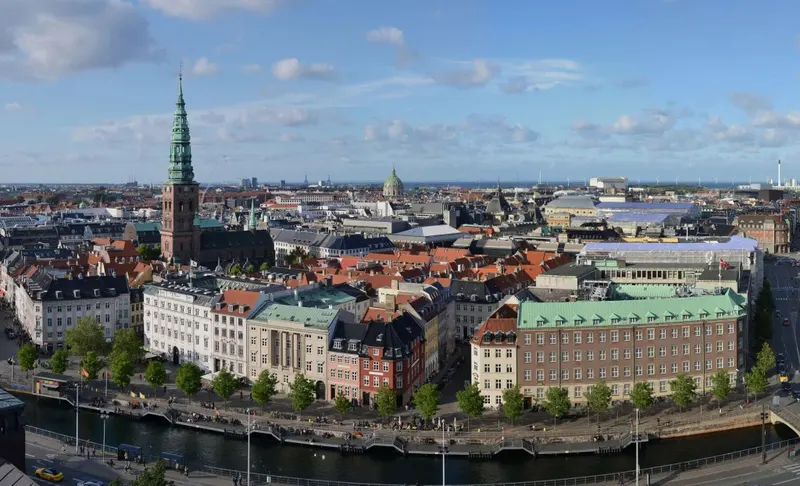
Copenhagen glides by on two wheels. Bikes outnumber cars on its bridges and boulevards, streaming past the coloured gables of Nyhavn, the spires of the old town and clean-lined new architecture along the harbour. This is the home of hygge, that untranslatable Danish knack for cosiness, and of a design sensibility that runs from the chair you sit in to the bridge you cross. Compact, calm and green, it rewards a slow pace.
Copenhagen is a quieter alternative. It's ready to explore in the Nuvoha app: set your budget and see complete Copenhagen trips.
Why visit Copenhagen
Copenhagen is a masterclass in liveable city-making, and a joy to potter around. Rent a bike and you travel like a local, over harbour bridges to the food halls, design museums and swimmable canals that define the place. The set pieces are gentle rather than grand: the painted merchant houses of Nyhavn, the fairground lights of Tivoli, the palaces of Amalienborg and the spiral spire of Our Saviour, all within an easy ride. It is also a great eating city, birthplace of the New Nordic movement and still crowded with imaginative kitchens and open-sandwich lunch spots. Above all it does atmosphere, wrapping long dark winters in candlelight and hygge.
Sights worth the ride
- Nyhavn: The seventeenth-century canal lined with brightly painted merchant houses and old wooden boats, once home to Hans Christian Andersen.
- Tivoli Gardens: The 1843 pleasure garden by the central station, part amusement park and part fairy-lit promenade, at its best after dusk.
- Amalienborg Palace: The royal family's winter home, four rococo mansions around an octagonal square, with a daily changing of the guard at noon.
- Rosenborg Castle: A Renaissance royal castle set in the King's Garden, its basement guarding the Danish crown jewels.
- Church of Our Saviour: A baroque church in Christianshavn whose golden spire is climbed by an external spiral staircase to a giddy harbour view.
- Freetown Christiania: A self-governing community on a former military site, part commune and part alternative quarter, walked with respect for local rules.
Neighbourhoods to explore
- Indre By: The old town at the core, threaded by the Stroget shopping street and holding Nyhavn, the Round Tower and the royal palaces.
- Christianshavn: A canal quarter of houseboats and cafes across the harbour, home to the spiral-spired Church of Our Saviour and Freetown Christiania.
- Vesterbro: A formerly rough district turned fashionable, centred on the old Meatpacking District and the bars of Istedgade.
- Norrebro: The city's most multicultural and youthful quarter, packed with independent shops on Jaegersborggade and the leafy Assistens Cemetery.
- Osterbro: A calm, prosperous residential area of wide streets and the sprawling Faelledparken, the city's largest park.
- Frederiksberg: A genteel enclave of grand avenues, gardens and the zoo, technically its own municipality set within the city.
New Nordic and old classics
Copenhagen turned New Nordic cooking into a global movement, and its restaurants remain some of the most inventive anywhere, big on foraging, fermentation and the produce of sea and forest. The everyday classic, though, is smorrebrod: dense rye bread piled with herring, prawns, roast pork or egg and eaten at lunch. Comfort food runs to frikadeller, pan-fried pork meatballs, and stegt flaesk, crisp pork belly with parsley sauce that many call the national dish. Bakeries turn out the buttery pastry the world knows simply as Danish, and street-food halls gather the lot under one roof.
- Smorrebrod
- Stegt flaesk
- Frikadeller
- Sild
- Wienerbrod
What Copenhagen feels like
Copenhagen feels calm, orderly and quietly content. Cyclists flow in unhurried streams, strangers give each other space, and even the rush hour has a certain hush. The Danish art of hygge shapes daily life: candles flicker in cafe windows by mid-afternoon, blankets appear on terrace chairs, and long winter evenings are spent cosy and indoors with good company. Summers flip the mood outward, with people swimming in the clean harbour, picnicking in the parks and lingering over waterside beers until late in the long northern light. It is understated and egalitarian, a place that prizes comfort, good design and balance over show. Not flashy, simply pleasant to be in.
Getting around by bike and metro
Copenhagen is made for bikes, and hiring one is the quickest way to feel at home; the cycle lanes are wide, flat and treated as proper roads. On foot the centre is small and level too. When you need it, a driverless metro runs around the clock, backed by S-tog suburban trains, buses and yellow harbour ferries that count as public transport. A Rejsekort card or contactless payment covers everything, and the same network reaches the airport and crosses the bridge to Sweden. Copenhagen Airport (CPH), at Kastrup on the island of Amager, sits only about eight kilometres from the centre. The M2 metro line runs from the terminal to Kongens Nytorv in around fifteen minutes, and mainline trains reach the central station almost as fast, continuing over the Oresund bridge to Sweden.
Before you arrive
- Never walk or stand in the cycle lane: it is a fast-moving road, and stepping into it unannounced is a real hazard and a clear faux pas.
- Danes value modesty and understatement; loud displays and bragging tend to fall flat.
- Tipping is not expected, as service is included by law, though rounding up for a good meal is appreciated.
- Punctuality matters, and pedestrian signals are respected even on an empty street; wait for the green man.
- Hire a bike or use a city-bike scheme to see Copenhagen as locals do, but learn the hand signals and lane rules first.
- Summer brings long, bright evenings and harbour swimming; winter is dark and cold but full of candlelit hygge and Christmas markets.
- Tap water is excellent and free everywhere, so carry a refillable bottle.
- Many restaurants, especially the sought-after ones, need booking well ahead; lunchtime smorrebrod is an easier walk-in.
- A harbour bus, on the yellow boats, is a scenic way to see the waterfront on an ordinary transport ticket.
- Card and phone payment is near-universal; many places are effectively cashless, so you rarely need cash at all.
Best for
- City breaks
- Quieter travel
Key facts
| Country | Denmark |
|---|---|
| Region | Europe |
| Airports | CPH |
| Trip length fit | Short-trip friendly |
Copenhagen essentials
| Currency | Danish Krone (DKK) |
|---|---|
| Language | Danish; English is very widely spoken, especially in the cities |
| Time zone | Central European Time (UTC+1, UTC+2 in summer) |
| Emergency number | 112 (all emergencies) |
| Driving side | Right |
| Tap water | Safe to drink; among the cleanest tap water in the world |
Climate & seasons
| Month | Typical range | Season |
|---|---|---|
| January | -1°C to 4°C | Cold winter |
| April | 4°C to 12°C | Cool spring |
| July | 14°C to 22°C | Mild summer |
| October | 8°C to 13°C | Windy autumn |
Typical stay
- Weekend-friendly
- Short break (2–5 days)
Copenhagen works as a weekend break just as well as a longer stay.
Getting there
Copenhagen is served via CPH.
- CPH
Is it your kind of trip?
Ideal if…
- you like walkable city energy
- you like places before everyone else finds them
Maybe not if…
- a beach-first holiday is the priority
Pairs well with
Compare with
More in Europe
Near Copenhagen
Travel style
- Short-trip friendly
- City
Frequently asked questions
Which airports serve Copenhagen?
Copenhagen is served via CPH.
Is Copenhagen good for a weekend trip?
Yes, Copenhagen works for a weekend as well as a longer stay.
What kind of trip is Copenhagen best for?
Copenhagen is best for city trips.
Which destinations pair well with Copenhagen?
Within multi-city range: Berlin (366 km), Oslo (517 km), Stockholm (524 km).
How many days do you need in Copenhagen?
Two to three days suits the compact centre, covering Nyhavn, Tivoli, the palaces and a couple of neighbourhoods by bike. A third or fourth day leaves room for Christiania, the design museums, a harbour swim in summer or a short trip across to Malmo in Sweden.
Is Copenhagen a cycling city?
Thoroughly. Bikes outnumber cars, the flat centre is laced with wide dedicated lanes, and hiring one is the fastest and most local way to get about. Just follow the lane discipline and hand signals, as Danish cyclists take the rules seriously.
What is hygge?
Hygge is the Danish idea of cosy contentment: candlelight, warm drinks, soft blankets and unhurried time with people you like. It is less a thing to buy than a mood to create, and it explains a lot about how Copenhageners get through the long, dark winters.
When is the best time to visit Copenhagen?
Late spring through summer brings long daylight, outdoor swimming and life spilling into the streets and parks. Winter is short on daylight and cold, but the city answers with candlelit cafes, hygge and Christmas markets, Tivoli among them.