
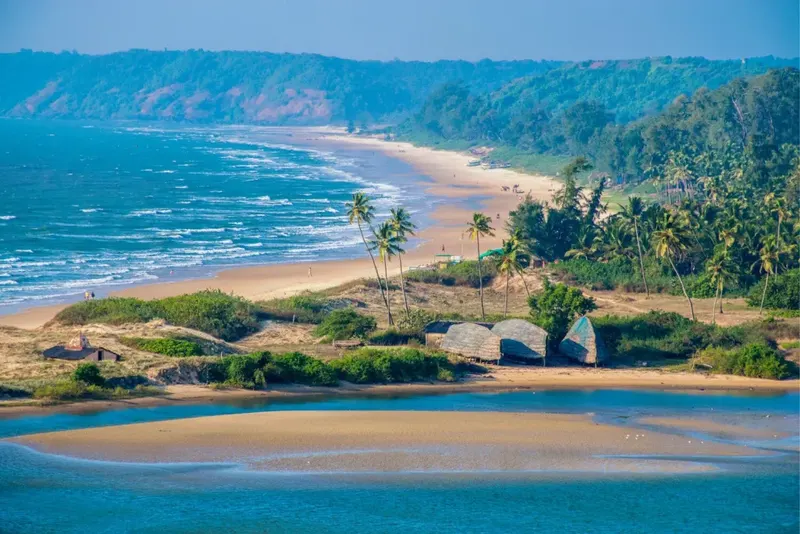
Goa is India in a different key: slower, greener, tilted towards the sea. Whitewashed churches and Hindu temples stand among paddy fields and coconut groves; the old Portuguese quarters wear ochre, indigo and terracotta; and the Konkan coast unspools in a long ribbon of sand from the busy north to the quiet south. For four and a half centuries this was Portuguese territory, and that history still flavours the food, the architecture and the unhurried local temper the Goans call sossegado.
Goa is made for unwinding. It's ready to explore in the Nuvoha app: set your budget and see complete Goa trips.
Why visit Goa
Goa offers beaches for every mood alongside a genuine cultural inheritance. The north, around Calangute, Baga, Anjuna and Vagator, is lively, with markets, water sports and nightlife; the south, from Colva to Agonda and Palolem, is wider, calmer and greener. Inland lie the Baroque churches of Old Goa, the coloured lanes of Fontainhas, spice plantations and the Dudhsagar falls in the Western Ghats. The food, built on coconut, chillies, vinegar and the daily catch, is unlike anywhere else in India. The trade-offs: the popular northern beaches can feel crowded at peak times, and in the monsoon many shacks close and the sea turns rough.
What Goa feels like
Life here runs on a longer rhythm. Mornings smell of the sea and of fish frying in coconut oil; afternoons stretch out under palm shade; and evenings belong to the beach shacks, where the light turns amber and the tide creeps in. Church bells and temple drums share the same soundtrack, and Konkani, Portuguese loan-words and English mingle in the markets. The red laterite earth, the whitewashed chapels at bends in the road, the old villas with their oyster-shell windows: it all feels a world away from the mainland's intensity. This is a place that quietly resists hurry.
Sights to plan around
- Basilica of Bom Jesus: A Baroque church in Old Goa, completed in 1605 and a UNESCO World Heritage Site, holding the revered remains of Saint Francis Xavier.
- Se Cathedral: One of the largest churches in Asia, a grand Portuguese cathedral in Old Goa famous for its surviving Golden Bell.
- Fontainhas: The Latin Quarter of Panaji, a maze of narrow lanes lined with colour-washed Portuguese-era houses, chapels and tiled street signs.
- Fort Aguada: A seventeenth-century Portuguese fort and freshwater spring above the mouth of the Mandovi, crowned by a nineteenth-century lighthouse.
- Anjuna: A rocky-fringed beach in the north, long associated with Goa's counterculture and its busy Wednesday flea market.
- Palolem: A crescent of calm, palm-backed sand in the far south, one of the state's most sheltered swimming beaches.
North, south and inland
- Panaji (Panjim): The riverside state capital on the Mandovi, home to the Fontainhas quarter and the whitewashed Church of Our Lady of the Immaculate Conception.
- Old Goa (Velha Goa): The former colonial capital a few kilometres upriver, now a cluster of monumental churches and cathedrals set among lawns.
- North Goa: The busier coast of Candolim, Calangute, Baga, Anjuna and Vagator, with markets, water sports and nightlife, and quieter sands at Morjim and Ashwem.
- South Goa: The calmer, greener stretch of Colva, Benaulim, Agonda and Palolem, with wider and emptier beaches.
- Margao (Madgaon): South Goa's commercial centre and main railway junction, with a lively covered market and old Portuguese mansions.
- The hinterland: Inland around Ponda lie Hindu temples and the spice plantations of the Western Ghats foothills.
The Goan table
Goan cooking is a coastal fusion found nowhere else in India, built on the daily catch, coconut, kokum, vinegar and chillies, and seasoned by four centuries of Portuguese contact. Fish curry with rice is the everyday staple; special occasions bring pork vindaloo and sorpotel, prawn balchao, green-spiced chicken cafreal and the coconut-rich xacuti. The Catholic kitchen loves the pig, while the Hindu Saraswat one leans vegetarian and subtle. Puddings mean the layered bebinca, and the local spirit is feni, distilled from cashew or coconut.
- Goan fish curry rice
- Prawn balchao
- Pork vindaloo
- Chicken cafreal
- Xacuti
- Bebinca
Getting from A to B
Goa is spread out and has no metro, so most visitors get around on two wheels or four. Rented scooters are the classic choice, though they call for a valid licence, a helmet and some nerve on sandy roads. Taxis and app-based cars cover longer trips, and local buses link the main towns slowly. The drive between the northern and southern beaches takes a while, so it pays to base yourself near the coast you prefer. Goa has two airports: Dabolim, in the centre-south near Vasco da Gama, and the newer Manohar International Airport at Mopa in the north. Prepaid taxis serve both, so choose the one closer to your stretch of coast.
Practical pointers
- Cover your shoulders and knees inside churches and temples, and remember these are working places of worship, not tourist props.
- Public nudity is illegal on Goa's beaches, and it is polite to ask before photographing local people or fishing crews.
- Save beachwear for the sand, and cover up for towns, markets, churches and restaurants.
- Alcohol is relaxed and legal here, but drink in moderation, especially before swimming or riding a scooter.
- November to February is the dry, temperate peak; the monsoon from June to September brings rough seas and closes many beach shacks.
- North Goa is livelier and more built-up, while the south is quieter and greener.
- Beach shacks are seasonal, taken down before the monsoon and rebuilt each autumn.
- Heed the lifeguards and their flags; currents can be strong, especially early and late in the season.
- Drink sealed bottled or filtered water rather than tap.
Best for
- Beach time
- Unwinding
Key facts
| Country | India |
|---|---|
| Region | Asia |
| Airports | GOI |
| Trip length fit | Short-trip friendly |
Goa essentials
| Currency | Indian rupee (INR) |
|---|---|
| Language | Hindi and English are the union-level official languages, alongside twenty-two scheduled languages and hundreds of others; English is widely used in cities, business and tourism. |
| Time zone | IST (UTC+5:30), a single time zone across the whole country |
| Emergency number | 112 |
| Driving side | Left |
| Tap water | Not reliably safe to drink; choose sealed bottled water, or water that has been filtered or boiled. |
Climate & seasons
| Month | Typical range | Season |
|---|---|---|
| January | 21°C to 32°C | Sunny dry season |
| April | 26°C to 34°C | Hot pre-monsoon |
| July | 24°C to 29°C | Monsoon season |
| October | 24°C to 32°C | Lush late monsoon |
Goa is one of Nuvoha's winter-sun picks.
Typical stay
- Weekend-friendly
- Short break (2–5 days)
Goa works as a weekend break just as well as a longer stay.
Getting there
Goa is served via GOI.
- GOI
Is it your kind of trip?
Ideal if…
- time on the coast is the point of the trip
- you want to slow down and reset
Maybe not if…
- you want big-city energy around the clock
Pairs well with
Compare with
More in Asia
Near Goa
Travel style
- Winter sun
- Short-trip friendly
- Beach
Frequently asked questions
Which airports serve Goa?
Goa is served via GOI.
Is Goa good for a weekend trip?
Yes, Goa works for a weekend as well as a longer stay.
What kind of trip is Goa best for?
Goa is best for beach trips, popular for unwinding.
Which destinations pair well with Goa?
Within multi-city range: Pune (356 km), Mumbai (425 km), Bengaluru (483 km).
Should I choose North or South Goa?
North Goa is livelier, with markets, water sports, restaurants and nightlife along busier beaches. South Goa is quieter and greener, with wider, emptier sands and a slower feel. Many visitors sample both, since the state is small.
When is the best time to visit Goa?
November to February is the dry, temperate peak. The monsoon, roughly June to September, is lush but wet, with many beach shacks closed and rough seas. March to May turns hot and humid.
Do I need to hire a vehicle in Goa?
It helps. Goa is spread out and public transport is limited, so most people rent a scooter or hire taxis and app-based cars. Riding a two-wheeler requires a valid licence and a helmet, and roads can be uneven.
Which airport should I use for Goa?
Goa has two: Dabolim, in the centre-south near Vasco da Gama, and the newer Manohar International Airport at Mopa in the north. Choose whichever is closer to where you are staying, as they sit at opposite ends of the state.