
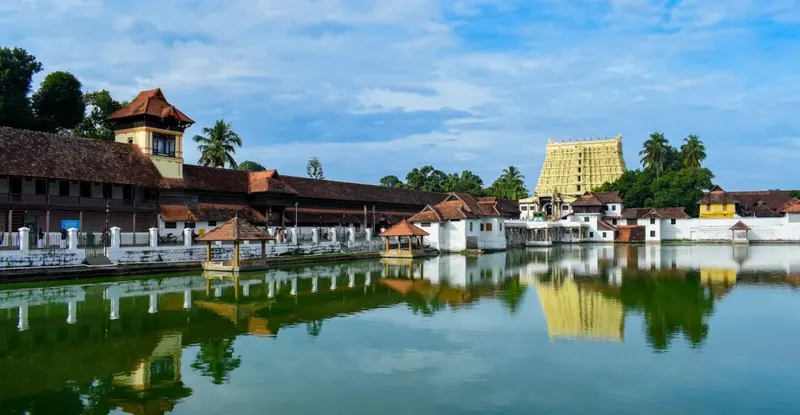
Thiruvananthapuram, still widely known as Trivandrum, is the seaside capital of Kerala, spread over low green hills where the coconut palms run down to the Arabian Sea. It takes its name and its soul from the great Padmanabhaswamy Temple, whose gopuram towers over the old fort quarter. Beyond the busy centre lie the beaches of Kovalam and Varkala, quiet backwaters and the forests of the Western Ghats, making the city both a capital and a gateway to Kerala's tropical south.
Thiruvananthapuram is a quieter alternative. It's ready to explore in the Nuvoha app: set your budget and see complete Thiruvananthapuram trips.
Why visit Thiruvananthapuram
Thiruvananthapuram blends temple-town devotion, colonial-era grandeur and easy access to the coast. At its heart stands the Padmanabhaswamy Temple, an extraordinary Dravidian shrine to a reclining Vishnu, ringed by the lanes of Fort. The city also keeps the legacy of the Travancore royals in the Napier Museum, the Kuthiramalika palace and the art of Raja Ravi Varma. A short drive south brings the lighthouse beach and coves of Kovalam, while Varkala's dramatic red cliffs lie to the north. Inland rise the tea hills of Ponmudi and the wildlife of the Ghats, and the backwaters begin nearby. The honest caveat is that the city itself is workaday, and its beaches sit a little outside it.
Sights to plan around
- Sri Padmanabhaswamy Temple: A magnificent Dravidian temple to Vishnu reclining on the serpent Ananta, its seven-tiered gopuram rising over Fort; open only to Hindus, with a strict traditional dress code.
- Napier Museum: An ornate Indo-Saracenic museum of 1880 in the public gardens, its polychrome exterior as celebrated as the bronzes and temple art within.
- Kovalam: A cluster of palm-backed coves about sixteen kilometres south, its Lighthouse Beach the best known, with headland views and warm swimming.
- Kuthiramalika Palace: The Horse Palace of the Travancore rulers beside the temple, a teak-and-rosewood mansion of carved brackets shaped like horses, now a museum of royal treasures.
- Kanakakunnu Palace: A former royal palace set in gardens near the museum quarter, now a cultural venue for concerts and festivals.
- Varkala Cliffs: About forty kilometres north, a dramatic red-laterite cliff above a beach held sacred, lined with a clifftop path of cafes and shrines.
Around the city and coast
- Fort (East Fort): The old temple quarter around Padmanabhaswamy, a warren of lanes, shrines, the Kuthiramalika palace and the produce and flower markets of Chalai nearby.
- Palayam: A central district where a temple, a church and a mosque stand close together, near the secretariat, the university and the public library.
- Museum quarter (Vellayambalam): The green northern precinct of the Napier Museum, the zoo, the art gallery and Kanakakunnu Palace, set among the public gardens.
- Kovalam: The beach district south of the city, its coves, headland lighthouse and seafront the focus of most coastal stays.
- Kazhakkoottam and Technopark: The technology corridor on the northern approach to the city, home to Technopark and the campuses driving the modern economy.
- Shanghumukham and Veli: The western shore near the airport, with a long city beach, the Veli backwater park and the coastal road out of town.
The Kerala table
The cooking here is coastal Kerala at its most fragrant, leaning on coconut, curry leaves, tapioca and the day's catch. A traditional sadya, served on a banana leaf, layers rice with a dozen vegetable dishes, pickles and the sweet payasam. Seafood is everywhere, from meen curry soured with kudampuli to prawns and mussels fried with spice, while tapioca with fish curry is the beloved local staple. Toddy shops serve fierce, coconut-rich dishes alongside palm liquor, and breakfast means lacy appam, puttu or idiyappam. Banana chips and jackfruit turn up at every turn.
- Kerala sadya
- Kappa and meen curry
- Appam with stew
- Karimeen fry
- Puttu and kadala
- Banana chips
What Thiruvananthapuram feels like
For a state capital, Thiruvananthapuram keeps a gentle, small-town warmth, greener and more relaxed than India's big metros. Red-tiled roofs and church spires poke above the palms, the air is humid and salt-tinged, and life bends around the temple and the heat. Mornings bring worshippers in mundu and set-mundu to Padmanabhaswamy; afternoons slow under the trees; and evenings draw families to Kovalam's lighthouse beach or the Shanghumukham shore for the sunset. Malayalam signage, Communist flags, roadside toddy shops and the smell of frying banana chips all mark this out as unmistakably Kerala. The rhythm is unhurried, literate and quietly proud.
Getting from A to B
The city spreads over hills, so most journeys go by road. Autorickshaws are the everyday way to get about; ask for the meter or agree a fare first. App-based cabs and city buses cover longer trips, including the run out to Kovalam and the airport. The compact Fort area rewards walking, while the coast and the backwaters are best reached by taxi or hired car. Roads are busy and winding, so allow time. Thiruvananthapuram International Airport (TRV) sits close to the city at Shanghumukham, only a few kilometres from the centre and near the coast, with domestic and international terminals and strong links to the Gulf. Prepaid taxis and app-based cabs reach the centre and Kovalam quickly.
Practical pointers
- Padmanabhaswamy Temple admits only Hindus and enforces a strict dress code: men in a mundu without a shirt, women in a sari or similar, with wraps available to hire at the entrance.
- Remove your shoes before entering temples, and dress modestly with shoulders and knees covered away from the beach.
- Use your right hand for eating and passing dishes, especially at a sadya served on a banana leaf.
- Kerala is welcoming but modest in dress in towns and at places of worship, so save beachwear for the sand at Kovalam.
- October to March is the driest, most pleasant season; the south-west monsoon soaks the coast from June, with a lighter second monsoon later in the year.
- Kovalam and Varkala both make easy beach escapes, one south of the city and the other to the north.
- The Padmanabhaswamy Temple has a firm dress code and admits only Hindus, so check the requirements before visiting.
- The city is a natural launch point for Kerala's backwaters, the tea hills of Ponmudi and the far southern cape at Kanyakumari.
- Carry small notes for autorickshaws, temple offerings and beachside stalls.
- Drink sealed bottled or filtered water rather than tap.
Best for
- City breaks
- Quieter travel
Key facts
| Country | India |
|---|---|
| Region | Asia |
| Airports | TRV |
| Trip length fit | Short-trip friendly |
Thiruvananthapuram essentials
| Currency | Indian rupee (INR) |
|---|---|
| Language | Hindi and English are the union-level official languages, alongside twenty-two scheduled languages and hundreds of others; English is widely used in cities, business and tourism. |
| Time zone | IST (UTC+5:30), a single time zone across the whole country |
| Emergency number | 112 |
| Driving side | Left |
| Tap water | Not reliably safe to drink; choose sealed bottled water, or water that has been filtered or boiled. |
Climate & seasons
| Month | Typical range | Season |
|---|---|---|
| January | 23°C to 31°C | Warm dry season |
| April | 25°C to 33°C | Hot humid season |
| July | 24°C to 29°C | Monsoon season |
| October | 24°C to 30°C | Retreating monsoon |
Typical stay
- Weekend-friendly
- Short break (2–5 days)
Thiruvananthapuram works as a weekend break just as well as a longer stay.
Getting there
Thiruvananthapuram is served via TRV.
- TRV
Is it your kind of trip?
Ideal if…
- you like walkable city energy
- you like places before everyone else finds them
Maybe not if…
- a beach-first holiday is the priority
Pairs well with
Compare with
More in Asia
Near Thiruvananthapuram
Travel style
- Short-trip friendly
- City
Frequently asked questions
Which airports serve Thiruvananthapuram?
Thiruvananthapuram is served via TRV.
Is Thiruvananthapuram good for a weekend trip?
Yes, Thiruvananthapuram works for a weekend as well as a longer stay.
What kind of trip is Thiruvananthapuram best for?
Thiruvananthapuram is best for city trips.
Which destinations pair well with Thiruvananthapuram?
Within multi-city range: Kochi (194 km), Colombo (357 km), Bengaluru (531 km).
Is Thiruvananthapuram the same as Trivandrum?
Yes. Trivandrum is the older anglicised name for the same city, which officially uses its Malayalam name, Thiruvananthapuram, meaning the city of Lord Ananta. Both are still used in everyday speech.
Can anyone enter Padmanabhaswamy Temple?
No. The temple admits only Hindus and enforces a traditional dress code, with men required to wear a mundu and no shirt and women a sari or similar. Wraps can usually be hired at the entrance.
Which beaches are near Thiruvananthapuram?
Kovalam, about sixteen kilometres south, is the closest and best known, with its lighthouse headland and sheltered coves. Varkala, with its striking cliffs, lies roughly forty kilometres north. Both are easy trips from the city.
When is the best time to visit?
October to March offers the driest, most comfortable weather. The south-west monsoon brings heavy rain from June to September, and a second, lighter monsoon can arrive later in the year, keeping the landscape lush.