
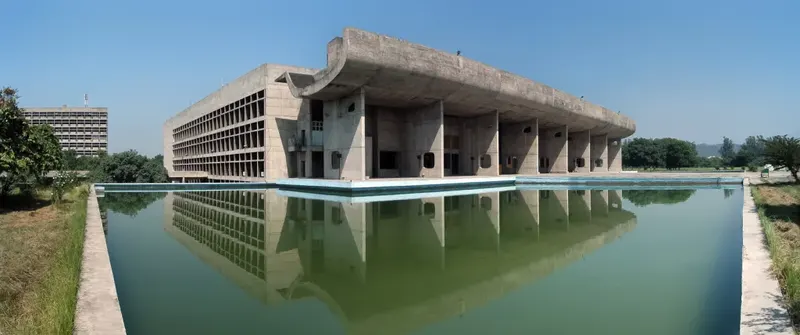
Chandigarh is unlike any other Indian city: a planned modernist capital laid out in the 1950s by the architect Le Corbusier on a grid of numbered sectors. Built as a symbol of a newly independent nation, it is green, orderly and low-rise, threaded with parks and cycle paths and framed by the Shivalik foothills. Shared as the capital of both Punjab and Haryana, it trades the tangle of older cities for wide avenues, roundabouts and open space.
Chandigarh is a quieter alternative. It's ready to explore in the Nuvoha app: set your budget and see complete Chandigarh trips.
Why visit Chandigarh
Chandigarh appeals to anyone interested in architecture, design and calm, breathable urban space. Le Corbusier's Capitol Complex, a UNESCO World Heritage Site, gathers the sculptural concrete of the High Court, Secretariat and Assembly around the raised Open Hand monument. Nearby, Nek Chand's Rock Garden turns industrial and household waste into a sprawling dreamworld of courtyards and figures, and Sukhna Lake offers boating and a favourite evening promenade. The sector grid makes the city legible and unusually walkable, and its parks and rose garden earn its green reputation. Chandigarh is also the gateway to Himachal Pradesh and the hill station of Shimla. The trade-off is that it feels quieter and less classically Indian than its neighbours.
Sights to plan around
- Capitol Complex: Le Corbusier's UNESCO-listed government precinct in Sector 1, where the Assembly, Secretariat and High Court stand around the rotating Open Hand monument in raw concrete.
- Rock Garden of Chandigarh: Nek Chand's secret sculpture garden, built over decades from recycled waste into a labyrinth of walls, waterfalls and thousands of mosaic figures.
- Sukhna Lake: A large man-made lake at the foot of the Shivaliks, ringed by a promenade for boating, morning walks and evening crowds.
- Zakir Hussain Rose Garden: One of Asia's largest rose gardens, spread across Sector 16 with thousands of rose bushes and hundreds of varieties, liveliest during the spring festival.
- Open Hand Monument: Le Corbusier's giant rotating metal hand in the Capitol Complex, the city's emblem, signifying a hand open to give and to receive.
- Government Museum and Art Gallery: A modernist museum in Sector 10 holding Gandhara sculpture, Pahari miniatures and a gallery devoted to the city's own architecture.
Reading the grid
- The Capitol Complex and Sector 1: The monumental northern head of the plan, holding Le Corbusier's government buildings and the open ground below the hills.
- Sector 17: The pedestrian city centre, a grid of concrete plazas, fountains and shopping arcades designed as Chandigarh's civic heart.
- Sector 22: One of the earliest residential sectors, with a busy market and a cross-section of the city's original housing.
- Sectors 10 and 16: Cultural and green sectors holding the Government Museum and Art Gallery, the Rose Garden and quiet residential streets.
- Sukhna Lake and the Leisure Valley: The green northeast edge, where the lake meets a chain of linked gardens and parks running through the city.
- Mohali and Panchkula: The satellite towns of neighbouring Punjab and Haryana that, with Chandigarh, form the wider Tricity, home to the airport, a cricket stadium and IT parks.
The Punjabi table
Chandigarh eats like the Punjab that surrounds it: robust, buttery and generous. This is the homeland of the tandoor and the dhaba, where clay-oven breads come with rich dal makhani, butter chicken and paneer in silky gravies, all crowned with cream and coriander. Sarson ka saag with makki di roti is the winter classic, and roadside dhabas on the highways out of town are an institution. The sector markets add South Indian, Chinese and cafe cooking, and a lassi thick enough to stand a spoon in cools the heat.
- Butter chicken
- Dal makhani
- Sarson ka saag with makki di roti
- Amritsari kulcha
- Chole bhature
- Lassi
What Chandigarh feels like
After the sensory rush of most Indian cities, Chandigarh can feel almost startlingly serene. Traffic flows around roundabouts rather than snarling at junctions, pavements are wide, and greenery is everywhere, from the rose garden to the leafy dividers between sectors. Each sector is a self-contained neighbourhood with its own market, so daily life is walkable and unhurried. There is a prosperous, well-ordered ease to the place, popular with cyclists, joggers and families strolling by Sukhna Lake at dusk. Some visitors find it a touch sterile compared with the chaos and history elsewhere, but for many that very calm, along with the clean lines of its architecture, is the appeal.
Getting from A to B
Chandigarh is built for movement, with wide, gridded roads, roundabouts and one of India's better networks of cycle tracks. The sector layout is logical once you grasp it, and many areas are pleasant to walk or cycle. Autorickshaws and app-based cabs cover longer trips, and city buses run between the sectors and out to Mohali and Panchkula. A metro has long been discussed but is not yet built, so roads carry the load. Chandigarh International Airport (IXC) lies southeast of the city near Mohali, roughly a thirty-minute drive out, with domestic flights and a handful of international routes. Prepaid taxis and app-based cabs make the run; there is no rail link to the terminal.
Practical pointers
- Remove your shoes and cover your head before entering a gurdwara; the city and region are strongly Sikh, and Punjabi hospitality is warm.
- Dress modestly at temples and gurdwaras, and accept the langar meal respectfully if it is offered.
- Use your right hand for eating and for giving or receiving, as is customary across India.
- The Capitol Complex is a working government precinct near the state border, so photography is controlled and some buildings can only be seen on a guided tour arranged in advance.
- October to March is the comfortable season; summers from April to June are very hot, and the monsoon arrives around July.
- Chandigarh is laid out on numbered sectors, so learn the grid; addresses give the sector and often the market or house number.
- Guided tours of the Capitol Complex usually need to be arranged in advance because of its status, so check the current rules before visiting.
- The city makes an easy launch point for Shimla and the Himachal hills, and for Amritsar and its Golden Temple.
- Sukhna Lake is at its best early in the morning or in the cool of the evening.
- Drink sealed bottled or filtered water rather than tap.
Best for
- City breaks
- Quieter travel
Key facts
| Country | India |
|---|---|
| Region | Asia |
| Airports | IXC |
| Trip length fit | Short-trip friendly |
Chandigarh essentials
| Currency | Indian rupee (INR) |
|---|---|
| Language | Hindi and English are the union-level official languages, alongside twenty-two scheduled languages and hundreds of others; English is widely used in cities, business and tourism. |
| Time zone | IST (UTC+5:30), a single time zone across the whole country |
| Emergency number | 112 |
| Driving side | Left |
| Tap water | Not reliably safe to drink; choose sealed bottled water, or water that has been filtered or boiled. |
Climate & seasons
| Month | Typical range | Season |
|---|---|---|
| January | 6°C to 20°C | Cool dry winter |
| April | 18°C to 34°C | Hot spring |
| July | 26°C to 35°C | Humid monsoon summer |
| October | 16°C to 31°C | Warm autumn |
Typical stay
- Weekend-friendly
- Short break (2–5 days)
Chandigarh works as a weekend break just as well as a longer stay.
Getting there
Chandigarh is served via IXC.
- IXC
Is it your kind of trip?
Ideal if…
- you like walkable city energy
- you like places before everyone else finds them
Maybe not if…
- a beach-first holiday is the priority
Pairs well with
Compare with
More in Asia
Near Chandigarh
Travel style
- Short-trip friendly
- City
Frequently asked questions
Which airports serve Chandigarh?
Chandigarh is served via IXC.
Is Chandigarh good for a weekend trip?
Yes, Chandigarh works for a weekend as well as a longer stay.
What kind of trip is Chandigarh best for?
Chandigarh is best for city trips.
Which destinations pair well with Chandigarh?
Within multi-city range: Delhi (237 km), Ahmedabad (940 km), Mumbai (1,347 km).
Who designed Chandigarh?
The city's master plan and its landmark buildings were the work of the Swiss-French architect Le Corbusier, who took over the project in 1950. He designed it as a modern, gridded capital, and his Capitol Complex is now a UNESCO World Heritage Site.
How is Chandigarh organised into sectors?
Chandigarh is laid out as a grid of numbered rectangular sectors, each meant to be a self-sufficient neighbourhood with its own market, schools and green space. There is famously no Sector 13, a superstition of the planners.
Is Chandigarh worth visiting?
Yes, especially for anyone drawn to modern architecture, gardens and calm, orderly streets. Its Capitol Complex, Rock Garden and Sukhna Lake stand out, and it makes a comfortable, green base for trips into the Himachal hills.
Is Chandigarh the capital of Punjab or Haryana?
Both. Chandigarh is a union territory that serves as the shared capital of the states of Punjab and Haryana, while being administered directly by the central government.