
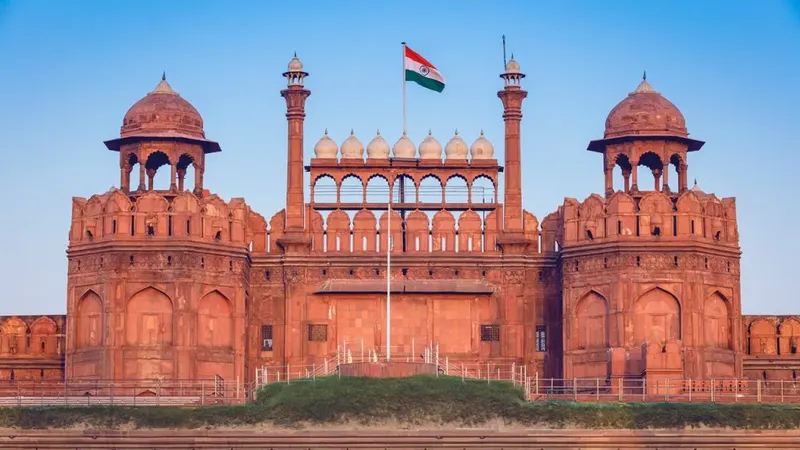
Few capitals wear their history so openly. In Old Delhi, cycle-rickshaws thread the lanes below the red sandstone walls of Shah Jahan's fort, while a few kilometres south the wide, tree-lined avenues of Lutyens' New Delhi run past domed government buildings. Between them lie Mughal tombs, medieval minarets and Sufi shrines, all folded into the noise and heat of a modern city of many millions. Delhi rarely pauses, and rarely repeats itself.
Delhi is a quieter alternative. It's ready to explore in the Nuvoha app: set your budget and see complete Delhi trips.
Why visit Delhi
Delhi is the layered heart of northern India and its finest single lesson in the country's past. The Red Fort, Jama Masjid and Humayun's Tomb trace the Mughal centuries in red sandstone and marble; Qutub Minar reaches back further still to the first Islamic dynasties; and Lutyens' calm imperial avenues record the years of British rule. The street food of Old Delhi is reason enough on its own, and the city is the natural gateway to Agra and Jaipur. Be ready for the trade-offs, though: heavy traffic, fierce summer heat, and winter air pollution that can settle over the city for days.
Monuments to plan around
- Red Fort (Lal Qila): Shah Jahan's vast seventeenth-century citadel in red sandstone, a UNESCO World Heritage Site from whose ramparts the prime minister addresses the nation each Independence Day.
- Humayun's Tomb: A mid-sixteenth-century Mughal garden-tomb of red sandstone and white marble, the first of its kind on the subcontinent and an acknowledged forerunner of the Taj Mahal.
- Jama Masjid: Shah Jahan's grand congregational mosque, one of India's largest, its sandstone-and-marble courtyard able to hold tens of thousands of worshippers.
- Qutub Minar: A soaring brick-and-sandstone victory tower more than seventy metres high, begun around 1200 amid the ruins of India's earliest Islamic capital.
- India Gate: A forty-two-metre war memorial arch designed by Edwin Lutyens, anchoring the ceremonial avenue now known as Kartavya Path.
- Lodhi Gardens: A landscaped park scattered with the domed tombs of fifteenth- and sixteenth-century Sayyid and Lodhi rulers, a favourite green retreat for Delhiites.
Across the city
- Old Delhi (Shahjahanabad): The walled Mughal city, where Chandni Chowk's bazaars, the Jama Masjid and the spice market of Khari Baoli crowd together in a tangle of lanes.
- Lutyens' New Delhi: The planned imperial capital of the 1910s and 1920s, laid out in broad tree-lined avenues around Rashtrapati Bhavan and the government secretariats.
- Connaught Place: The colonnaded, Georgian-style business and shopping hub built by the British, its white arcades radiating from a central circle.
- Hauz Khas: An urban village beside a medieval reservoir and the ruins of a fourteenth-century seminary, now edged with cafes and boutiques.
- Nizamuddin: The quarter around the Sufi shrine of Hazrat Nizamuddin Auliya, where devotional qawwali singing fills the air on Thursday evenings.
- Chanakyapuri: The leafy diplomatic enclave in the south-west, home to embassies and some of the city's quietest, greenest streets.
The Delhi table
Delhi eats richly. The Mughal kitchens left a legacy of kebabs, slow-cooked kormas and biryani, while the arrival of Punjabi families after Partition gave the city its beloved butter chicken and dal makhani. Old Delhi is the street-food capital: crisp chaat, stuffed parathas fried in ghee, nihari simmered overnight, and warm milk-based sweets. Everywhere there is the pull of a roadside chai stall, and in summer the cooling swirl of a kulfi on a stick.
- Butter chicken
- Nihari
- Chole bhature
- Aloo tikki chaat
- Stuffed paratha
- Kulfi
What Delhi feels like
Delhi tests and rewards the senses in equal measure. Horns, temple bells and the call to prayer overlap; woodsmoke, frying spices and marigolds scent the air; autorickshaws weave through gaps that should not exist. Yet step inside a Mughal garden-tomb, or into the green calm of Lodhi Gardens, and the volume drops to birdsong and the scratch of a gardener's rake. The city runs on contrast: imperial order beside medieval density, marble serenity beside market clamour. Winters are cool and foggy, summers punishing, and the whole place slows only briefly, in the sticky pause before the monsoon breaks.
Getting from A to B
The Delhi Metro does the heavy lifting: extensive, air-conditioned, easy on the nerves, and clear of the surface traffic, with a dedicated coach for women. Above ground, autorickshaws and app-based cabs cover shorter hops, and in the crush of Old Delhi a cycle-rickshaw is often quickest of all. Traffic is heavy, so allow generous time between neighbourhoods and lean on the metro wherever you can. Indira Gandhi International Airport sits in the south-west of the city. The Airport Express metro line reaches central New Delhi in around twenty minutes, with taxis and app-based cabs as the alternative.
Practical pointers
- Remove your shoes before entering temples, mosques and gurdwaras, and dress modestly at religious sites, covering your head where asked.
- Use your right hand for eating and for giving or receiving, as the left is traditionally considered unclean.
- At gurdwaras such as Bangla Sahib, cover your head, leave leather items outside and sit on the floor in the prayer hall.
- A namaste with folded hands is a warm greeting, and it is courteous to ask before photographing people at close range.
- October to March is the season to aim for; May and June are fiercely hot, and the monsoon arrives around July.
- Winter mornings can bring thick fog that disrupts flights and trains, and air quality dips in the colder months, so check conditions if you are sensitive.
- Explore Old Delhi early in the day, on foot or by cycle-rickshaw, before the lanes fill.
- Agree an autorickshaw fare or insist on the meter before setting off.
- Drink sealed bottled or filtered water rather than tap, and favour freshly cooked, hot food.
Best for
- City breaks
- Quieter travel
Key facts
| Country | India |
|---|---|
| Region | Asia |
| Airports | DEL |
| Trip length fit | Short-trip friendly |
Delhi essentials
| Currency | Indian rupee (INR) |
|---|---|
| Language | Hindi and English are the union-level official languages, alongside twenty-two scheduled languages and hundreds of others; English is widely used in cities, business and tourism. |
| Time zone | IST (UTC+5:30), a single time zone across the whole country |
| Emergency number | 112 |
| Driving side | Left |
| Tap water | Not reliably safe to drink; choose sealed bottled water, or water that has been filtered or boiled. |
Climate & seasons
| Month | Typical range | Season |
|---|---|---|
| January | 8°C to 21°C | Cool winter |
| April | 21°C to 36°C | Hot spring |
| July | 27°C to 36°C | Monsoon heat |
| October | 19°C to 33°C | Warm autumn |
Typical stay
- Weekend-friendly
- Short break (2–5 days)
Delhi works as a weekend break just as well as a longer stay.
Getting there
Delhi is served via DEL.
- DEL
Is it your kind of trip?
Ideal if…
- you like walkable city energy
- you like places before everyone else finds them
Maybe not if…
- a beach-first holiday is the priority
Pairs well with
Compare with
More in Asia
Near Delhi
Travel style
- Short-trip friendly
- City
Frequently asked questions
Which airports serve Delhi?
Delhi is served via DEL.
Is Delhi good for a weekend trip?
Yes, Delhi works for a weekend as well as a longer stay.
What kind of trip is Delhi best for?
Delhi is best for city trips.
Which destinations pair well with Delhi?
Within multi-city range: Chandigarh (237 km), Ahmedabad (756 km), Mumbai (1,137 km).
When is the best time to visit Delhi?
October to March is the comfortable season, cool and mostly dry, though December and January can bring thick morning fog and poor winter air. April to June is very hot, and the monsoon arrives around July.
Is Delhi a good base for the Taj Mahal and the Golden Triangle?
Yes. Agra and the Taj Mahal are around three to four hours away by road, or roughly two hours on the fastest trains, and Jaipur is a similar distance. Together the three cities form the well-travelled Golden Triangle.
What is the difference between Old Delhi and New Delhi?
Old Delhi is the walled Mughal city of Shahjahanabad, dense with bazaars, mosques and street food. New Delhi is the early-twentieth-century capital the British laid out, all wide avenues and government buildings. The two sit side by side.
Is the Delhi Metro a good way to get around?
Very much so. The metro is extensive, air-conditioned and avoids the worst of the traffic, with an express line linking the airport to the centre. Autorickshaws and app-based cabs fill in the gaps.