
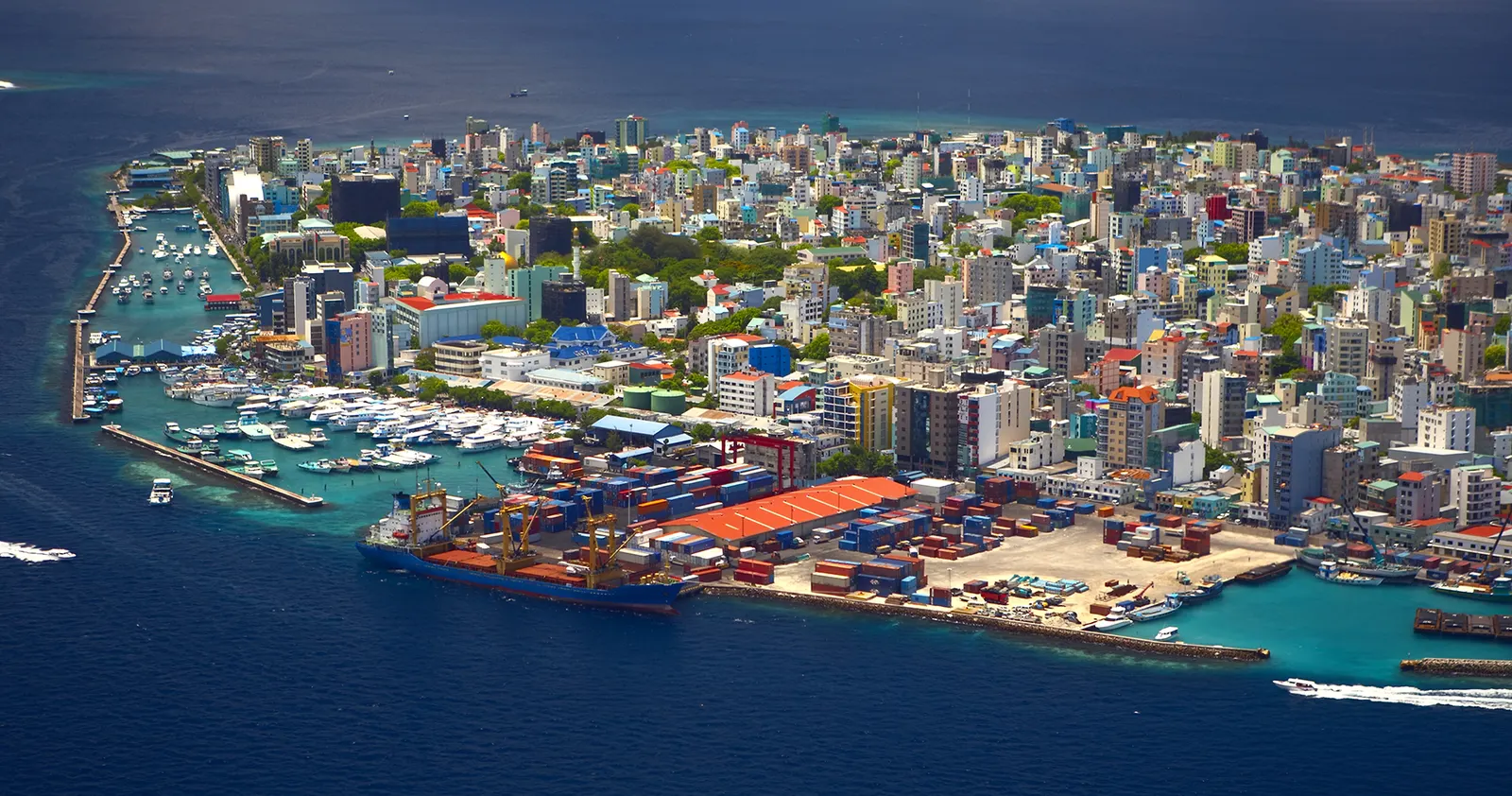
From a seaplane window the Maldives resolves into rings of turquoise scattered across open ocean, each ring freckled with islands barely a metre above the sea. At the centre of it sits Malé, one of the world's most densely packed capitals: a tight grid of colourful buildings, minarets and fish markets crammed onto an island you can walk across in under an hour.
Malé is made for unwinding. It's ready to explore in the Nuvoha app: set your budget and see complete Malé trips.
Why visit Malé
The Maldives is really two destinations sharing one lagoon. The resort islands deliver the postcard: a single hotel per island, house reefs a few fin-kicks from shore, sandbanks that vanish at high tide. Malé and the local islands offer the other half: a working Islamic nation of tuna fishermen, coral-stone mosques and ferry timetables, where you see how Maldivians actually live. Divers and snorkellers come for manta rays, reef sharks and some of the clearest water on the planet; everyone else comes to do gloriously little beside it.
What Malé feels like
Life here runs on boat time. Engines idle at Malé's jetties from dawn, schoolchildren commute by ferry, and the day's rhythm follows the tides and the five calls to prayer. Malé itself is compact and busy (motorbikes threading narrow streets, men playing carrom in the shade) while ten minutes away by boat everything slows to sand-floored cafés and the hiss of the reef. That short crossing between capital density and island quiet is the whole point.
Sights across the atoll
- Old Friday Mosque (Hukuru Miskiy): A seventeenth-century mosque built from carved coral stone, with lacquered woodwork and an ancient graveyard of coral headstones.
- Malé Fish Market: The capital's working heart on the north waterfront, where skipjack and yellowfin tuna are landed and filleted with astonishing speed.
- Grand Friday Mosque: The golden-domed centrepiece of the Islamic Centre, the largest mosque in the Maldives and a landmark visible from arriving ferries.
- Hulhumalé Beach: A long public beach on the reclaimed island of Hulhumalé, with a designated area where swimwear is permitted.
- National Museum: Home to royal parasols, lacquerware and pre-Islamic coral carvings tracing the islands' long history.
- Artificial Beach: Malé's own small swimming cove on the east side of the island, popular with local families at dusk.
Islands and quarters
- Malé city: The capital island itself, a dense grid holding the markets, mosques, Republic Square and the seat of government.
- Hulhumalé: A modern reclaimed island joined to the airport by causeway and to Malé by the Sinamalé Bridge, laid out with wide streets, parks and a long beach.
- Villimalé: A quiet residential island a short ferry ride west of the capital, largely free of motorised traffic and fringed by public beaches.
- Maafushi: A local island in South Malé Atoll with a designated bikini beach and a harbour busy with excursion dhonis and speedboats.
Maldivian flavours
Maldivian cooking is built on tuna and coconut. Breakfast means mas huni: shredded smoked tuna with coconut, onion and chilli, scooped up with warm roshi flatbread. Garudhiya, a clear tuna broth with rice, lime and chilli, is the national comfort dish, while café counters pile up hedhikaa, the fried short eats eaten with black tea. On resort islands the dining goes global, but the local table is worth seeking out.
- Mas huni with roshi
- Garudhiya
- Hedhikaa short eats
- Fihunu mas
- Rihaakuru
Boats, bridges and seaplanes
Everything moves by water. Cheap public ferries link Malé with Hulhumalé, Villimalé and the local islands on set timetables, while speedboats cover the same routes faster and reach nearer resorts. Far-flung resorts use seaplanes, which fly in daylight hours only. On land, buses cross the Sinamalé Bridge between Malé, the airport and Hulhumalé, and Malé itself is small enough to explore entirely on foot. Velana International Airport occupies its own island, Hulhulé, linked to Malé by bridge and bus. Resort transfers leave directly from the airport jetties by speedboat or seaplane, so most visitors never need to enter the capital.
Practical pointers
- Dress modestly on Malé and all local islands (shoulders and knees covered) and save swimwear for resort islands and designated bikini beaches.
- Alcohol is available only on resort islands; it cannot be brought into the country or consumed on local islands.
- Friday is the holy day, when shops close around prayer times and ferry schedules thin out.
- Tipping is welcomed at resorts and by boat crews and guides, but it is never demanded.
- Check ferry timetables the day before you travel: services are infrequent and Friday schedules differ.
- US dollars are accepted almost everywhere alongside the Maldivian rufiyaa, but carry small denominations for change.
- Seaplane transfers stop at dusk, so late international arrivals to distant resorts may involve an overnight near the airport.
- Reef-safe sun cream and a rash vest earn their space in your bag: the equatorial sun is fierce even through cloud.
- The dry northeast monsoon from roughly December to April brings the calmest seas and clearest water.
- Bring any medication you need with you; pharmacies outside Malé are limited.
Best for
- Beach time
- Unwinding
Key facts
| Country | Maldives |
|---|---|
| Region | Asia |
| Airports | MLE |
| Trip length fit | Short-trip friendly |
Malé essentials
| Currency | Maldivian Rufiyaa (MVR); US dollars widely accepted at resorts |
|---|---|
| Language | Dhivehi; English is spoken throughout the tourism industry and in Malé |
| Time zone | Maldives Time, UTC+5, no daylight saving; some resorts run their clocks one hour ahead |
| Emergency number | 119 (police) |
| Driving side | Left |
| Tap water | Not drunk from the tap; resorts and guesthouses supply desalinated or bottled water |
Climate & seasons
| Month | Typical range | Season |
|---|---|---|
| January | 26°C to 31°C | Drier season |
| April | 27°C to 32°C | Hot transition |
| July | 26°C to 31°C | Southwest monsoon |
| October | 26°C to 31°C | Humid wet season |
Malé is one of Nuvoha's winter-sun picks.
Typical stay
- Weekend-friendly
- Short break (2–5 days)
Malé works as a weekend break just as well as a longer stay.
Getting there
Malé is served via MLE.
- MLE
Is it your kind of trip?
Ideal if…
- time on the coast is the point of the trip
- you want to slow down and reset
Maybe not if…
- you want big-city energy around the clock
Pairs well with
Compare with
More in Asia
Near Malé
Travel style
- Winter sun
- Short-trip friendly
- Beach
Frequently asked questions
Which airports serve Malé?
Malé is served via MLE.
Is Malé good for a weekend trip?
Yes, Malé works for a weekend as well as a longer stay.
What kind of trip is Malé best for?
Malé is best for beach trips, popular for unwinding.
Which destinations pair well with Malé?
Within multi-city range: Thiruvananthapuram (607 km), Kochi (735 km), Colombo (778 km).
Can I drink alcohol in the Maldives?
Only on resort islands, which are licensed. Malé and inhabited local islands are entirely dry, and bringing alcohol through the airport is prohibited: bags are scanned on arrival.
What are the dress rules on local islands?
Cover shoulders and knees in villages and towns. Swimwear is fine at resorts and on clearly signed bikini beaches such as those on Maafushi and Hulhumalé, but nowhere else.
When is the sea at its best?
The dry season from about December to April brings calm, clear water and reliable sunshine. The wetter May-to-November months are greener and quieter, with brief downpours and livelier seas, and often better manta ray sightings.