
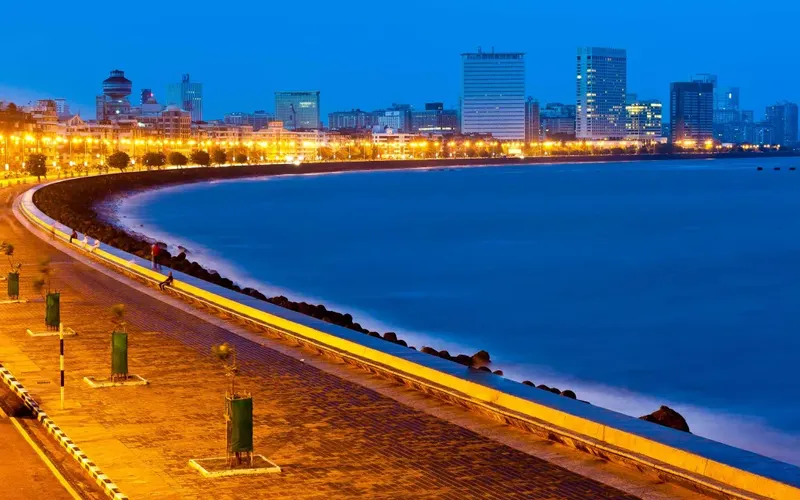
Mumbai rises from a chain of reclaimed islands on the Arabian Sea, and the water is never far away. At the Gateway of India, ferries churn out towards Elephanta, and along Marine Drive the evening crowd gathers to watch the light go soft over the bay. This is India's commercial engine and the home of Hindi cinema, a city of Victorian Gothic facades and Art Deco frontages, of colossal energy and colossal contrasts, forever building and forever in a hurry.
Mumbai is a quieter alternative. It's ready to explore in the Nuvoha app: set your budget and see complete Mumbai trips.
Why visit Mumbai
Mumbai is India at its most driven and most cosmopolitan. The waterfront set pieces, the Gateway of India and the grand curve of Marine Drive, share the peninsula with two UNESCO ensembles: the Victorian Gothic and Art Deco buildings of the old city, and Chhatrapati Shivaji Maharaj Terminus, still a working station. Boats cross the harbour to the rock-cut temples of Elephanta, and the street food ranks among the country's best. It is also a city of stark inequality and famous crowds, wrapped in a dramatic monsoon. Come for the energy, the sea air and the food, and give yourself patience for the traffic.
Sights to plan around
- Gateway of India: A monumental basalt arch on the Colaba waterfront, completed in 1924, from where ferries set out across the harbour to Elephanta.
- Marine Drive: A sweeping seafront boulevard along Back Bay, lined with Art Deco buildings and ending at Girgaum Chowpatty beach; its curve of night-time lights is nicknamed the Queen's Necklace.
- Chhatrapati Shivaji Maharaj Terminus: A florid Victorian Gothic railway station of 1887, a UNESCO World Heritage Site that still functions as a busy commuter terminus.
- Elephanta Caves: Rock-cut Hindu cave temples on an island in the harbour, centred on a colossal three-headed Shiva and reached by ferry; a UNESCO World Heritage Site.
- Haji Ali Dargah: A fifteenth-century mosque and tomb on an islet off Worli, reached along a causeway that is walkable only at low tide.
- Chhatrapati Shivaji Maharaj Vastu Sangrahalaya: The city's principal museum, an Indo-Saracenic landmark once called the Prince of Wales Museum, holding art, archaeology and natural history.
Around the city
- Colaba: The southern tip, home to the Gateway of India, the Colaba Causeway market and the art galleries of the Kala Ghoda quarter.
- Fort: The old business district, dense with Victorian Gothic offices, the Flora Fountain crossing and pavement bookstalls.
- Marine Drive and Nariman Point: The curving bayfront promenade and the cluster of business towers at its southern end.
- Bandra: A lively western suburb of sea-facing promenades, boutiques and cafes, with the old Bandra Fort, Mount Mary Church and the homes of many film stars.
- Juhu: A northern beach suburb known for its long sands, evening food stalls and film-industry residents.
- Dharavi: One of Asia's most densely populated districts and a vast hive of small-scale industry, from leather and pottery to recycling.
The Mumbai table
Mumbai may be India's finest street-food city. The local staples are quick and moreish: vada pav, a spiced potato fritter in a bun, alongside pav bhaji and the beachside chaats of bhel and sev puri. The old Parsi and Irani cafes serve dhansak, berry pulao and bun maska with sweet chai, while the Koli fishing community brings the catch to the table as fiery curries and fries. Add Mughlai grills, Gujarati thalis and South Indian tiffin, and few cities eat so well.
- Vada pav
- Pav bhaji
- Bhel puri
- Bombil (Bombay duck) fry
- Parsi dhansak
- Bun maska with Irani chai
What Mumbai feels like
The pace is quick and the crowds constant, yet Mumbai carries them with a certain good humour. Commuter trains disgorge rivers of people; vendors fry vada pav on every corner; the smell of sea salt, hot oil and diesel hangs over it all. There is old-money calm in the leafy lanes of Malabar Hill and hard graft in the informal quarters, sometimes within sight of each other. Evenings soften the edges: families spill onto Chowpatty and Juhu beaches, couples line the sea wall, and the lights of the bay switch on one by one. In the monsoon, the whole city glistens and floods.
Getting from A to B
The suburban railway is the city's lifeline, its Western, Central and Harbour lines carrying millions daily, though rush hour is not for the faint-hearted. An expanding metro network, including a new underground line, is steadily easing cross-town journeys. Black-and-yellow taxis work across the city and app-based cabs are everywhere, while autorickshaws run only in the suburbs, not in the southern island city. In Colaba and Fort, walking is a genuine pleasure. Chhatrapati Shivaji Maharaj International Airport lies in the northern suburbs. Prepaid and app-based taxis run into town, though journeys to South Mumbai can be long in traffic, and the metro network is expanding to serve the airport area.
Practical pointers
- Dress modestly and remove your shoes at temples, mosques and dargahs, and carry a scarf for covering up at Haji Ali.
- Keep a close eye on food and belongings around the monkeys at Elephanta, and in the crush of the local trains.
- Use your right hand for eating and for passing food or money, keeping the left aside by custom.
- Public displays of affection are best kept discreet, and asking before photographing people is always appreciated.
- November to February is the driest, most comfortable season; the monsoon from June to September brings heavy rain and street flooding.
- Avoid the local trains at peak hours if you can, and use app-based cabs off-peak instead.
- Ferries to Elephanta leave from the Gateway of India; the caves close on Mondays and the last boats return by late afternoon.
- Keep an umbrella and sturdy shoes to hand in the monsoon months.
- Drink sealed bottled or filtered water rather than tap.
Best for
- City breaks
- Quieter travel
Key facts
| Country | India |
|---|---|
| Region | Asia |
| Airports | BOM |
| Trip length fit | Short-trip friendly |
Mumbai essentials
| Currency | Indian rupee (INR) |
|---|---|
| Language | Hindi and English are the union-level official languages, alongside twenty-two scheduled languages and hundreds of others; English is widely used in cities, business and tourism. |
| Time zone | IST (UTC+5:30), a single time zone across the whole country |
| Emergency number | 112 |
| Driving side | Left |
| Tap water | Not reliably safe to drink; choose sealed bottled water, or water that has been filtered or boiled. |
Climate & seasons
| Month | Typical range | Season |
|---|---|---|
| January | 18°C to 31°C | Dry season |
| April | 25°C to 34°C | Hot pre-monsoon |
| July | 25°C to 30°C | Peak monsoon |
| October | 24°C to 34°C | Humid autumn |
Typical stay
- Weekend-friendly
- Short break (2–5 days)
Mumbai works as a weekend break just as well as a longer stay.
Getting there
Mumbai is served via BOM.
- BOM
Is it your kind of trip?
Ideal if…
- you like walkable city energy
- you like places before everyone else finds them
Maybe not if…
- a beach-first holiday is the priority
Pairs well with
Compare with
More in Asia
Near Mumbai
Travel style
- Short-trip friendly
- City
Frequently asked questions
Which airports serve Mumbai?
Mumbai is served via BOM.
Is Mumbai good for a weekend trip?
Yes, Mumbai works for a weekend as well as a longer stay.
What kind of trip is Mumbai best for?
Mumbai is best for city trips.
Which destinations pair well with Mumbai?
Within multi-city range: Pune (124 km), Goa (425 km), Ahmedabad (444 km).
When is the best time to visit Mumbai?
November to February is the driest and most comfortable stretch. The southwest monsoon, roughly June to September, brings heavy rain that can flood low-lying streets, while April and May are hot and humid.
Who are the dabbawalas?
They are Mumbai's lunchbox couriers, a network that collects freshly cooked meals from homes each morning and delivers them to office workers across the city using a simple colour-coded system, then returns the empty tins. The scheme is famous for its accuracy.
Can you experience Bollywood in Mumbai?
To a degree. The film industry is based here, with studio complexes such as Film City in Goregaon offering tours, and Bandra is known for stars' homes. Actual star sightings, though, are down to luck.
How do you visit the Elephanta Caves?
Ferries run from the Gateway of India and take about an hour each way to the island. The caves are closed on Mondays, boats stop by late afternoon, and reaching the temples involves a climb up stepped paths.