
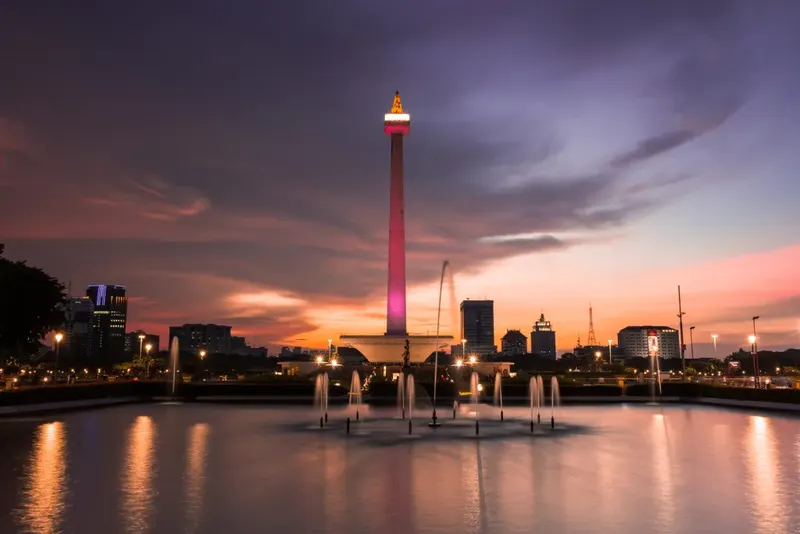
Indonesia strings some 17,000 islands along the equator, so many that hundreds stay uninhabited and the official count is still occasionally revised. It is a land of volcanoes above all: well over a hundred are active, and dawn climbs up Bromo, Ijen and Rinjani rank among the great experiences of Southeast Asia. Java carries most of the population and the ninth-century temples of Borobudur and Prambanan; Bali adds Hindu shrines and terraced rice fields; and eastward, the dragons of Komodo and the reefs of Raja Ampat draw travellers to some of the richest waters on the planet. With hundreds of languages spread across three time zones, Indonesia is less a single destination than a continent in disguise.
Indonesia on Nuvoha spans 2 destinations: Jakarta, Bali. Set your budget and Nuvoha builds the complete trip: flights and hotels together.
Why visit Indonesia
- Cities you can explore on foot, from headline sights to quiet neighbourhoods
- Coastline worth building a trip around
- Quieter alternatives beyond the obvious stops
- Easy to combine two cities in a single trip
Best known for
- Bali's temples and rice terraces
- Borobudur and Prambanan
- Komodo dragons and Flores
- Sunrise volcano treks up Bromo and Ijen
- Diving in Raja Ampat
- Orangutans in the Sumatran jungle
Across the archipelago
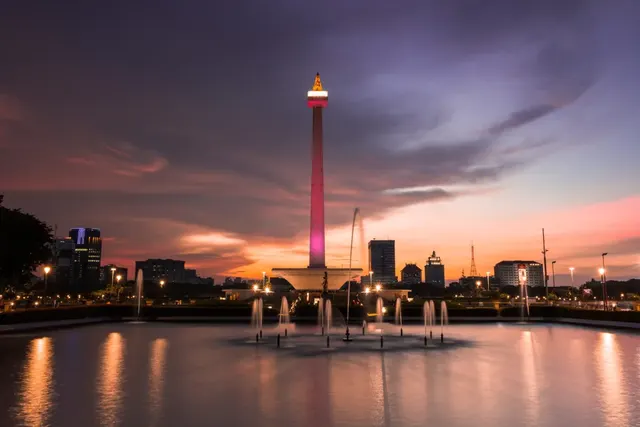
- Java: The crowded, cultured heartland, from the capital Jakarta to the royal city of Yogyakarta, the vast temples of Borobudur and Prambanan and the smoking craters of Bromo and Ijen.
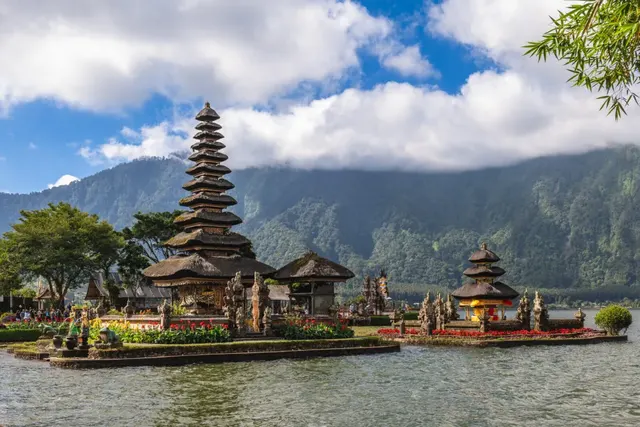
- Bali: The Hindu island of terraced rice fields and cliff-top temples, with the arts town of Ubud inland and surf beaches from Kuta to Uluwatu along the south.
- Lombok and the Gili Islands: Quieter beaches beside Bali, the volcano of Mount Rinjani rising at the centre, and three tiny car-free Gili islands fringed by coral just offshore.
- Komodo and Flores: Reached through Labuan Bajo, this is the home of the Komodo dragon, pink-sand beaches and the three coloured crater lakes of Kelimutu on the island of Flores.
- Sumatra: A huge, wild island of jungle and volcano, with the orangutans of Bukit Lawang, the vast crater lake of Toba and the surf of the Mentawai Islands.
- Sulawesi: An orchid-shaped island known for the elaborate funeral traditions of Tana Toraja in the highlands and the coral walls of Bunaken in the north.
Where to go
Indonesia essentials
| Currency | Indonesian Rupiah (IDR) |
|---|---|
| Language | Indonesian (Bahasa Indonesia) is the national language, spoken alongside hundreds of regional tongues; English is common in tourist areas |
| Time zone | Three zones: Western (UTC+7) covering Sumatra and Java, Central (UTC+8) covering Bali and Sulawesi, and Eastern (UTC+9) covering Papua; no daylight saving |
| Emergency number | 112 (national emergency line) |
| Driving side | Left |
| Tap water | Not safe from the tap; bottled and boiled water are the norm |
Seasons at a glance in Jakarta
| Month | Typical range | Season |
|---|---|---|
| January | 24°C to 30°C | Wet season |
| April | 25°C to 32°C | Humid transition |
| July | 24°C to 32°C | Drier season |
| October | 25°C to 33°C | Warmer transition |
Seasons vary across Indonesia. Each destination page has its own climate table.
More in Asia
More Asia country guides
Frequently asked questions
Which Indonesia destinations can I book with Nuvoha?
Jakarta, Bali, each with complete flight and hotel trips built around your budget.
What kind of trips suit Indonesia?
Indonesia works for city breaks and beach holidays, and its cities pair well for multi-stop itineraries.
How do you get around Indonesia?
With islands this far apart, flying does most of the heavy lifting, and a web of domestic airlines links the main hubs. Ferries and fast boats connect neighbouring islands, Java and Sumatra have rail networks, and Bali gets around by road alone.
What plug type does Indonesia use?
Types C and F, the round two-pin European sockets, at 230 volts. Travellers from the UK, North America and Australia need an adapter.
Do I need cash in Indonesia?
Away from Bali and the big cities, yes: warungs, markets and village shops deal in rupiah, and small notes are useful. Cards and mobile wallets are accepted in hotels, malls and tourist restaurants, and ATMs are common in towns.
When is the best time to visit?
The dry season, roughly April to October, suits beaches, diving and volcano hikes across most of the country. The wet season from November to March brings afternoon downpours, though the eastern islands follow slightly different patterns.