
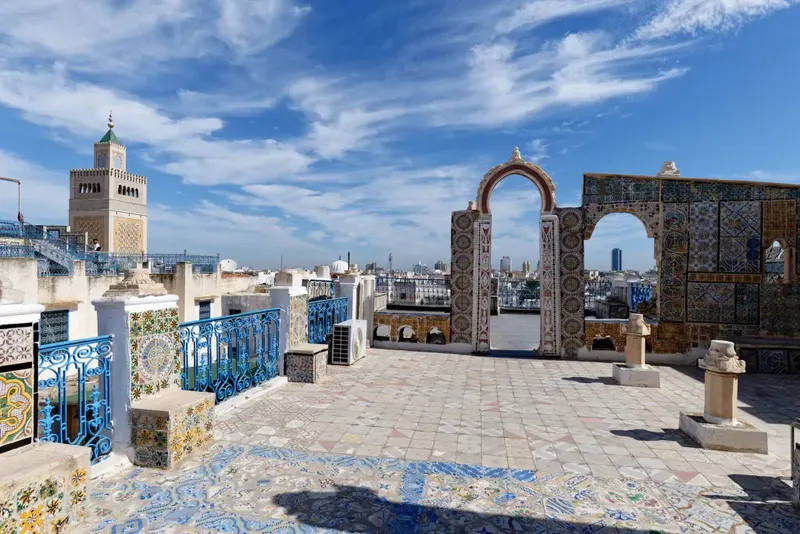
Tunisia's capital layers a medieval Arab medina, a French colonial new town and the ruins of ancient Carthage along one Mediterranean bay. At its centre the Zitouna Mosque anchors a UNESCO-listed maze of souqs; on the coast, the blue-and-white village of Sidi Bou Said tumbles towards the sea. Add the mosaic-filled Bardo Museum and easy North African warmth, and Tunis makes a compact, layered introduction to the Maghreb.
Tunis is a quieter alternative. It's ready to explore in the Nuvoha app: set your budget and see complete Tunis trips.
Why visit Tunis
Few capitals pack so many eras into so small a space. The medina of Tunis, founded in the seventh century, wraps the Zitouna Mosque in covered souqs of perfume, chechia hats and copperware, all UNESCO-listed. A short train ride north, the ruins of Carthage scatter across a seaside suburb, from the Punic ports and Byrsa Hill to the Antonine Baths, while clifftop Sidi Bou Said charms with cobbled lanes, bright doors and mint tea. The Bardo Museum holds one of the world's greatest collections of Roman mosaics, and the palm-lined Avenue Habib Bourguiba gives the French-era new town its grand promenade. La Goulette and La Marsa add seafood and Mediterranean beaches.
Ruins, souqs and sea villages
- Medina of Tunis: A UNESCO-listed old city of covered souqs, palaces and madrasas wound around the Zitouna Mosque.
- Zitouna Mosque (Great Mosque): The spiritual and physical heart of the medina, a centre of learning for over a thousand years, with a courtyard open to visitors.
- Carthage: The seaside ruins of the great Punic and Roman city, from Byrsa Hill and the ports to the Antonine Baths.
- Sidi Bou Said: A clifftop village of blue shutters and whitewashed walls above the Gulf of Tunis, ending at the Cafe des Nattes.
- Bardo National Museum: A former palace holding a peerless collection of Roman mosaics gathered from across Tunisia.
- Avenue Habib Bourguiba: The tree-lined main boulevard of the French-era new town, with cafes, the municipal theatre and the cathedral.
Around the bay
- Medina: The walled old city and UNESCO site, a dense weave of souqs, mosques and courtyard houses.
- Ville Nouvelle (Centre Ville): The French colonial grid around Avenue Habib Bourguiba, with cafes, shops and belle-epoque facades.
- Carthage: An affluent coastal suburb north-east of the centre, scattered with ancient ruins among villas.
- Sidi Bou Said: The famous blue-and-white village on the cliffs, full of art galleries, cafes and sea views.
- La Marsa: A leafy seaside suburb at the end of the TGM line, with a beach promenade and restaurants.
- La Goulette: The port district on the lagoon, known for its seafood restaurants and ferry harbour.
The Tunisian table
Tunisian food is the spiciest in the Maghreb, defined by harissa, the fiery chilli paste that accompanies almost everything. Couscous is the Friday centrepiece, steamed with lamb, fish or vegetables, while brik, a crisp fried pastry folded around egg and tuna, is the classic starter. Look for ojja, a stew of eggs, tomato and merguez, and lablabi, a garlicky chickpea soup eaten for breakfast. The coast supplies grilled fish and prawns, and sweets like makroudh, semolina stuffed with dates, close the meal beside mint tea with pine nuts.
- Couscous
- Brik
- Harissa
- Ojja with merguez
- Lablabi
- Makroudh
What Tunis feels like
Tunis feels Mediterranean and Maghrebi at once, its pace easier than Cairo's and its manner bilingual in Arabic and French. Mornings belong to strong coffee on Avenue Habib Bourguiba and the unhurried opening of the souqs; afternoons drift towards the sea breezes of the northern suburbs. The medina hums with bargaining, the scent of jasmine and grilling merguez, and calls to prayer over the rooftops, while Sidi Bou Said fills with families and artists at golden hour. Dress is more relaxed than in the Gulf but still modest away from the beaches, and hospitality is generous. Summers are hot and dry, winters mild and green.
Getting around
Central Tunis is walkable, from the new-town boulevards into the medina, and much of the sightseeing clusters there. The TGM light rail is the scenic way to the northern suburbs, running from Tunis Marine station out to Carthage, Sidi Bou Said and La Marsa. A tram network, the Metro Leger, covers the wider city, and yellow taxis are metered and inexpensive; check the meter is running before you set off. Shared louage minibuses handle trips further afield. Tunis-Carthage International Airport (TUN) sits just north-east of the centre, one of the closest capital airports to its city. Taxis are the usual link, and the ride into town is short outside rush hour.
Good to know
- Dress modestly away from the beaches, covering shoulders and knees, especially in the medina and at religious sites.
- At mosques, dress conservatively and note that non-Muslims may be limited to courtyards rather than prayer halls.
- A little French or Arabic greeting is warmly received, and bargaining in the souqs is expected and good-humoured.
- During Ramadan, eat and drink discreetly in daylight, as many cafes and restaurants close until sunset.
- Spring and autumn bring the kindest weather; summer is hot and the beaches busy, winter mild but changeable.
- Take the TGM train to Carthage and Sidi Bou Said for an easy half-day along the coast.
- Check that a taxi meter is on before setting off, or settle the fare in advance.
- Start the medina early, before the heat and the crowds, and accept a mint tea if a shopkeeper offers.
- Carry small notes for souq purchases and cafes; card acceptance is patchy in the old city.
- Dress a little more smartly for the new-town cafes, where locals take their evening promenade seriously.
Best for
- City breaks
- Quieter travel
Key facts
| Country | Tunisia |
|---|---|
| Region | Middle East & North Africa |
| Airports | TUN |
| Trip length fit | Short-trip friendly |
Tunis essentials
| Currency | Tunisian Dinar (TND) |
|---|---|
| Language | Arabic is official, with Tunisian Arabic spoken day to day; French is very widely used, and English is growing in tourist areas |
| Time zone | Central European Time (UTC+1), no daylight saving |
| Emergency number | 197 (police), 190 (ambulance), 198 (fire and civil protection) |
| Driving side | Right |
| Tap water | Treated in the cities but heavily chlorinated; most visitors prefer bottled water |
Climate & seasons
| Month | Typical range | Season |
|---|---|---|
| January | 7°C to 16°C | Mild winter |
| April | 11°C to 22°C | Warm spring |
| July | 22°C to 34°C | Hot dry summer |
| October | 16°C to 26°C | Warm autumn |
Typical stay
- Weekend-friendly
- Short break (2–5 days)
Tunis works as a weekend break just as well as a longer stay.
Getting there
Tunis is served via TUN.
- TUN
Is it your kind of trip?
Ideal if…
- you like walkable city energy
- you like places before everyone else finds them
Maybe not if…
- a beach-first holiday is the priority
Pairs well with
Compare with
| Tunis | Casablanca | Marrakesh | |
|---|---|---|---|
| Country | Tunisia | Morocco | Morocco |
| Region | Middle East & North Africa | Middle East & North Africa | Middle East & North Africa |
| Styles | City | City | City |
| Trip length fit | Weekend-friendly | Weekend-friendly | Weekend-friendly |
| Airports | 1 | 1 | 1 |
More in Middle East & North Africa
Near Tunis
Travel style
- Short-trip friendly
- City
Frequently asked questions
Which airports serve Tunis?
Tunis is served via TUN.
Is Tunis good for a weekend trip?
Yes, Tunis works for a weekend as well as a longer stay.
What kind of trip is Tunis best for?
Tunis is best for city trips.
Which destinations pair well with Tunis?
Within multi-city range: Rome (577 km), Palma de Mallorca (720 km), Ibiza (809 km).
Is Tunis a good base for seeing Carthage and Sidi Bou Said?
Ideal. Both sit on the TGM rail line that runs from the city out along the coast, so the ancient ruins of Carthage and the blue-and-white village of Sidi Bou Said are each a short, simple ride from the centre and easily combined in a day.
What language is spoken in Tunis?
Arabic is the official language, in its Tunisian dialect, and French is very widely used in business, signage and daily life. English is growing among younger Tunisians and in tourist areas, but a few words of French go a long way.
When is the best time to visit Tunis?
Spring and autumn are the most comfortable, with warm days and manageable crowds. Summer is hot and busy along the coast, while winter stays mild and green but can bring rain and cooler spells.
Is Tunis walkable?
The centre is, on foot between the French-era boulevards and the medina. For Carthage, Sidi Bou Said and La Marsa, the TGM train does the work, and taxis fill the gaps cheaply within the city.