
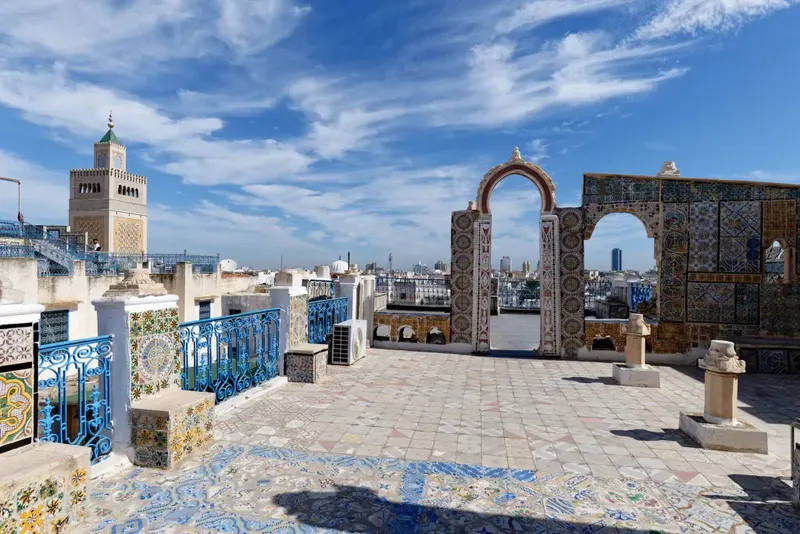
Tunisia folds Roman cities, Mediterranean beaches and the edge of the Sahara into the northernmost country in Africa. Ancient Carthage, once Rome's great rival, stands in the suburbs of the capital, Tunis, a short ride from the blue-and-white cliff village of Sidi Bou Said. The coast runs south through Sousse and Monastir to the island of Djerba, passing El Djem and one of the best-preserved Roman amphitheatres anywhere. Inland lie the holy city of Kairouan and, beyond the shimmering salt flats, the palm oases and dunes of the deep south, where several Star Wars films found their desert planet. French is widely spoken here, a legacy of the colonial era, and mint tea and couscous anchor almost every table.
Tunis is the Tunisia destination on Nuvoha today. Set your budget and Nuvoha builds the complete trip: flights and hotels together.
Why visit Tunisia
- Cities you can explore on foot, from headline sights to quiet neighbourhoods
- Quieter alternatives beyond the obvious stops
Best known for
- The ruins of ancient Carthage
- Sidi Bou Said's blue-and-white lanes
- El Djem's Roman amphitheatre
- Sahara dunes around Douz and Tozeur
- Star Wars desert filming sites
- The medinas of Tunis and Kairouan
Coast, interior and desert
- Tunis and Carthage: The capital blends a UNESCO-listed medina with French-era boulevards, the mosaics of the Bardo Museum and the seaside ruins of ancient Carthage, with Sidi Bou Said perched on the cliffs nearby.
- Cap Bon and the North Coast: Beach resorts at Hammamet and Nabeul, the cork forests and coral around Tabarka, and the harbour town of Bizerte on Africa's northern tip.
- The Sahel: The central coast of Sousse, Monastir and Mahdia, holding walled medinas, long beaches and the colossal Roman amphitheatre at El Djem.
- Kairouan and the Interior: Kairouan, one of Islam's holiest cities, with its Great Mosque, and the hilltop Roman ruins of Dougga out among the wheat plains and olive groves.
- Djerba and the South-East: The sunny island of Djerba with its ancient synagogue, the underground cave homes of Matmata and the fortified granaries, or ksour, around Tataouine.
- The Sahara and the Oases: Douz, the gateway to the dunes, the palm oases of Tozeur and Nefta, the mountain springs of Chebika and Tamerza and the great salt flat of Chott el Djerid.
Where to go
Tunisia essentials
| Currency | Tunisian Dinar (TND) |
|---|---|
| Language | Arabic is official, with Tunisian Arabic spoken day to day; French is very widely used, and English is growing in tourist areas |
| Time zone | Central European Time (UTC+1), no daylight saving |
| Emergency number | 197 (police), 190 (ambulance), 198 (fire and civil protection) |
| Driving side | Right |
| Tap water | Treated in the cities but heavily chlorinated; most visitors prefer bottled water |
Seasons at a glance in Tunis
| Month | Typical range | Season |
|---|---|---|
| January | 7°C to 16°C | Mild winter |
| April | 11°C to 22°C | Warm spring |
| July | 22°C to 34°C | Hot dry summer |
| October | 16°C to 26°C | Warm autumn |
Seasons vary across Tunisia. Each destination page has its own climate table.
More in Middle East & North Africa
More Middle East & North Africa country guides
Frequently asked questions
Which Tunisia destinations can I book with Nuvoha?
Tunis, with complete flight and hotel trips built around your budget.
What kind of trips suit Tunisia?
Tunisia works for city breaks.
How do you get around Tunisia?
Shared taxis known as louages are the workhorse of intercity travel, fast and frequent between towns. Trains run along the coast between Tunis and the Sahel, while the desert south is best reached by hire car with a driver or on an organised tour.
What plug type does Tunisia use?
Types C and E, the round two-pin European sockets, at 230 volts. Visitors from the UK and North America need an adapter; continental European plugs fit directly.
Cash or card in Tunisia?
Cash rules day to day. The dinar is a closed currency that cannot legally be taken in or out, so you change money on arrival and spend it before you leave. Cards work in hotels and larger shops, and ATMs are common in the towns.
When is the best time to visit Tunisia?
Spring and autumn are the most comfortable, with warm days and mild evenings. Summers are hot on the coast and fierce in the desert, while winters stay mild by the sea and can turn genuinely cold in the interior at night.