
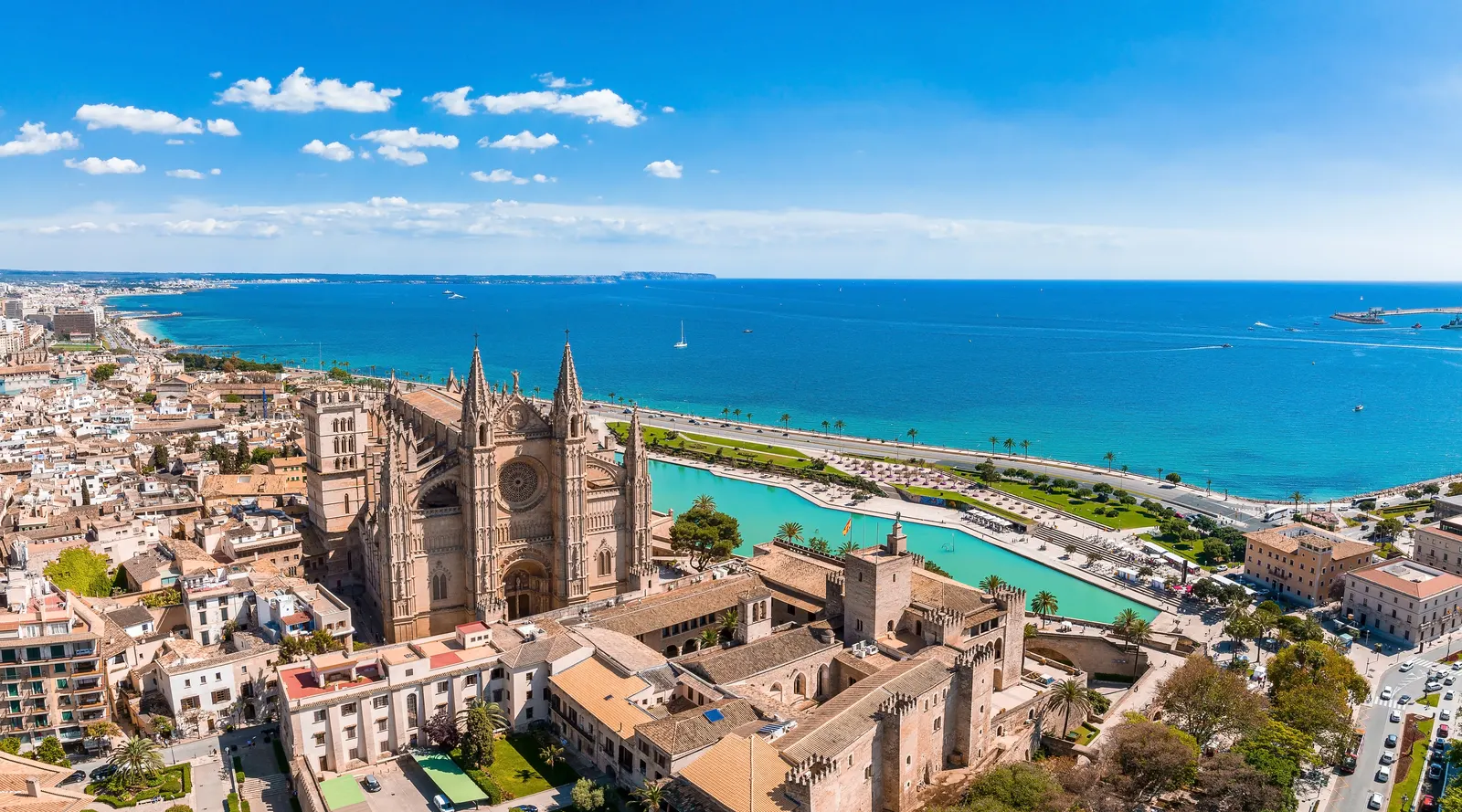
La Seu's golden sandstone rises straight above Palma's seafront, its flying buttresses doubled in the lake of Parc de la Mar. Behind the cathedral, the old town's shaded lanes wind past patio courtyards and Arab baths towards Passeig del Born. The Serra de Tramuntana hangs blue on the horizon, a reminder that Mallorca is far more than its beaches.
Palma de Mallorca is a favourite for couples. It's ready to explore in the Nuvoha app: set your budget and see complete Palma de Mallorca trips.
Why visit Palma de Mallorca
Palma rewards travellers who linger rather than pass through to the resorts. The city holds one of Europe's great Gothic cathedrals, a circular hilltop castle and a dense old town of courtyard palaces, yet it stays a working Mediterranean capital with proper markets, galleries and café life. From the centre you can ride a vintage wooden train through the mountains to Sóller, swim from a city beach by mid-morning and be back for a late dinner in Santa Catalina. Few island capitals pack so much within walking distance of the waterfront.
What Palma de Mallorca feels like
Mornings belong to locals: coffee and ensaïmada at marble counters, deliveries rattling over cobbles, the Mercat de l'Olivar filling with fish and fruit. By afternoon the Born fills with slow strollers under lime trees, and the marina glitters with rigging. Evenings stretch long: Mallorcans eat late, and the lanes around Sa Llotja and Santa Catalina carry terrace conversation well past midnight in summer.
What not to miss
- La Seu (Palma Cathedral): The 14th-century Gothic cathedral holds one of Europe's largest rose windows and a chapel reimagined in ceramics by the Mallorcan artist Miquel Barceló.
- Castell de Bellver: A rare circular Gothic castle set in pinewood above the bay, with a moat, a round central courtyard and long views over Palma.
- Palau de l'Almudaina: A royal palace of Moorish origin facing the cathedral, still used for official ceremonies of the Spanish crown.
- Ferrocarril de Sóller: A 1912 wooden-carriage railway that climbs through the Serra de Tramuntana from Palma to the orange-growing town of Sóller.
- Es Baluard: A museum of modern and contemporary art built into Renaissance sea walls, with a ramparts terrace overlooking the harbour.
Quarters of the old town and beyond
- Casc Antic: Palma's medieval core of courtyard palaces and narrow lanes, home to the Banys Àrabs, one of the few Moorish remains in the city.
- Santa Catalina: A former fishermen's quarter west of the centre, known for its covered market, low painted houses and streets of tapas bars.
- Portixol and Es Molinar: Old seafront villages absorbed by the city, joined by a flat promenade where locals cycle, run and swim off small beaches.
- El Terreno: A hillside quarter beneath Bellver Castle with faded belle-époque villas and a bohemian past centred on Plaça Gomila.
Eating in Palma
Mallorcan cooking is farmhouse food refined by centuries of trade. Sobrassada, the island's soft paprika-cured sausage, appears everywhere from bakeries to fine dining, while pa amb oli (bread rubbed with tomato and olive oil) anchors casual menus. Try tumbet, a layered vegetable bake, or frito mallorquín, and finish with an ensaïmada, the coiled pastry Mallorcans carry home in octagonal boxes.
- Ensaïmada
- Sobrassada
- Pa amb oli
- Tumbet
- Frito mallorquín
Moving around city and island
Central Palma is best explored on foot. EMT city buses accept contactless cards, while TIB buses and SFM trains (covered by the rechargeable Targeta Intermodal) leave the Estació Intermodal beneath Plaça d'Espanya for the rest of Mallorca, alongside the single-line Palma Metro. The vintage Sóller railway departs from its own station next door. A hire car opens up the Tramuntana, though old-town parking is scarce. Son Sant Joan Airport lies about eight kilometres east of the city; the A1 EMT bus runs to the centre and a taxi takes roughly fifteen minutes outside peak traffic.
Good to know
- Round up the bill or leave small change in cafés; tipping is appreciated but never expected in Mallorca.
- Dress for town when leaving the beach: cover-ups are expected away from the sand, and shoulders should be covered inside the cathedral.
- Both Catalan, in its Mallorcan form, and Spanish are official languages; a cheerful 'bon dia' is warmly received.
- Lunch runs late, around two, and dinner rarely starts before nine: many kitchens close in between.
- Ride the Sóller train early in the day in high season; morning departures are the coolest and least crowded.
- Around 2 February and 11 November, sunlight through La Seu's rose window projects a second rose beneath it: locals call it the Festa de la Llum.
- Palma's city beach, Can Pere Antoni, is a ten-minute walk from the cathedral; Cala Major and Illetes are a short bus ride further.
- Many old-town shops close on Sundays; markets, museums and the seafront make better plans that day.
- Walk up to Bellver Castle through the pine woods from El Terreno: the path is short, shaded and far pleasanter than the road.
Best for
- Beach time
- Couples
Key facts
| Country | Spain |
|---|---|
| Region | Europe |
| Airports | PMI |
| Trip length fit | Short-trip friendly |
| Editorial | Featured destination |
Palma de Mallorca essentials
| Currency | Euro (EUR) |
|---|---|
| Language | Spanish (Castilian), with Catalan, Basque and Galician co-official regionally; English is common in tourist areas |
| Time zone | Mainland: Central European Time (UTC+1, UTC+2 in summer); the Canaries are one hour behind the mainland |
| Emergency number | 112 (general emergency) |
| Driving side | Right |
| Tap water | Safe to drink across the country; the taste varies by region |
Climate & seasons
| Month | Typical range | Season |
|---|---|---|
| January | 6°C to 15°C | Mild winter |
| April | 10°C to 20°C | Mild spring |
| July | 22°C to 31°C | Hot dry summer |
| October | 15°C to 24°C | Warm autumn |
Typical stay
- Weekend-friendly
- Short break (2–5 days)
Palma de Mallorca works as a weekend break just as well as a longer stay.
Getting there
Palma de Mallorca is served via PMI.
- PMI
Is it your kind of trip?
Ideal if…
- time on the coast is the point of the trip
- you're planning a trip for two
- you want one of our featured destinations
Maybe not if…
- you want big-city energy around the clock
Pairs well with
Compare with
More in Europe
Near Palma de Mallorca
Travel style
- Short-trip friendly
- Beach
Frequently asked questions
Which airports serve Palma de Mallorca?
Palma de Mallorca is served via PMI.
Is Palma de Mallorca good for a weekend trip?
Yes, Palma de Mallorca works for a weekend as well as a longer stay.
What kind of trip is Palma de Mallorca best for?
Palma de Mallorca is best for beach trips, popular for trips for two.
Which destinations pair well with Palma de Mallorca?
Within multi-city range: Ibiza (140 km), Barcelona (202 km), Madrid (547 km).
Is Palma easy to explore on foot?
Very. The old town, seafront and Santa Catalina sit within a compact, mostly flat area, and the walk from cathedral to market takes about fifteen minutes. Bellver Castle is the one real climb worth planning around.
Can you swim in Palma itself?
Yes. Can Pere Antoni beach starts a short walk east of the cathedral, with Cala Major and Illetes nearby by bus. The comfortable swimming season generally runs from late May into October.
Do I need Spanish or Catalan to get by?
English is widely understood in shops, restaurants and hotels. Locals speak both Spanish and Mallorquí, the island's form of Catalan, and any attempt at either language is met kindly.