
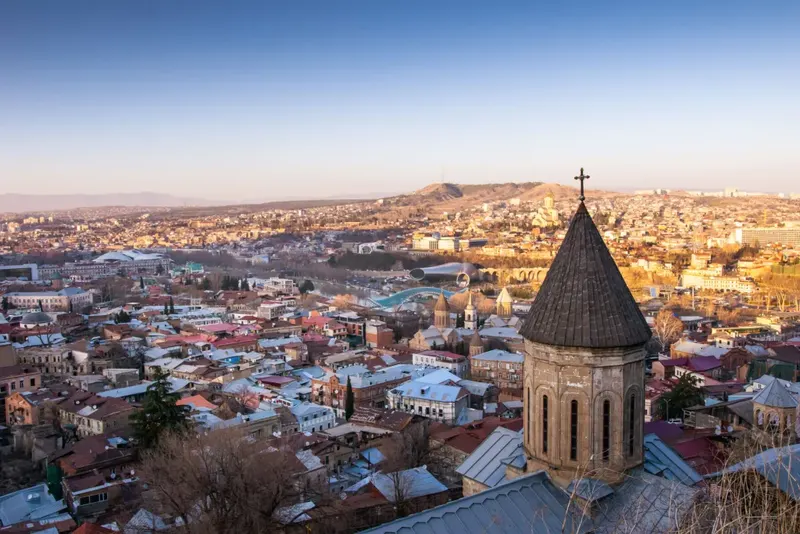
Tbilisi tumbles down both banks of the Mtkvari River, a city of carved wooden balconies, domed brick bathhouses and a hilltop fortress watching over it all. Founded, so the legend goes, on the site of warm sulphur springs, the Georgian capital has been fought over and rebuilt for centuries, and it wears that history in a jumble of styles. Old churches, art-nouveau facades and glassy modern bridges stand within a few streets of one another.
Tbilisi is a quieter alternative. It's ready to explore in the Nuvoha app: set your budget and see complete Tbilisi trips.
Why visit Tbilisi
Tbilisi is a city for walking, eating and slowing down. The Old Town knots together cobbled lanes, balconied houses and small churches beneath the Narikala fortress, reached on foot or by a cable car that swings up from the riverside park. In the Abanotubani quarter you can still bathe in the natural sulphur baths under their low brick domes. Above all it is a place to eat and drink well: Georgia is one of the oldest wine cultures on earth, and the city's cellars, bakeries and long feasting tables show why. A generation of cafes, galleries and courtyards has grown up alongside the old.
Highlights
- Old Town (Dzveli Tbilisi): A warren of cobbled lanes, carved wooden balconies and small churches below the fortress hill.
- Abanotubani sulphur baths: The domed brick bathhouses of the old sulphur-spring quarter, some with beautifully tiled facades.
- Narikala Fortress: The ancient citadel above the city, reached by cable car, with the Mother of Georgia statue standing along the ridge.
- Bridge of Peace and Rike Park: A curving glass-and-steel footbridge linking the Old Town to a riverside park and the cable-car station.
- Rustaveli Avenue: The grand central boulevard, lined with the opera house, theatres, museums and the parliament.
- Mtatsminda: The wooded hill above town, topped by a park and pantheon and reached by a historic funicular.
Areas to know
- Old Town (Kala): The historic core, taking in Abanotubani, Meidan Square and the streets below Narikala.
- Sololaki: A handsome nineteenth-century quarter of ornate facades, sculpted doorways and courtyard staircases.
- Vera: A leafy, cafe-filled neighbourhood on the slopes above the centre, favoured by students and creatives.
- Vake: A greener, upmarket residential district built around the large Vake Park.
- Marjanishvili and Chugureti: The revived left-bank districts, home to the restored Agmashenebeli Avenue and the Fabrika complex.
- Rustaveli and Freedom Square: The civic centre, gathered around the main avenue and the column of Saint George.
Food & drink
Georgian food is one of the great reasons to visit, generous and built for sharing. Khachapuri, the national cheese bread, comes in many forms, most famously the boat-shaped Adjarian version crowned with a runny egg. Khinkali are large, twisted dumplings filled with spiced meat and hot broth, eaten by hand. The table fills out with walnut-rich dishes like badrijani and pkhali, bean stews, grilled mtsvadi skewers and, always, wine made in the ancient way in buried clay qvevri. Strings of nutty churchkhela hang in every market.
- Khachapuri
- Khinkali
- Badrijani (walnut-stuffed aubergine)
- Mtsvadi (grilled skewers)
- Churchkhela
What Tbilisi feels like
Tbilisi mixes faded grandeur with easy, unhurried energy. Wander the Old Town and you pass crumbling balconies, quiet courtyards, tiny wine bars and churches where candles burn, all within a short climb of one another. The mood is famously hospitable: Georgians treat guests as a gift, and a shared meal can turn into a long evening of toasts led by a tamada. Days drift between cafe tables, bakeries selling fresh khachapuri and the steam of the bathhouses. By night, the restored districts on the left bank draw a young crowd to their bars and courtyards. Summers are hot and winters cold, with the surrounding hills often dusted in snow.
Getting around
Central Tbilisi is best explored on foot, though the Old Town's hills and cobbles ask for sturdy shoes. A two-line metro runs beneath the city and takes a rechargeable travel card, which also works on the buses. Ride-hailing apps are widely used and straightforward. A cable car climbs from Rike Park to Narikala, and a funicular rises to Mtatsminda, both as much sights as transport. Marshrutka minibuses fan out to the surrounding towns. Tbilisi International Airport lies about 17 kilometres east of the centre. A city bus and an infrequent train connect it to town, while ride-hailing apps and airport taxis are the quickest door-to-door option at any hour.
Good to know
- Georgian hospitality is heartfelt; if you are invited to a supra feast, arrive hungry and pace yourself through the toasts.
- Churches are active places of worship: cover shoulders and knees, women often cover their hair, and men remove hats before entering.
- Tipping is becoming normal in city restaurants; a little extra for good service is welcome, though some places already add a charge.
- Georgian, with its own alphabet, is the local language; a few words of greeting are always appreciated, and English is common among the young.
- Wear shoes with grip for the Old Town's steep, uneven lanes and the climb to Narikala.
- Set aside an afternoon for the sulphur baths, where you can hire a private room and a scrub.
- Day trips to the old capital of Mtskheta and the wine country of Kakheti are easy from the city.
- Georgian wine repays curiosity, especially the amber, skin-contact styles made in qvevri; ask cellars what they pour.
- The metro travel card can be shared between riders, so one card can cover a small group.
- Summers are hot and winters cold, so pack for the season and expect changeable mountain weather nearby.
Best for
- City breaks
- Quieter travel
Key facts
| Country | Georgia |
|---|---|
| Region | Middle East & North Africa |
| Airports | TBS |
| Trip length fit | Short-trip friendly |
Tbilisi essentials
| Currency | Georgian Lari (GEL) |
|---|---|
| Language | Georgian, written in its own alphabet; Russian and some English also understood |
| Time zone | UTC+4, observed year-round |
| Emergency number | 112 |
| Driving side | Right |
| Tap water | Generally safe to drink in Tbilisi and most towns |
Climate & seasons
| Month | Typical range | Season |
|---|---|---|
| January | -1°C to 7°C | Cold winter |
| April | 8°C to 19°C | Mild spring |
| July | 20°C to 32°C | Hot summer |
| October | 10°C to 20°C | Mild autumn |
Typical stay
- Weekend-friendly
- Short break (2–5 days)
Tbilisi works as a weekend break just as well as a longer stay.
Getting there
Tbilisi is served via TBS.
- TBS
Is it your kind of trip?
Ideal if…
- you like walkable city energy
- you like places before everyone else finds them
Maybe not if…
- a beach-first holiday is the priority
Pairs well with
Compare with
More in Middle East & North Africa
Near Tbilisi
Travel style
- Short-trip friendly
- City
Frequently asked questions
Which airports serve Tbilisi?
Tbilisi is served via TBS.
Is Tbilisi good for a weekend trip?
Yes, Tbilisi works for a weekend as well as a longer stay.
What kind of trip is Tbilisi best for?
Tbilisi is best for city trips.
Which destinations pair well with Tbilisi?
Within multi-city range: Kutaisi (212 km), Antalya (1,327 km), Istanbul (1,349 km).
How many days should I spend in Tbilisi?
Three days give you time for the Old Town, the sulphur baths, Narikala and Rustaveli Avenue, with an evening or two for the city's food and wine. A fourth day makes room for a trip to Mtskheta or the Kakheti vineyards.
Are the sulphur baths worth trying?
Yes, they are one of the city's signatures. You can pay for entry to the shared pools or hire a private room by the hour, often with the option of a vigorous scrub and massage. The natural water is warm and faintly sulphurous.
Is Tbilisi easy to explore without the language?
Largely, yes. Street signs and menus are often in Latin script as well as Georgian, ride-hailing apps remove the need to explain directions, and younger Georgians frequently speak English. Learning to read a few letters helps with smaller cafes and shops.
What is the best time to visit?
Late spring and early autumn bring warm, comfortable days and are ideal for walking and day trips. Summer is hot in the city, while winter is cold and grey but pairs well with skiing in the nearby mountains.