
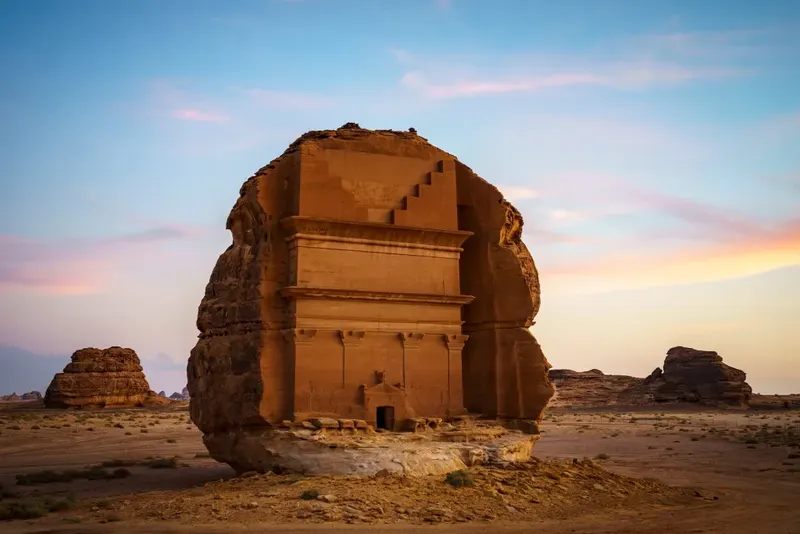
AlUla lies in the northwest of Saudi Arabia, a long oasis valley where sandstone outcrops rise from date palms and the desert floor. For more than two thousand years, caravans on the incense route passed this way, leaving tombs, inscriptions and whole cities carved into the rock. Today the valley pairs that deep history with sweeping canyon landscapes and a mirrored concert hall set among the cliffs. It remains, above all, a place of stone, light and quiet.
AlUla is a quieter alternative. It's ready to explore in the Nuvoha app: set your budget and see complete AlUla trips.
Why visit AlUla
AlUla holds Saudi Arabia's first UNESCO World Heritage Site, Hegra, where more than a hundred Nabataean tombs stand carved into desert sandstone, their facades as crisp as the day they were cut. Nearby lie the older kingdoms of Dadan, the inscription-covered canyon of Jabal Ikmah and the mud-brick lanes of AlUla Old Town. The landscape is a draw in its own right: the wind-carved Elephant Rock, the pinnacles of Gharameel and some of the clearest night skies in the region. Maraya, a hall clad entirely in mirrors, reflects the whole valley back at itself. Few places layer archaeology and scenery so completely.
Around the valley
- Old Town and the oasis: The historic heart, where restored mud-brick lanes give way to a dense band of date palms and citrus fed by the valley's springs.
- Hegra and the northern desert: The archaeological zone north of town, taking in Hegra, the isolated Tomb of Lihyan and open desert reaching toward the horizon.
- Dadan and Jabal Ikmah: A cluster of pre-Nabataean sites south of the oasis, pairing the cliff tombs of Dadan with the inscription canyon of Jabal Ikmah.
- Ashar Valley: A dramatic canyon of sheer sandstone walls east of the centre, home to Maraya and to desert retreats tucked among the rock.
- Gharameel: A field of slender sandstone pinnacles out in the desert, a favoured spot for stargazing under exceptionally dark skies.
- Harrat Uwayrid: A high volcanic plateau of dark basalt rising to the west, its lava fields overlooking the oasis far below.
What AlUla feels like
AlUla feels hushed and elemental. The valley is vast, the sandstone glows amber at dawn and deep red at dusk, and sound seems to fall away between the rock walls. Development has been deliberately light and low, so the oasis keeps its palm groves, its old town and its dark skies rather than a skyline. Days move with the sun: sheltered mornings and late afternoons for exploring the tombs and canyons, the hottest hours spent in shade. After dark the desert cools quickly and the stars arrive in force. It is a landscape that asks to be taken slowly.
Sites to plan around
- Hegra: Saudi Arabia's first UNESCO World Heritage Site, a Nabataean city of monumental rock-cut tombs, including the vast, freestanding Tomb of Lihyan son of Kuza.
- Dadan: The cliffside capital of the ancient Dadanite and Lihyanite kingdoms, its lion-flanked tombs cut high into red sandstone.
- Jabal Ikmah: A desert canyon lined with hundreds of ancient inscriptions, often called an open-air library and recognised on UNESCO's Memory of the World register.
- AlUla Old Town: A dense maze of mud-brick and stone houses on the oasis floor, layered over centuries and partly restored to wander.
- Elephant Rock: A towering natural arch of wind-carved sandstone resembling an elephant, a gathering point as the light softens in the evening.
- Maraya: A concert and events hall sheathed entirely in mirrored glass, reflecting the Ashar canyon and recognised as the world's largest mirrored building.
The oasis table
The oasis has fed travellers for millennia, and its groves still yield dates, citrus and moringa that turn up across local menus. Cooking here leans Bedouin and Hejazi: lamb and rice, bread baked over embers, and meat slow-cooked in earth ovens in the old desert way. Dates and gahwa (lightly spiced Arabic coffee) open most meals. A cluster of cafes and restaurants has grown up around the old town and the valley's retreats, many making a point of the oasis's own produce.
- Dates
- Kabsa
- Mandi
- Moringa tea
- Gahwa with dates
Getting around
The sites are spread along the valley and out into the desert, so getting between them means a car or a guided tour. Access to the main archaeological areas, including Hegra, is by official tour with a rawi (local guide), arranged through the AlUla experiences service, and shuttle buses link the visitor points in the central oasis. Distances are short by Saudi standards, but the desert stretches are best not tackled alone. AlUla International Airport sits a short drive south of the oasis and connects by air to Riyadh and Jeddah, with seasonal links reaching further afield. Most visitors arrange a transfer or car in advance, as options at the airport are limited.
Practical pointers
- AlUla is a heritage landscape; keep to marked paths and never touch, climb on or remove anything from the tombs, carvings or inscriptions.
- Dress modestly in this rural, traditional region; loose clothing covering shoulders and knees suits both the culture and the desert sun.
- Alcohol is prohibited across Saudi Arabia, AlUla included.
- Ask permission before photographing residents or guides, and follow your rawi's guidance at the sites.
- During Ramadan, avoid eating, drinking or smoking in public during daylight hours.
- October to March is the season here, with warm days and cold desert nights; bring layers for after dark and for early starts.
- Reserve Hegra and other guided experiences ahead, as access is by timed tour rather than open entry.
- Sunrise and the last hour before sunset give the sandstone its deepest colour and the gentlest heat for exploring.
- The dark skies reward a late night out; Gharameel and the open desert are known for stargazing.
- Carry water and sun protection at all times, even in winter, as shade is scarce out among the rocks.
- A Saudi tourist eVisa covers AlUla for eligible nationalities; check the requirements before travelling.
Best for
- Nature
- Quieter travel
Key facts
| Country | Saudi Arabia |
|---|---|
| Region | Middle East & North Africa |
| Airports | ULH |
| Trip length fit | Short-trip friendly |
AlUla essentials
| Currency | Saudi Riyal (SAR) |
|---|---|
| Language | Arabic; English is widely spoken in cities, hotels and restaurants |
| Time zone | Arabia Standard Time, UTC+3, no daylight saving |
| Emergency number | 911 |
| Driving side | Right |
| Tap water | Desalinated and generally safe in cities, though most residents and visitors drink bottled water |
Climate & seasons
| Month | Typical range | Season |
|---|---|---|
| January | 9°C to 22°C | Mild desert winter |
| April | 18°C to 31°C | Warm spring |
| July | 27°C to 40°C | Very hot desert summer |
| October | 20°C to 33°C | Hot autumn |
Typical stay
- Weekend-friendly
- Short break (2–5 days)
AlUla works as a weekend break just as well as a longer stay.
Getting there
AlUla is served via ULH.
- ULH
Is it your kind of trip?
Ideal if…
- you want nature within easy reach
- you like places before everyone else finds them
Maybe not if…
- a beach-first holiday is the priority
- you want big-city energy around the clock
Pairs well with
Compare with
More in Middle East & North Africa
Near AlUla
Travel style
- Short-trip friendly
- Nature
Frequently asked questions
Which airports serve AlUla?
AlUla is served via ULH.
Is AlUla good for a weekend trip?
Yes, AlUla works for a weekend as well as a longer stay.
What kind of trip is AlUla best for?
AlUla is best for nature trips.
Which destinations pair well with AlUla?
Within multi-city range: Medina (293 km), Sharm El Sheikh (379 km), Hurghada (413 km).
What is AlUla best known for?
AlUla is best known for Hegra, Saudi Arabia's first UNESCO World Heritage Site, a Nabataean city of monumental rock-cut tombs. The wider valley adds older kingdoms, inscription canyons, a historic oasis town and striking desert scenery.
Is AlUla a beach destination?
No. AlUla is an inland desert oasis in the northwest of Saudi Arabia. Its appeal lies in archaeology, sandstone canyons, palm groves and some of the clearest night skies in the region, not the coast.
How do you visit Hegra?
Access to Hegra is by official guided tour with a local rawi, arranged through AlUla's experiences service. Tours run to set times, so it is worth reserving your slot before you arrive.
When is the best time to visit AlUla?
The cooler months from October to March are the most comfortable, with pleasant daytime temperatures for exploring the tombs and canyons. Nights can be genuinely cold, and high summer is very hot.