
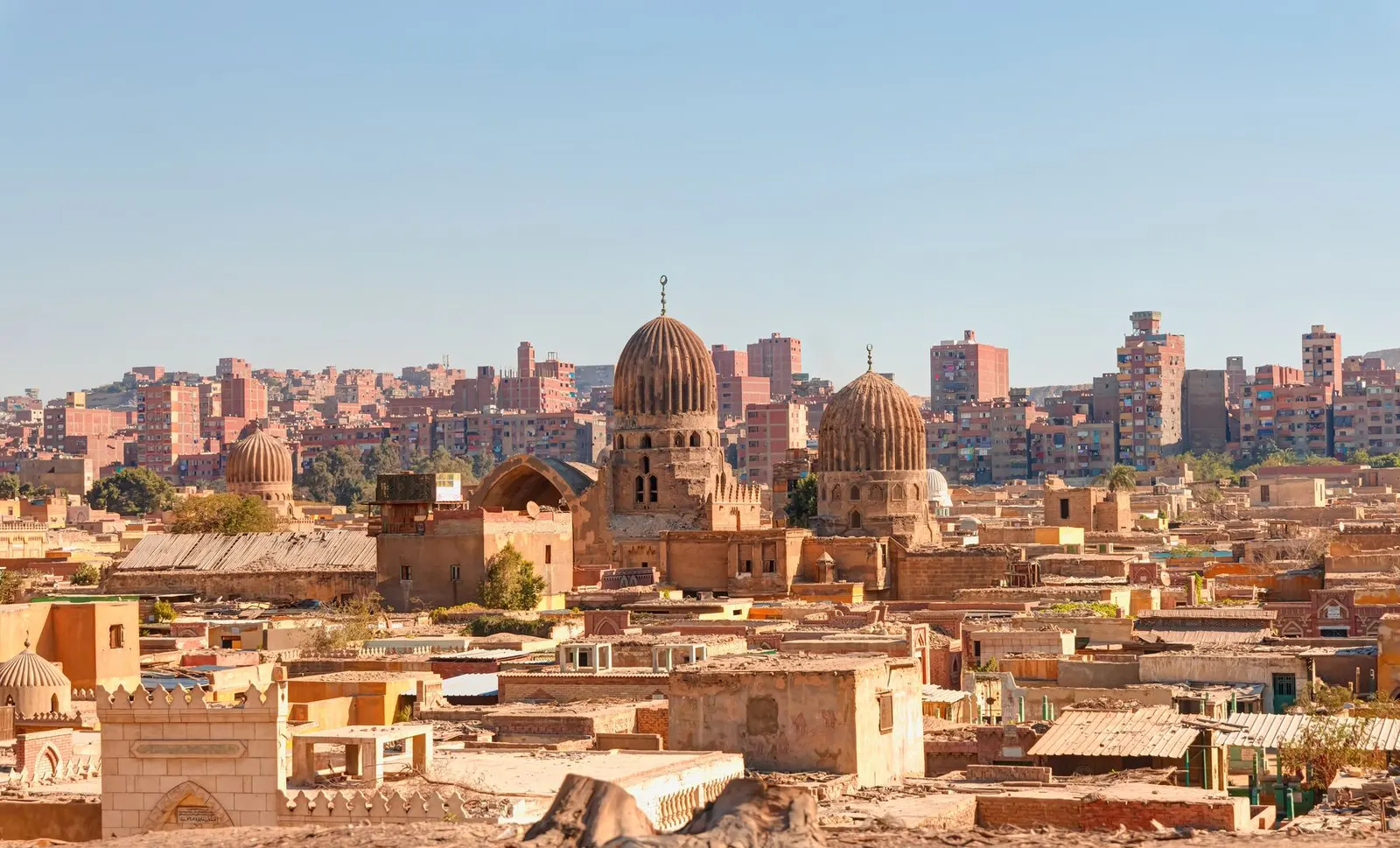
The pyramids first appear from an ordinary flyover: Giza's suburbs run right up to the plateau's edge, so Khufu's 4,500-year-old tomb shares a skyline with apartment blocks and billboards. That collision is Cairo: the Arab world's largest city, stacked along the Nile, where medieval minarets, Coptic churches and pharaonic stone all hold the same crowded horizon.
Cairo is a quieter alternative. It's ready to explore in the Nuvoha app: set your budget and see complete Cairo trips.
Why visit Cairo
The Giza Plateau needs no argument, and the Grand Egyptian Museum nearby now shows Tutankhamun's burial treasures in full. Yet Islamic Cairo is a wonder of its own: a thousand years of mosques, madrasas and caravanserais along Al-Muizz Street, with Saladin's Citadel above. Coptic Cairo preserves some of Christianity's oldest churches inside a Roman fortress, and Khan el-Khalili has bazaar-traded since the fourteenth century. Few cities let you cross five millennia between breakfast and dinner.
Pyramids, mosques and museums
- Pyramids of Giza and the Sphinx: The last survivor of the ancient world's seven wonders; the Great Pyramid stood as the tallest structure on earth for nearly four thousand years.
- Grand Egyptian Museum: The vast museum beside the Giza Plateau, purpose-built to display Tutankhamun's complete burial treasures and Khufu's cedar solar boat.
- Al-Muizz Street: A kilometre of Fatimid, Mamluk and Ottoman monuments through the heart of Islamic Cairo, running between the gates of Bab al-Futuh and Bab Zuweila.
- Citadel of Saladin: The twelfth-century fortress above the city, crowned by the alabaster-clad Mosque of Muhammad Ali, with views towards Giza on clear days.
- Khan el-Khalili: Cairo's great bazaar since the fourteenth century: brass, spices and the mirrored halls of El Fishawy, a cafe pouring tea since 1797.
- Coptic Cairo: The walled Old Cairo quarter, where the Hanging Church is built over a Roman gatehouse near the Ben Ezra Synagogue.
Cairo, district by district
- Downtown (Wust el-Balad): The nineteenth-century centre of grand, faded boulevards around Tahrir Square, laid out under Khedive Ismail.
- Islamic Cairo: The medieval city east of Downtown, a UNESCO-listed density of mosques, gates, madrasas and markets.
- Zamalek: A leafy Nile island of embassies, galleries and cafes, joined to both banks by bridges.
- Old (Coptic) Cairo: The city's oldest inhabited quarter, holding Roman fortress remains and its earliest churches.
- Giza: The west-bank sprawl that ends abruptly at the desert plateau and the pyramids.
Street food and slow stews
Egyptian cooking is hearty and street-led. Koshari (rice, lentils, pasta, chickpeas, crisped onions and spiced tomato sauce in one bowl) is the national comfort dish. Breakfast runs on ful medames, slow-stewed fava beans, and ta'ameya, the fava-based Egyptian take on falafel. Molokhia, a garlicky jute-leaf stew, inspires lifelong devotion, while feteer, a flaky layered pastry, swings sweet or savoury depending on the hour.
- Koshari
- Ful medames with ta'ameya
- Molokhia (jute-leaf stew)
- Feteer (layered pastry)
- Mahshi (stuffed vine leaves and vegetables)
What Cairo feels like
Cairo is loud, warm-hearted and unceasing: around twenty million people, car horns as conversation, tea and backgammon at every pavement cafe. The Nile provides the breathing space: felucca sails at sunset, the leafy island calm of Zamalek. Fridays start hushed until midday prayers; Ramadan flips the clock entirely, with quiet days and celebratory nights. Expect friendliness, expect welcome-to-Egypt greetings, and expect everything to take a little longer than planned.
Navigating a giant of a city
The Cairo Metro is the quickest way through the traffic, with useful stops for Downtown and Coptic Cairo at Mar Girgis, and women-only carriages in the middle of every train. Ride-hailing apps are the standard visitor alternative to street taxis and remove the fare negotiation. Distances are large and the traffic is legendary, so cluster your sightseeing by district and allow slack between neighbourhoods. Cairo International Airport lies north-east of the centre, and the drive to Downtown or Giza varies hugely with traffic. Pad your departure timings generously.
Hard-won local advice
- Baksheesh (small tips for services large and small) is a genuine part of the economy; keep a pocket of small notes for attendants, helpers and washroom staff.
- In mosques, cover shoulders and knees, remove shoes, and carry a headscarf if you are a woman; historic mosques welcome respectful visitors outside prayer times.
- Modest dress generally draws less attention for men and women alike, particularly away from the main visitor districts.
- During Ramadan, eat and drink discreetly in public by day; the evenings become the social high point of the year.
- Crossing the street is an acquired art: keep a steady pace with no sudden stops, or simply cross alongside a local.
- Use ride-hailing or agree fares before any taxi journey: airport and pyramid touts open with optimistic numbers.
- At Giza, a firm and cheerful la shukran handles camel-photo offers and self-appointed guides you did not ask for.
- Carry small Egyptian pound notes for baksheesh, toilets and water; large notes are hard to break at street level.
- Start early: the plateau light is at its best before mid-morning and the heat still manageable.
- A sunset felucca sail from the Zamalek or Garden City banks is the calmest hour the city offers.
Best for
- City breaks
- Quieter travel
Key facts
| Country | Egypt |
|---|---|
| Region | Middle East & North Africa |
| Airports | CAI |
| Trip length fit | Short-trip friendly |
Cairo essentials
| Currency | Egyptian Pound (EGP) |
|---|---|
| Language | Arabic; English is widely understood in tourism |
| Time zone | Eastern European Time (UTC+2), with daylight saving observed in summer (UTC+3) |
| Emergency number | 122 (police), 123 (ambulance), 180 (fire) |
| Driving side | Right |
| Tap water | Not for drinking: stick to bottled water, which is available everywhere |
Climate & seasons
| Month | Typical range | Season |
|---|---|---|
| January | 9°C to 19°C | Mild winter |
| April | 15°C to 29°C | Warm spring |
| July | 23°C to 35°C | Hot dry summer |
| October | 18°C to 30°C | Warm autumn |
Typical stay
- Weekend-friendly
- Short break (2–5 days)
Cairo works as a weekend break just as well as a longer stay.
Getting there
Cairo is served via CAI.
- CAI
Is it your kind of trip?
Ideal if…
- you like walkable city energy
- you like places before everyone else finds them
Maybe not if…
- a beach-first holiday is the priority
Pairs well with
Compare with
| Cairo | Sharm El Sheikh | Hurghada | |
|---|---|---|---|
| Country | Egypt | Egypt | Egypt |
| Region | Middle East & North Africa | Middle East & North Africa | Middle East & North Africa |
| Styles | City | Beach | Beach |
| Trip length fit | Weekend-friendly | Weekend-friendly | Weekend-friendly |
| Airports | 1 | 1 | 1 |
More in Middle East & North Africa
Near Cairo
Travel style
- Short-trip friendly
- City
Frequently asked questions
Which airports serve Cairo?
Cairo is served via CAI.
Is Cairo good for a weekend trip?
Yes, Cairo works for a weekend as well as a longer stay.
What kind of trip is Cairo best for?
Cairo is best for city trips.
Which destinations pair well with Cairo?
Within multi-city range: Aqaba (353 km), Sharm El Sheikh (376 km), Hurghada (402 km).
Is Cairo safe to walk around?
Central districts stay busy late into the night and petty crime is comparatively rare; the real hazards are traffic and uneven pavements. Persistent selling around the tourist sites is tiring rather than threatening: a good-humoured, firm no covers nearly all of it.
Should I use the metro as a visitor?
Yes, especially to beat the traffic. It is fast, frequent and signed in English. Women travelling alone often prefer the women-only carriages in the middle of each train. Avoid the crush of peak commuting hours where you can.
How much time do the pyramids need?
Half a day covers the plateau (the three pyramids, the Sphinx and a panoramic viewpoint) comfortably. The Grand Egyptian Museum deserves several hours of its own, so many visitors split plateau and museum across two cooler mornings.