
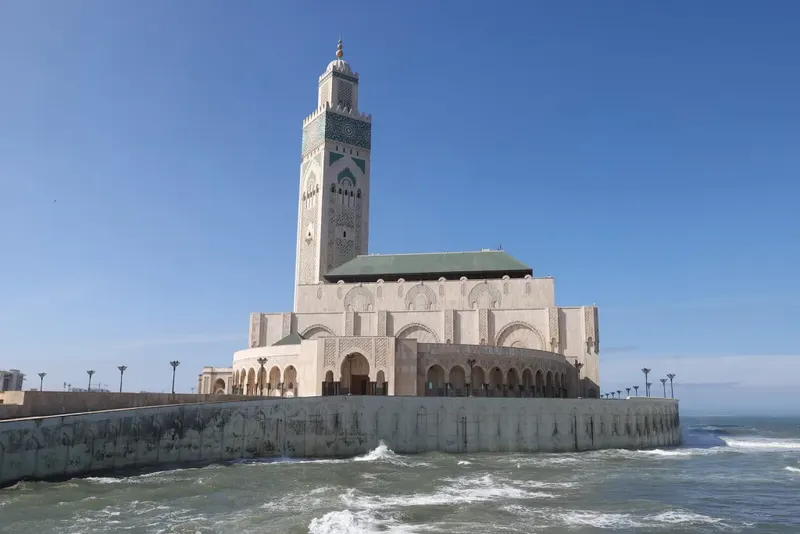
Casablanca is Morocco's largest city and its commercial engine, a working Atlantic port rather than a holiday resort. It is a city of boulevards and offices, of 1920s Art Deco facades and a French-era plan, gathered around the vast Hassan II Mosque that stands out over the sea. Here the everyday Morocco of business, trains and markets meets the ocean at the Corniche. Travellers usually come for the architecture, the mosque and the life of the country's biggest city, not for the beach.
Casablanca is a quieter alternative. It's ready to explore in the Nuvoha app: set your budget and see complete Casablanca trips.
Why visit Casablanca
Casablanca rewards those who like cities. The Hassan II Mosque is the set piece, one of the largest in the world and among the few in Morocco open to non-Muslim visitors, its minaret rising above a platform built out over the Atlantic. The centre holds one of the largest concentrations of Art Deco and neo-Moorish architecture in North Africa, best seen on foot around Place Mohammed V. The Habous quarter blends Moroccan craft with French planning, the old medina sits by the port, and the Ain Diab Corniche is where the city eats and walks by the sea. Fast trains run north to Rabat and Tangier, with regular services on to Marrakesh.
Landmarks and architecture
- Hassan II Mosque: One of the largest mosques in the world, part-built over the Atlantic, with a soaring minaret and interiors of carved plaster, cedar and tilework, open to visitors on guided tours.
- The Art Deco centre: Streets of 1920s and 1930s Art Deco and neo-Moorish buildings around Place Mohammed V, the architectural heart of the city.
- The Habous quarter: A district built in the French era that blends Moroccan medina and Art Deco, known for its arcades, olives, pastries and bookshops.
- The Corniche at Ain Diab: The seafront strip of promenades, pools and restaurants, with the shrine of Sidi Abderrahmane on a tidal rock offshore.
- The old medina: The city's original walled quarter by the port, smaller and less visited than those of Fez or Marrakesh.
- Sacre-Coeur: A white former church in Art Deco Gothic style, now deconsecrated and standing as an architectural landmark near the Parc de la Ligue Arabe.
Around the city
- Centre-ville: The downtown core of Art Deco avenues, administrative squares and the main train stations.
- Old Medina: The walled old town by the port, a knot of lanes and small shops between the centre and the sea.
- Habous: The planned new medina to the south, with arcaded streets, craft shops and traditional food.
- Ain Diab: The coastal district west of the mosque, home to the Corniche, beach clubs and the Morocco Mall.
- Maarif: A modern district of shops, cafes and restaurants, one of the city's main places to eat and stroll.
The Casablanca table
Casablanca eats like a coastal capital, pairing Moroccan classics with Atlantic seafood and a strong cafe culture. The central market and the port are the places for grilled fish, fried sardines and shellfish, while restaurants turn out tagines, couscous and the sweet-savoury layered pie called pastilla. Street corners sell msemen and other flatbreads, snail soup and maakouda potato fritters. French influence lingers in the patisseries and pavement cafes, and the ritual of sweet mint tea runs through the day. Morocco is a major sardine producer, and the fish here is a point of pride.
- Grilled Atlantic fish and seafood
- Pastilla (sweet-savoury layered pie)
- Tagine
- Grilled sardines
- Msemen (flaky flatbread)
What Casablanca feels like
This is urban Morocco at full tilt: traffic, cafes, construction and commerce, softened by ocean light and sea air. Mornings belong to the markets and the offices, evenings to the Corniche, where families stroll and restaurants fill along the shore. The mix of eras is everywhere, from crumbling Art Deco apartments to the sleek marina and the modern tramway threading the avenues. It is less immediately charming than Marrakesh or Fez and makes fewer concessions to visitors, which is part of its appeal: a real city getting on with its day, with the great mosque and the Atlantic as its backdrop.
Getting around the city
A modern tramway crosses the city and is handy for the main avenues, while metered red petit taxis cover short hops within the centre and larger grand taxis run longer routes. Trains leave the central Casa-Port and Casa-Voyageurs stations for the wider country, including fast Al Boraq services to Rabat and Tangier. The centre is walkable, though the Corniche at Ain Diab is a tram-and-walk or taxi ride from downtown, and traffic can be heavy. Mohammed V International Airport is Morocco's main gateway, at Nouaceur about thirty kilometres south of the city. Direct trains connect it to the central Casa-Voyageurs and Casa-Port stations, and taxis are available for the journey into town.
Practical pointers
- As a working city with fewer tourists, Casablanca appreciates modest dress, with shoulders and knees covered away from the Corniche.
- The Hassan II Mosque is visited on a guided tour with modest dress and shoes removed, while other mosques are closed to non-Muslims.
- Ask before photographing people, and haggle good-naturedly in the medina and Habous rather than in fixed-price shops.
- Tipping is customary for waiters, guides and attendants, and small cash is useful for taxis and markets.
- The Hassan II Mosque is one of the few in Morocco you can enter, on timed guided tours, so check the schedule and dress modestly.
- Give the Art Deco centre an unhurried walk around Place Mohammed V to appreciate the facades.
- The Ain Diab Corniche is where the city relaxes by the sea, busiest in the evenings and at weekends.
- Casablanca is a city break more than a beach stay, and pairs naturally with Rabat or Marrakesh by train.
- Al Boraq high-speed trains reach Rabat and Tangier quickly from Casa-Voyageurs.
- Insist on the meter in petit taxis for short trips, and carry small notes.
Best for
- City breaks
- Quieter travel
Key facts
| Country | Morocco |
|---|---|
| Region | Middle East & North Africa |
| Airports | CMN |
| Trip length fit | Short-trip friendly |
Casablanca essentials
| Currency | Moroccan Dirham (MAD) |
|---|---|
| Language | Arabic and Amazigh (Berber) are official; French is widely spoken, and English is increasingly common in tourist areas |
| Time zone | UTC+1 year-round, except during Ramadan when clocks move back to UTC+0 |
| Emergency number | 19 (police in cities); 15 (ambulance and fire) |
| Driving side | Right |
| Tap water | Treated in major cities, but most visitors drink bottled or filtered water |
Climate & seasons
| Month | Typical range | Season |
|---|---|---|
| January | 8°C to 18°C | Mild winter |
| April | 12°C to 22°C | Warm spring |
| July | 20°C to 27°C | Warm dry summer |
| October | 16°C to 24°C | Mild autumn |
Typical stay
- Weekend-friendly
- Short break (2–5 days)
Casablanca works as a weekend break just as well as a longer stay.
Getting there
Casablanca is served via CMN.
- CMN
Is it your kind of trip?
Ideal if…
- you like walkable city energy
- you like places before everyone else finds them
Maybe not if…
- a beach-first holiday is the priority
Pairs well with
Compare with
More in Middle East & North Africa
Near Casablanca
Travel style
- Short-trip friendly
- City
Frequently asked questions
Which airports serve Casablanca?
Casablanca is served via CMN.
Is Casablanca good for a weekend trip?
Yes, Casablanca works for a weekend as well as a longer stay.
What kind of trip is Casablanca best for?
Casablanca is best for city trips.
Which destinations pair well with Casablanca?
Within multi-city range: Marrakesh (200 km), Agadir (380 km), Lisbon (618 km).
Is Casablanca a beach resort?
No. It is Morocco's largest city and business capital, and the draw is the Hassan II Mosque, the Art Deco architecture and urban life, with the Ain Diab Corniche for the seafront. For a beach holiday, Agadir or the smaller coastal towns are a better fit.
Can I go inside the Hassan II Mosque?
Yes. It is one of the few mosques in Morocco open to non-Muslims, on guided tours at set times through the day. Dress modestly and expect to remove your shoes.
Is there a connection to the film Casablanca?
The 1942 film was made in Hollywood, not in the city, and its wartime story is fictional. A restaurant called Rick's Cafe was later created here as a homage to it.
How do I get from the airport into the city?
Mohammed V Airport is about thirty kilometres south, with direct trains to the central Casa-Voyageurs and Casa-Port stations as well as taxis for the trip into town.