
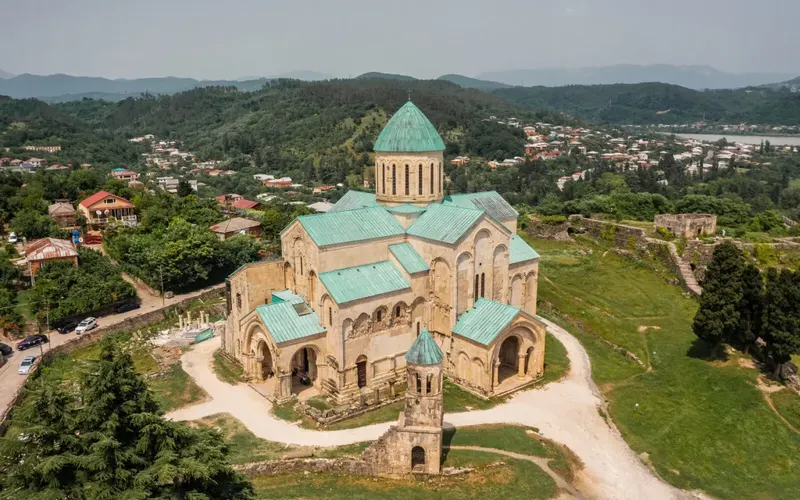
Kutaisi is western Georgia's old royal capital, a green, low-rise city set on the fast-flowing Rioni River. Once the seat of the ancient kingdom of Colchis, the land of the Golden Fleece, it keeps a slower pace than Tbilisi and a wetter, softer climate. Its great draws stand on the hills around it: the restored Bagrati Cathedral above the town, the medieval monastery of Gelati, and a limestone landscape riddled with caves just beyond the suburbs.
Kutaisi is well suited to city trips. It's ready to explore in the Nuvoha app: set your budget and see complete Kutaisi trips.
Why visit Kutaisi
Kutaisi rewards travellers who use it as a base for the surrounding hills and caves. Gelati Monastery, founded by King David the Builder, holds some of Georgia's finest medieval mosaics and frescoes, while nearby Motsameta perches dramatically on a cliff above a river gorge. Above the town, the great dome of Bagrati Cathedral has crowned the hill above the Rioni since the eleventh century. Beyond the streets lie two remarkable caves, the stalactite chambers of Prometheus and the karst passages and prehistoric footprints of Sataplia, along with the faded mineral-bath town of Tskaltubo. The city itself is small, walkable and refreshingly unhurried.
Highlights
- Gelati Monastery: A UNESCO-listed medieval monastery and former academy, celebrated for its golden mosaics and layered frescoes.
- Bagrati Cathedral: The great domed cathedral on Ukimerioni Hill, first raised in the eleventh century and rebuilt in recent years.
- Motsameta Monastery: A small, atmospheric monastery set on a cliff above a bend in the Tskaltsitela River, near Gelati.
- Prometheus Cave: A vast system of illuminated stalactite halls near Tskaltubo, ending with an optional underground boat ride.
- Sataplia Nature Reserve: A forested karst reserve with a show cave, preserved dinosaur footprints and a glass viewing platform.
- Central square and Green Bazaar: The Colchis Fountain, the White Bridge and the busy covered market at the heart of the town.
Areas to know
- Central square and old town: The heart of Kutaisi around the Colchis Fountain, the theatre and the streets down to the White Bridge.
- The Rioni riverbanks: The green banks and bridges either side of the fast river running through the middle of town.
- Ukimerioni Hill: The cathedral hill above the centre, crowned by Bagrati and offering a wide view over the rooftops.
- Gelati and Motsameta: The monastery hills to the north-east, reached by a short drive through orchards and villages.
- Tskaltubo: A once-grand mineral-bath town to the west, with faded sanatoriums and the road to Prometheus Cave.
- Sataplia and the karst hills: The wooded reserve just outside town where caves and prehistoric footprints sit among the greenery.
Food & drink
Kutaisi sits in Imereti, a region with its own take on the Georgian table. The local khachapuri, Imeruli, is a round, flat cheese bread, less rich than the boat-shaped coastal version. Cooks here lean on walnuts, herbs and the fiery red-pepper paste ajika, turning out vivid pkhali, stuffed vegetables and bean dishes. The covered market is the place to taste it, its stalls piled with cheeses, spices, pickles and strings of churchkhela, alongside the amber wines of the surrounding valleys.
- Imeruli khachapuri
- Pkhali (vegetable and walnut pate)
- Khinkali
- Ajika (red-pepper paste)
- Churchkhela
What Kutaisi feels like
Kutaisi is quiet and green, a provincial capital where daily life still centres on the river, the market and the church bells. The wide Rioni rushes through the middle of town, crossed by the little White Bridge, and the central square turns around a golden fountain modelled on Colchian treasures. The pace is gentle: mornings at the covered bazaar, afternoons under the plane trees, evenings that end early. Being western Georgia, the weather is milder and wetter than Tbilisi, the hills a lush green after rain. What gives Kutaisi its character is the sense of deep history sitting lightly among ordinary streets.
Getting around
Central Kutaisi is compact and easily walked, with the main sights, market and river all close together. For the monasteries, caves and Tskaltubo, taxis and ride-hailing apps are the simplest choice, and many visitors hire a driver for a half or full day to link several together. Marshrutka minibuses connect the city with Tbilisi, Batumi and nearby towns, and the caves lie only a short drive from the centre. Kutaisi International Airport, named after King David the Builder, sits around 20 kilometres west of the city and has grown into one of Georgia's main international gateways, with wide connections across Europe. Buses and taxis meet arriving flights for the run into town and on to Tbilisi or Batumi.
Good to know
- Gelati, Motsameta and Bagrati are working religious sites: cover shoulders and knees, and women usually cover their hair, with wraps often provided at the door.
- The pace of life is gentle and provincial, so expect shops and kitchens to keep their own unhurried hours.
- A little Georgian goes a long way here, where English is less common than in Tbilisi.
- Tskaltubo's abandoned sanatoriums are atmospheric but decaying; tread carefully and respect any that are still lived in or guarded.
- Group the sights by direction, pairing Gelati with Motsameta, and Prometheus Cave with Sataplia, to save doubling back.
- Hiring a driver for the day is the easiest way to see the monasteries and caves without your own car.
- Bring a light waterproof; western Georgia is greener because it is noticeably wetter than the east.
- The caves stay cool year-round, so carry a layer even in high summer.
- Allow time for the Green Bazaar, one of the liveliest and most colourful markets in the country.
- Kutaisi makes a natural first or last stop in Georgia, given its international airport.
Best for
- City breaks
Key facts
| Country | Georgia |
|---|---|
| Region | Middle East & North Africa |
| Airports | KUT |
| Trip length fit | Short-trip friendly |
Kutaisi essentials
| Currency | Georgian Lari (GEL) |
|---|---|
| Language | Georgian, written in its own alphabet; Russian and some English also understood |
| Time zone | UTC+4, observed year-round |
| Emergency number | 112 |
| Driving side | Right |
| Tap water | Generally safe to drink in Tbilisi and most towns |
Climate & seasons
| Month | Typical range | Season |
|---|---|---|
| January | 2°C to 10°C | Cool wet winter |
| April | 10°C to 20°C | Mild spring |
| July | 21°C to 30°C | Warm humid summer |
| October | 12°C to 21°C | Mild autumn |
Typical stay
- Weekend-friendly
- Short break (2–5 days)
Kutaisi works as a weekend break just as well as a longer stay.
Getting there
Kutaisi is served via KUT.
- KUT
Is it your kind of trip?
Ideal if…
- you like walkable city energy
Maybe not if…
- a beach-first holiday is the priority
Pairs well with
Compare with
More in Middle East & North Africa
Near Kutaisi
Travel style
- Short-trip friendly
- City
Frequently asked questions
Which airports serve Kutaisi?
Kutaisi is served via KUT.
Is Kutaisi good for a weekend trip?
Yes, Kutaisi works for a weekend as well as a longer stay.
What kind of trip is Kutaisi best for?
Kutaisi is best for city trips.
Which destinations pair well with Kutaisi?
Within multi-city range: Tbilisi (212 km), Istanbul (1,143 km), Antalya (1,160 km).
What is Kutaisi best used for?
It works well as a relaxed base for western Georgia. Within a short drive you have the monasteries of Gelati and Motsameta, the Prometheus and Sataplia caves and the town of Tskaltubo, while the compact centre is pleasant to walk in the evenings.
How do I reach the caves and monasteries?
Most visitors use taxis, ride-hailing apps or a hired driver, since public transport to the sites is limited. Gelati and Motsameta sit close together to the north-east, and the two caves lie to the west near Tskaltubo, so each pair makes an easy half-day.
Is Kutaisi worth a stop between Tbilisi and Batumi?
Yes. It sits roughly midway and has its own international airport, so many people begin or end a Georgian trip here, or break the journey for a night to see the monasteries and caves.
What is the weather like?
Western Georgia is milder and considerably wetter than Tbilisi, so the countryside is lush and green. Summers are warm and humid, winters are cool rather than harsh, and a waterproof is useful in most seasons.