
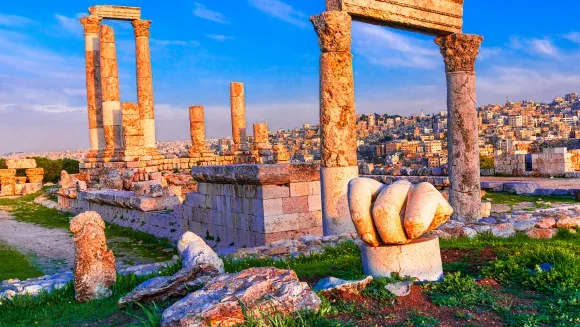
Amman spreads across a tangle of hills where cream-coloured houses climb every slope and staircases stitch one neighbourhood to the next. At its heart the Roman Theatre cuts into the hillside below the Citadel, whose broken columns and Umayyad palace survey the whole basin. Ancient Philadelphia to the Greeks and Romans, the modern capital wears its layers lightly, folding markets, mosques and coffee houses into the folds of the land.
Amman is a quieter alternative. It's ready to explore in the Nuvoha app: set your budget and see complete Amman trips.
Why visit Amman
Amman rewards slow wandering more than a checklist. The Citadel and Roman Theatre anchor the ancient city, while the Jordan Museum gathers the country's deep history, from the plaster Ain Ghazal figures to scrolls found near the Dead Sea. Downtown, the souks trade gold, spices and sweets, and Rainbow Street fills with cafe tables as the afternoon cools. Just as important is what lies beyond: Amman is the natural base for the Roman colonnades of Jerash, the mosaic town of Madaba, the heights of Mount Nebo and the long descent to the Dead Sea, with Petra a half-day's drive south.
Highlights
- Amman Citadel: The hilltop heart of ancient Philadelphia, where the Temple of Hercules and a domed Umayyad palace look out over the theatre and downtown.
- Roman Theatre: A steep second-century amphitheatre cut into the hillside, still seating thousands and framed by the smaller Odeon next door.
- The Jordan Museum: The national collection, home to the Neolithic Ain Ghazal statues and artefacts linked to the Dead Sea Scrolls.
- Rainbow Street: A ridge-top run of cafes, old villas and the Friday Souk Jara market in the Jabal Amman quarter.
- King Abdullah I Mosque: A blue-domed mosque whose mosaic interior welcomes respectful visitors outside prayer times.
- Downtown souks (Al-Balad): The old commercial core, where gold, spice and sweet shops cluster and the scent of knafeh drifts from the bakeries.
Areas to know
- Downtown (Al-Balad): The historic core in the valley, home to the Roman Theatre, the souks and the oldest mosques.
- Jabal Amman: An old hill of embassies and restored villas, threaded by Rainbow Street and organised around the numbered Circles.
- Jabal al-Weibdeh: A creative quarter of galleries, bookshops and courtyard cafes on one of the central hills.
- Abdali: The new downtown, a cluster of towers, a boulevard and modern hotels north of the old centre.
- Sweifieh: A busy west-Amman district for shopping and dining, spread around Wakalat Street.
- Shmeisani: A business and hotel district of offices, banks and evening restaurants.
Food & drink
Jordanian tables centre on generosity. The national dish is mansaf, lamb simmered in a sauce of fermented dried yoghurt called jameed, spooned over rice and thin shrak bread and shared from a communal platter. Around it comes a spread of mezze: hummus, moutabal, tabbouleh, warm falafel and fresh khubz from the bakery. Amman finishes sweet and famous, with trays of knafeh, its stretchy cheese under crisp orange pastry and syrup, cut and served warm by the piece.
- Mansaf
- Knafeh
- Hummus and falafel
- Maqluba (upturned rice and meat)
- Shawarma
What Amman feels like
The city runs on gradients and coffee. Mornings begin with the smell of cardamom coffee and fresh khubz, and the hum of traffic winding up and down the jabals. West Amman leans modern and unhurried, its cafes, galleries and leafy circles drawing students and families; the older east feels denser and more traditional, its markets busiest in the cool of evening. Because Amman sits high on the plateau, the air stays dry and the nights turn genuinely cool, and winter can even bring snow. Fridays are quiet until the afternoon, when families gather and downtown slowly wakes.
Getting around
Amman has no metro, so most visitors move by taxi or ride-hailing app, which removes the need to haggle over fares. A bus rapid transit network now links parts of the city, though it takes some learning. The centre is walkable in patches, but the hills are steep and long; look for the public staircases that shortcut between neighbourhoods, and cluster your sightseeing by hill to spare your legs and the traffic. Queen Alia International Airport lies around 30 kilometres south of the city. The Airport Express bus (Sariyah) runs to and from the centre through the day and evening, and taxis are metered from the arrivals rank; allow extra time in weekday rush hours.
Good to know
- Dress modestly away from hotel pools: covered shoulders and knees keep you comfortable and welcome, especially downtown and in the older east.
- In mosques, remove shoes and cover up; women should carry a headscarf, and all visitors should come outside prayer times.
- A small tip for good service is customary in restaurants, cafes and to helpers; keep some small notes handy.
- The weekend falls on Friday and Saturday, and Friday mornings are quiet; plan errands and transport around the midday prayer.
- Wear proper shoes for the hills and staircases; the centre is steeper than it looks on a map.
- Give downtown its due at dusk, when the souks are lively and the Citadel catches the last light.
- Jerash, Madaba, Mount Nebo and the Dead Sea all make comfortable half or full-day trips by car from the city.
- Nights and winters are cold on the plateau, so pack a warm layer even in the shoulder seasons.
- Agree on a taxi meter or use a ride-hailing app to keep journeys simple.
- Carry small notes for tips, bakeries and market stalls, where change for large notes is scarce.
Best for
- City breaks
- Quieter travel
Key facts
| Country | Jordan |
|---|---|
| Region | Middle East & North Africa |
| Airports | AMM |
| Trip length fit | Short-trip friendly |
Amman essentials
| Currency | Jordanian Dinar (JOD) |
|---|---|
| Language | Arabic; English is widely spoken in tourism |
| Time zone | UTC+3, observed year-round |
| Emergency number | 911 |
| Driving side | Right |
| Tap water | Many visitors prefer bottled or filtered water |
Climate & seasons
| Month | Typical range | Season |
|---|---|---|
| January | 4°C to 12°C | Cool winter |
| April | 10°C to 23°C | Mild spring |
| July | 19°C to 32°C | Hot dry summer |
| October | 14°C to 27°C | Warm autumn |
Typical stay
- Weekend-friendly
- Short break (2–5 days)
Amman works as a weekend break just as well as a longer stay.
Getting there
Amman is served via AMM.
- AMM
Is it your kind of trip?
Ideal if…
- you like walkable city energy
- you like places before everyone else finds them
Maybe not if…
- a beach-first holiday is the priority
Pairs well with
Compare with
More in Middle East & North Africa
Near Amman
Travel style
- Short-trip friendly
- City
Frequently asked questions
Which airports serve Amman?
Amman is served via AMM.
Is Amman good for a weekend trip?
Yes, Amman works for a weekend as well as a longer stay.
What kind of trip is Amman best for?
Amman is best for city trips.
Which destinations pair well with Amman?
Within multi-city range: Aqaba (253 km), Sharm El Sheikh (444 km), Cairo (472 km).
How many days does Amman need?
Two days cover the Citadel, the Roman Theatre, the Jordan Museum and downtown at an easy pace. Add a day or more if you plan to use the city as a base for Jerash, Madaba and the Dead Sea, which are all within an easy drive.
Is Amman a good base for the rest of Jordan?
Yes. Jerash, Ajloun, Madaba, Mount Nebo and the Dead Sea are close enough for day trips, and the Desert Highway and King's Highway both run south towards Petra and Wadi Rum from here.
Is Amman walkable?
In parts. Downtown and individual hills such as Jabal Amman and Weibdeh reward walking, but the valleys between them are steep and traffic-heavy, so most people combine short walks with taxis or ride-hailing between districts.
What should I know about visiting in winter?
Amman sits high on a plateau, so winters are genuinely cold, wet and occasionally snowy. Bring warm layers and waterproofs from December to February, and expect cool evenings well into spring and autumn.