
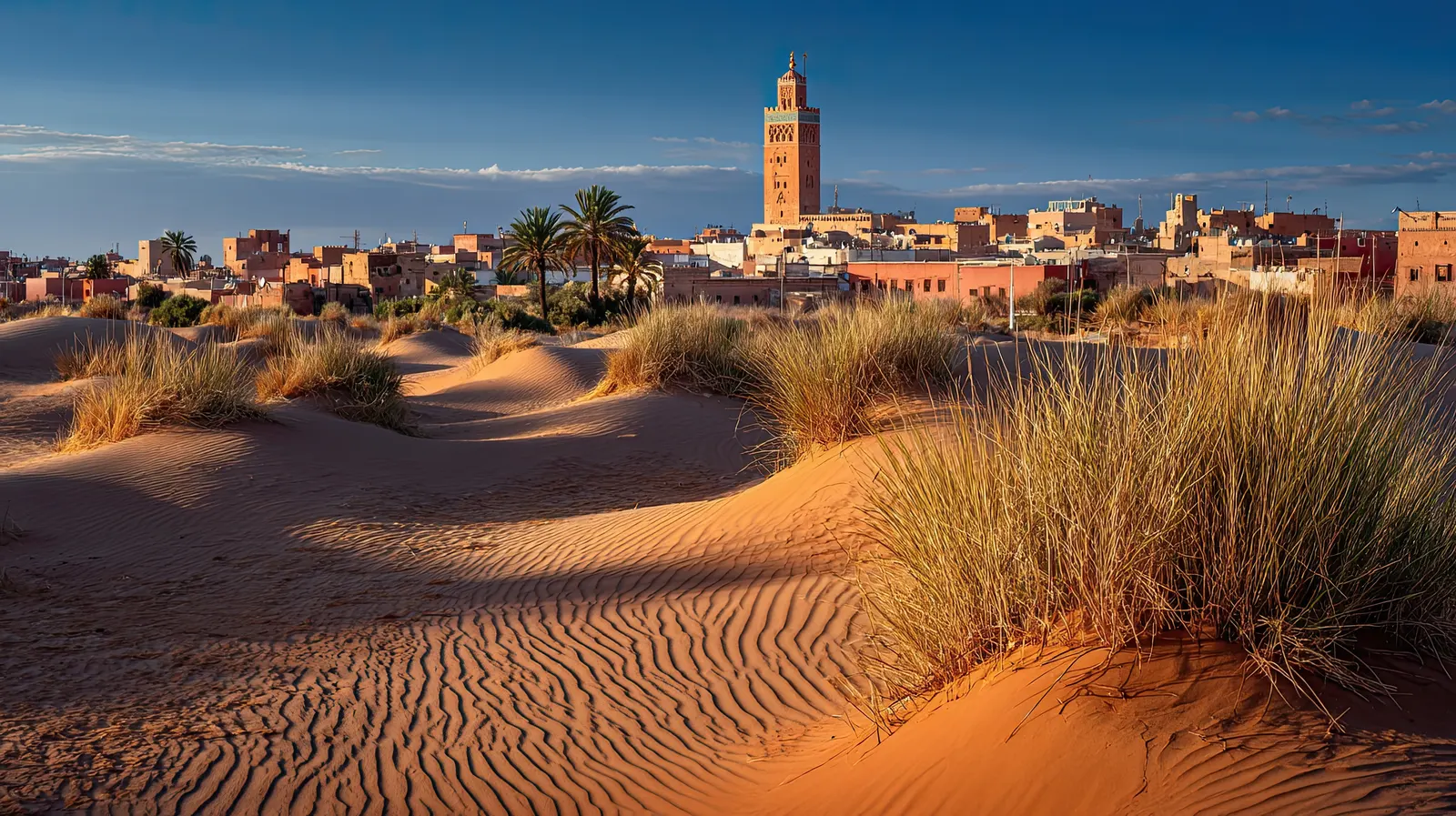
At dusk, Jemaa el-Fna changes shift: the orange-juice stalls give way to smoking grills, storytellers draw their circles, and the Koutoubia minaret catches the last pink light above it all. The medina behind the square has been trading, cooking and praying to much the same rhythm since the Almoravids founded the city in the eleventh century.
Marrakesh is a quieter alternative. It's ready to explore in the Nuvoha app: set your budget and see complete Marrakesh trips.
Why visit Marrakesh
Marrakesh compresses Morocco into one walled city: dyers' and metalworkers' souks branching off Jemaa el-Fna, the carved cedar and zellij tilework of the Ben Youssef Madrasa, the painted ceilings of the Bahia Palace, and the Saadian Tombs, sealed up and only rediscovered in 1917. Beyond the ramparts, Gueliz adds French-built avenues and the cobalt blue of the Majorelle Garden. With the High Atlas about an hour's drive away, the city pairs sensory overload with an easy escape route into the mountains.
Inside and beyond the walls
- Jemaa el-Fna: The medina's great square, recognised by UNESCO for its nightly gathering of storytellers, musicians and food stalls.
- Koutoubia Mosque: Its 77-metre twelfth-century minaret is the city's landmark and the model for Seville's Giralda; non-Muslims admire it from the gardens outside.
- Ben Youssef Madrasa: A sixteenth-century Quranic college around a marble courtyard, dense with zellij, stucco and carved cedar.
- Bahia Palace: A nineteenth-century grand vizier's palace of painted ceilings, marble courtyards and orange-tree gardens.
- Saadian Tombs: The sixteenth-century royal necropolis, hidden behind walls until 1917, centred on the Chamber of the Twelve Columns.
- Jardin Majorelle: The painter Jacques Majorelle's cactus garden in his signature cobalt blue, later restored by Yves Saint Laurent, with a museum of Amazigh culture inside.
Medina quarters and the new town
- The Medina: The walled old city, a UNESCO World Heritage Site of souk lanes, fondouks and minarets radiating out from Jemaa el-Fna.
- The Kasbah: The southern royal quarter behind the carved Bab Agnaou gate, holding the Saadian Tombs and the ruined Badi Palace.
- The Mellah: The historic Jewish quarter beside the Kasbah, with its spice market and the restored Slat al-Azama Synagogue.
- Gueliz: The French-protectorate new town of broad avenues, galleries and pavement cafes, a twenty-minute walk from the medina walls.
- The Palmeraie: A sprawling palm grove on the city's north-eastern edge, with tens of thousands of trees and a long history as the local oasis.
Tagines, souk snacks and mint tea
Tangia, not tagine, is the true Marrakshi dish: meat slow-cooked with preserved lemon and spices in a clay urn, traditionally left for hours in the embers of the hammam furnaces. Tagines and Friday couscous fill out the repertoire, with pastilla (a sweet-savoury filo pie dusted with icing sugar) for celebrations. Finish at the Jemaa el-Fna night stalls, and accept mint tea whenever it is offered; refusing takes longer than drinking it.
- Tangia marrakshia (urn-cooked meat)
- Lamb tagine with preserved lemon
- Couscous, traditionally on Fridays
- Pastilla (sweet-savoury filo pie)
- Mint tea, poured from a height
What Marrakesh feels like
The medina is intense by design: motorbikes threading the lanes, cries of balak (make way), the smell of leather, spice and charcoal. Then a carved doorway opens onto a courtyard and the noise simply stops: the city's oldest trick. Gueliz and Hivernage feel a generation apart, all cafe terraces and galleries. Spring and autumn are the kindest seasons; midsummer afternoons belong to shade and mint tea.
Finding your way through the lanes
The medina is walking territory: the lanes are too narrow for cars, though bicycles and motorbikes squeeze through regardless. Beige petits taxis handle trips to Gueliz, the gardens and the station; agree the fare or insist on the meter before setting off. Horse-drawn caleches circle the ramparts from Jemaa el-Fna, and ALSA city buses exist, though most visitors never need them. Map apps struggle in the deepest souks; landmarks work better. Marrakesh Menara Airport lies barely fifteen minutes' drive south-west of the medina walls, one of the shortest transfers of any city its size.
Wisdom for the souks
- Working mosques in Morocco are closed to non-Muslims, the Koutoubia included, so admire them from outside; the Ben Youssef Madrasa shows the artistry within.
- Dress modestly in the medina (shoulders and knees covered for everyone) even though Gueliz runs more relaxed.
- Tipping in small change is woven into daily life: for guides, porters, musicians you photograph and cafe staff.
- Always ask before photographing people, especially the performers on Jemaa el-Fna, who earn their living from the square.
- Learn la, shukran (no, thank you). Delivered with a smile, it politely ends most unsolicited offers of help or directions.
- Unofficial guides who insist a street is closed are steering you towards a shop; the street is almost never closed.
- The dirham is a closed currency obtained on arrival: carry small notes, as souk stalls rarely break large ones.
- Haggling is expected in the souks: counter well below the opening price and enjoy the theatre; walking away often settles it.
- See Jemaa el-Fna twice: quiet mid-morning and at full tilt after sunset are two different places.
- In summer, walk the medina early and late, and keep the hottest hours for gardens, courtyards and shade.
Best for
- City breaks
- Quieter travel
Key facts
| Country | Morocco |
|---|---|
| Region | Middle East & North Africa |
| Airports | RAK |
| Trip length fit | Short-trip friendly |
Marrakesh essentials
| Currency | Moroccan Dirham (MAD) |
|---|---|
| Language | Arabic and Amazigh (Berber) are official; French is widely spoken, and English is increasingly common in tourist areas |
| Time zone | UTC+1 year-round, except during Ramadan when clocks move back to UTC+0 |
| Emergency number | 19 (police in cities); 15 (ambulance and fire) |
| Driving side | Right |
| Tap water | Treated in major cities, but most visitors drink bottled or filtered water |
Climate & seasons
| Month | Typical range | Season |
|---|---|---|
| January | 6°C to 19°C | Mild winter days |
| April | 11°C to 27°C | Warm spring |
| July | 21°C to 38°C | Very hot summer |
| October | 15°C to 29°C | Warm autumn |
Typical stay
- Weekend-friendly
- Short break (2–5 days)
Marrakesh works as a weekend break just as well as a longer stay.
Getting there
Marrakesh is served via RAK.
- RAK
Is it your kind of trip?
Ideal if…
- you like walkable city energy
- you like places before everyone else finds them
Maybe not if…
- a beach-first holiday is the priority
Pairs well with
Compare with
| Marrakesh | Casablanca | Agadir | |
|---|---|---|---|
| Country | Morocco | Morocco | Morocco |
| Region | Middle East & North Africa | Middle East & North Africa | Middle East & North Africa |
| Styles | City | City | Beach |
| Trip length fit | Weekend-friendly | Weekend-friendly | Weekend-friendly |
| Airports | 1 | 1 | 1 |
More in Middle East & North Africa
Near Marrakesh
Travel style
- Short-trip friendly
- City
Frequently asked questions
Which airports serve Marrakesh?
Marrakesh is served via RAK.
Is Marrakesh good for a weekend trip?
Yes, Marrakesh works for a weekend as well as a longer stay.
What kind of trip is Marrakesh best for?
Marrakesh is best for city trips.
Which destinations pair well with Marrakesh?
Within multi-city range: Agadir (198 km), Casablanca (200 km), Lanzarote (611 km).
Is it easy to get lost in the medina?
Guaranteed, and mostly harmless. The main arteries between Jemaa el-Fna and the big gates are signposted, and any shopkeeper can point you back to the square. Keep the Koutoubia minaret as your compass and treat wrong turns as part of the visit.
Can non-Muslims visit mosques in Marrakesh?
No. Moroccan working mosques admit Muslims only, the Koutoubia included. The compensation is that the madrasas, palaces and tombs are open to all: Ben Youssef and the Saadian Tombs show the same craftsmanship at close range.
Do I need cash in the souks?
Yes. Cards appear in larger shops and restaurants, but stalls, food stands, taxis and tips all run on dirham notes and coins. Cash machines cluster near Jemaa el-Fna and in Gueliz; keep small denominations for easier bargaining.