
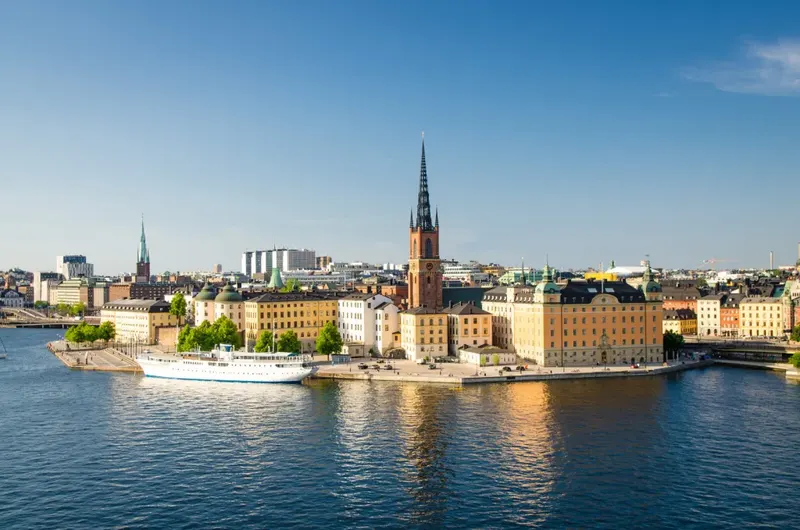
Sweden stretches almost 1,600 kilometres from the mild farmland of the south to the Arctic wilds of Lapland, which is why a single country can offer both long beach summers and winters of dog-sledding under the northern lights. Stockholm spreads across fourteen islands where the city meets a 30,000-island archipelago; Gothenburg fronts the seafood-rich west coast; and inland lie deep forests, red timber cottages and thousands of lakes. Swedes take their coffee breaks (fika), their Midsummer poles and their clean, functional design seriously, and a right-to-roam tradition means the outdoors is genuinely open to everyone. Fast trains connect the main cities, while sleeper services and the Inlandsbanan railway carry travellers north towards Sami country and the midnight sun.
Stockholm is the Sweden destination on Nuvoha today. Set your budget and Nuvoha builds the complete trip: flights and hotels together.
Why visit Sweden
- Cities you can explore on foot, from headline sights to quiet neighbourhoods
- Quieter alternatives beyond the obvious stops
Best known for
- Stockholm's island archipelago
- Design and minimalist style
- Swedish Lapland and the aurora
- Midsummer traditions
- Fika and cinnamon buns
- A strong music scene
From the south to the Arctic
- Stockholm and the archipelago: The capital spreads across fourteen islands where the old town of Gamla Stan and the Vasa warship museum meet a coastal archipelago of some 30,000 islands and skerries.
- Gothenburg and the west coast: Sweden's second city, with a canal-lined centre, a strong seafood tradition and easy access to the smooth granite islands and fishing villages of the Bohuslan coast.
- Skane and the south: The gentle farming country of the far south, where Malmo faces Denmark across the Oresund Bridge amid castles, beech woods and long sandy beaches.
- Dalarna and the lakes: The folk heartland of red timber cottages, Midsummer poles and painted Dala horses, gathered around Lake Siljan in a landscape of forest and water.
- Swedish Lapland: The vast Arctic north, home to the Sami people, the aurora-viewing station at Abisko, the original Icehotel and long days of midnight sun in summer.
- Gotland: A Baltic island of medieval Visby, a UNESCO World Heritage town inside its old walls, with limestone sea stacks, sheep pastures and reliable summer sunshine.
Where to go
Sweden essentials
| Currency | Swedish Krona (SEK) |
|---|---|
| Language | Swedish; English is very widely spoken, and Sami languages are recognised in the north |
| Time zone | Central European Time (UTC+1, UTC+2 in summer) |
| Emergency number | 112 (all emergencies) |
| Driving side | Right |
| Tap water | Safe to drink straight from the tap nationwide |
Seasons at a glance in Stockholm
| Month | Typical range | Season |
|---|---|---|
| January | -5°C to 1°C | Cold dark winter |
| April | 1°C to 10°C | Fresh spring |
| July | 13°C to 23°C | Mild bright summer |
| October | 5°C to 11°C | Cool autumn |
Seasons vary across Sweden. Each destination page has its own climate table.
More in Europe
More Europe country guides
Frequently asked questions
Which Sweden destinations can I book with Nuvoha?
Stockholm, with complete flight and hotel trips built around your budget.
What kind of trips suit Sweden?
Sweden works for city breaks.
How do you get around Sweden?
Fast SJ trains connect Stockholm, Gothenburg and Malmo, while overnight sleepers and the summer Inlandsbanan line head north towards Lapland. Domestic flights save time for the far Arctic, and city transport is clean and reliable.
Is Sweden really almost cashless?
Close to it. Cards and mobile payments work virtually everywhere, and some shops, cafes and museums no longer accept cash at all. A contactless card is the simplest way to pay.
What plug type does Sweden use?
Types C and F, the round two-pin sockets used across most of Europe, at 230 volts. Travellers from the UK and North America need an adapter.
Is Sweden in the Schengen Area, and does it use the euro?
Sweden is part of the Schengen Area, so travel from other Schengen countries is seamless. It is not in the eurozone, though: everyday spending is in Swedish kronor, and cards cover almost everything.