
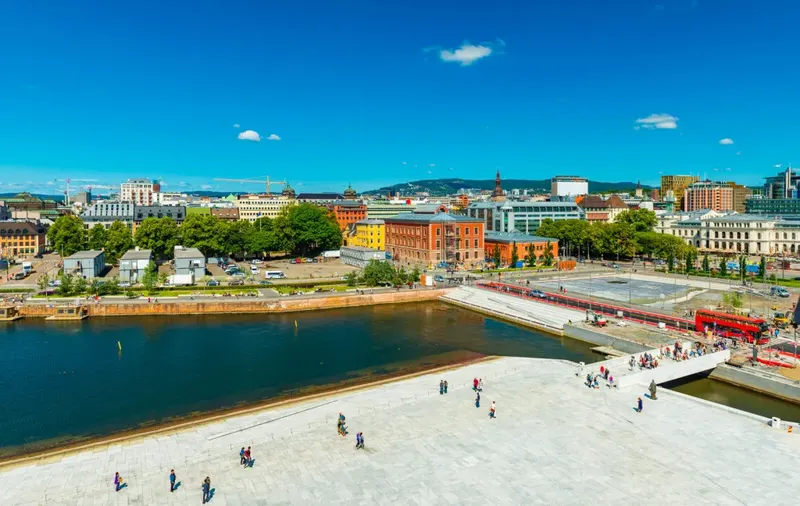
Oslo sits at the head of a long fjord, hemmed in by forested hills that locals ski and hike straight from the metro. Norway's capital has reinvented its waterfront in a generation, crowning it with the sloping white Opera House whose roof you can walk to the top of. Fjord on one side, deep woods on the other, and a compact, modern city of galleries and glass in between. Nature is never more than minutes away.
Oslo is a quieter alternative. It's ready to explore in the Nuvoha app: set your budget and see complete Oslo trips.
Why visit Oslo
Oslo is where a capital city meets the wild, and that blend is its draw. From the centre you can ride the metro up to forest trails and ski slopes, or catch a ferry out to bathing islands in the fjord, all within half an hour. The waterfront has become a showcase of modern architecture, led by the marble Opera House you can climb and the Munch museum and Barcode towers beside it. Culture runs deep too: Vigeland Park fills a green expanse with hundreds of Gustav Vigeland's sculptures, the National Museum holds a version of The Scream, and Bygdoy's museums tell of polar and seafaring feats. It is clean, calm and framed by nature.
Sights on fjord and hill
- Oslo Opera House: A striking waterfront theatre of white marble and glass, its sloping roof designed as a public plaza you can walk right up.
- Vigeland Park: The world's largest sculpture park by a single artist, where more than two hundred Gustav Vigeland figures ring the towering Monolith.
- Holmenkollen Ski Jump: The soaring ski jump above the city, with a ski museum inside and a viewing platform over Oslo and the fjord.
- The Fram Museum: On the Bygdoy peninsula, built around the Fram, the wooden ship that carried Norwegian expeditions further north and south than any other.
- Akershus Fortress: The medieval castle and fortress guarding the harbour, its ramparts giving open views across the water to the new waterfront.
- MUNCH: The waterfront museum devoted to Edvard Munch, holding versions of The Scream among thousands of his works.
Around the city's quarters
- Sentrum: The compact centre strung along Karl Johans gate, from the central station to the Royal Palace, taking in the cathedral and City Hall.
- Bjorvika: The reborn waterfront of the Opera House, the MUNCH museum, the Barcode high-rises and the Deichman library.
- Aker Brygge and Tjuvholmen: A lively quayside of restaurants, marinas and the Astrup Fearnley contemporary-art museum, where ferries leave for the fjord.
- Grunerlokka: The city's bohemian quarter along the Akerselva river, full of cafes, vintage shops, street art and the Mathallen food hall.
- Frogner: A smart residential west-side district of grand villas and embassies, home to the green sweep of Vigeland Park.
- Bygdoy: A green museum peninsula of beaches and woodland, gathering the Fram, the Kon-Tiki and the open-air folk museum.
The Norwegian table
Norwegian cooking leans on the sea, the mountain pasture and a make-it-last tradition of preserving. Salmon appears everywhere, cured, smoked or grilled, alongside creamy fish soups and, in late summer, buckets of sweet fjord prawns eaten with bread by the water. Heartier plates run to kjottkaker, meat cakes in brown gravy, and farikal, the autumn national dish of mutton slow-cooked with cabbage. The oddest local love is brunost, a sweet caramel-brown whey cheese sliced thin over waffles or crispbread. Coffee is taken seriously and often, Norwegians being among the world's keenest drinkers of it.
- Laks
- Fiskesuppe
- Kjottkaker
- Farikal
- Brunost
What Oslo feels like
Oslo feels relaxed, outdoorsy and a little unshowy for a capital. Life is organised around nature and the seasons: in summer the fjord fills with small boats and swimmers, and the harbour promenades hum until late in the long light; in winter the same locals are out on skis in the forest by day and gathered snugly indoors after dark. There is money here, and it shows in the sleek architecture and clean streets, but the manner is understated and egalitarian, more fleece and trainers than finery. A young, creative energy runs through neighbourhoods like Grunerlokka all the same. The overwhelming impression is space, air and easy access to the wild.
Getting around and into nature
Central Oslo is small and walkable, and the harbour promenade links much of the waterfront on foot. Ruter runs the public transport on one ticket, spanning a five-line metro known as the T-bane, trams, buses and local ferries, with a contactless card or the app for payment. The metro is the outdoor secret: some lines climb straight into the forest at Holmenkollen and Frognerseteren for skiing and hiking. Ferries from the central quays serve the Bygdoy museums and the fjord islands in summer. Oslo Airport Gardermoen (OSL) is about fifty kilometres north of the city, linked by fast trains. The Flytoget airport express reaches Oslo Central in around twenty minutes, and ordinary Vy regional trains cover the route a little more slowly. Some flights use Torp or Rygge, which are much further out and only marketed as Oslo.
Practical notes
- Norwegians are friendly but reserve small talk with strangers; a warm hei is enough, and quiet on public transport is the norm.
- Respect the outdoors and the right to roam, the allemannsretten: take your litter home and tread lightly on trails and by the water.
- Tipping is not expected, as service is included, though rounding up for good restaurant service is appreciated.
- Remove your shoes when entering someone's home unless you are told otherwise.
- Summer brings very long days and warm-enough fjord swimming; winter is cold, snowy and short on daylight, but ideal for skiing from the city.
- Oslo is one of Europe's more expensive cities, so lean on the excellent free tap water, the roam-anywhere parks and the walkable waterfront.
- Ride the T-bane to Holmenkollen or Frognerseteren for forest trails and views without needing a car.
- Take a summer ferry from Aker Brygge to a fjord island such as Hovedoya for an easy swim and picnic.
- Many top museums sit together on the Bygdoy peninsula, reachable by bus or seasonal ferry, so plan them as a group.
- Alcohol is sold in shops only through the state Vinmonopolet outlets and within set hours, so buy ahead for a weekend.
Best for
- City breaks
- Quieter travel
Key facts
| Country | Norway |
|---|---|
| Region | Europe |
| Airports | OSL |
| Trip length fit | Short-trip friendly |
Oslo essentials
| Currency | Norwegian Krone (NOK) |
|---|---|
| Language | Norwegian; Sami languages are also recognised, and English is very widely spoken |
| Time zone | Central European Time (UTC+1, UTC+2 in summer) |
| Emergency number | 112 (police), 110 (fire), 113 (ambulance) |
| Driving side | Right |
| Tap water | Safe to drink; among the best tap water anywhere |
Climate & seasons
| Month | Typical range | Season |
|---|---|---|
| January | -6°C to 0°C | Cold snowy winter |
| April | 1°C to 10°C | Fresh spring thaw |
| July | 12°C to 22°C | Mild bright summer |
| October | 4°C to 10°C | Cool autumn |
Typical stay
- Weekend-friendly
- Short break (2–5 days)
Oslo works as a weekend break just as well as a longer stay.
Getting there
Oslo is served via OSL.
- OSL
Is it your kind of trip?
Ideal if…
- you like walkable city energy
- you like places before everyone else finds them
Maybe not if…
- a beach-first holiday is the priority
Pairs well with
Compare with
| Oslo | Stockholm | Copenhagen | |
|---|---|---|---|
| Country | Norway | Sweden | Denmark |
| Region | Europe | Europe | Europe |
| Styles | City | City | City |
| Trip length fit | Weekend-friendly | Weekend-friendly | Weekend-friendly |
| Airports | 1 | 2 | 1 |
More in Europe
Near Oslo
Travel style
- Short-trip friendly
- City
Frequently asked questions
Which airports serve Oslo?
Oslo is served via OSL.
Is Oslo good for a weekend trip?
Yes, Oslo works for a weekend as well as a longer stay.
What kind of trip is Oslo best for?
Oslo is best for city trips.
Which destinations pair well with Oslo?
Within multi-city range: Stockholm (402 km), Copenhagen (517 km), Berlin (883 km).
How many days do you need in Oslo?
Two to three days covers the waterfront, the Opera House, Vigeland Park and the Bygdoy museums. Add a day to get into the nature that defines the city, whether a forest hike, a ski from Holmenkollen or a summer ferry out into the fjord.
Is Oslo an expensive city?
Oslo is among the pricier European capitals, so it pays to plan. Tap water is superb and free, many of the best experiences such as the parks, viewpoints, the Opera House roof and the forest and fjord cost nothing to enjoy, and a transport pass and picnics stretch a visit comfortably.
Can you reach nature easily from central Oslo?
Remarkably easily. The metro climbs into the forested Marka for hiking and cross-country skiing, and ferries run from the central quays to swimming islands in the fjord, most within about half an hour of the centre.
When is the best time to visit Oslo?
Summer, roughly June to August, brings long daylight, fjord swimming and a lively waterfront. Winter suits skiers, with snow and floodlit trails from the city, though daylight is short. Spring and early autumn are quiet, cool and clear.