
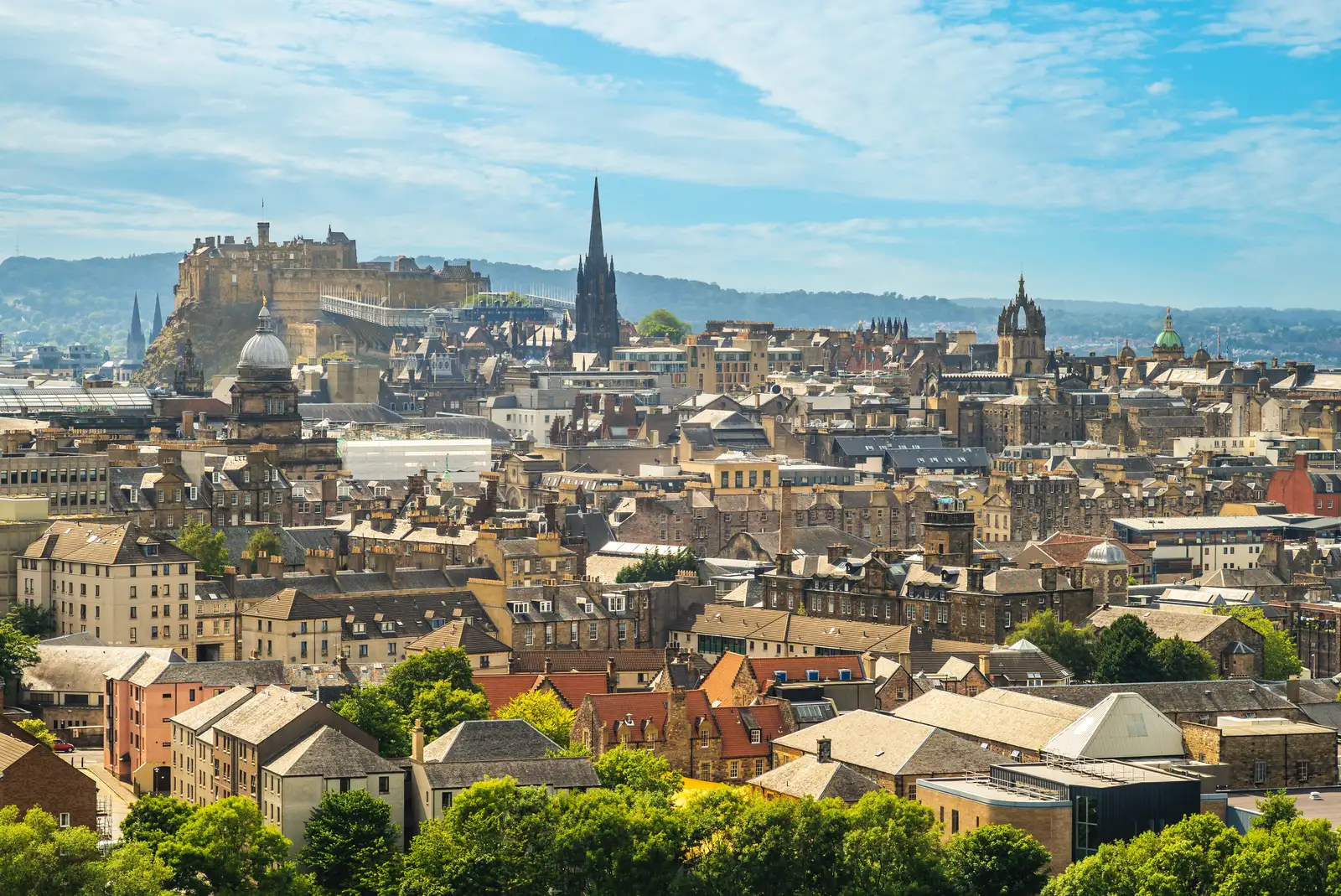
An extinct volcano anchors each end of this city: the castle glowers from its crag at the top of the Royal Mile, and Arthur's Seat rises green and wind-scoured above Holyrood at the bottom. Between them run the closes (narrow medieval alleys that drop off the Mile like ribs) and below the whole arrangement spreads the orderly Georgian grid of the New Town.
Edinburgh is a quieter alternative. It's ready to explore in the Nuvoha app: set your budget and see complete Edinburgh trips.
Why visit Edinburgh
Edinburgh compresses an extraordinary amount of drama into a walkable centre. You can stand on castle battlements, descend through medieval closes, cross into UNESCO-listed Georgian terraces and climb a mountain summit for a view of the Firth of Forth, all in one day and all on foot. The city wears its stories openly (grave-robbers, philosophers, the Enlightenment, a certain boy wizard drafted in its cafés) and every August it hosts the world's largest arts festival. Come in any season, though: the city under winter haar or low golden light is arguably at its best.
Landmarks of the Old and New Towns
- Edinburgh Castle: The fortress on Castle Rock has dominated the city for nine centuries and holds the Scottish Crown Jewels and the Stone of Destiny.
- Arthur's Seat: An extinct volcano in Holyrood Park whose summit, an easy-to-moderate climb, gives a full panorama of city, sea and hills.
- The Royal Mile: The spine of the Old Town running from the castle to the Palace of Holyroodhouse, lined with kirks, closes and courtyards.
- Calton Hill: A short climb from Princes Street to the unfinished National Monument and the classic postcard view over the city.
- National Museum of Scotland: A vast collection spanning Scottish history, natural sciences and design, topped by a roof terrace overlooking the Old Town.
- Dean Village: A former milling hamlet on the Water of Leith, minutes from the West End but improbably quiet and photogenic.
Areas with character
- Old Town: The medieval core stacked along the Royal Mile, a warren of closes, wynds and tall tenements descending the volcanic ridge.
- New Town: The Georgian grid of crescents and private gardens north of Princes Street, planned in the eighteenth century and now UNESCO-listed.
- Stockbridge: A village-like quarter on the Water of Leith known for its Sunday market, charity-shop treasure hunting and independent delis.
- Leith: The historic port district, home to the Royal Yacht Britannia, The Shore's waterside restaurants and a salty character all its own.
- Grassmarket: A broad old marketplace directly beneath the castle rock, ringed by historic pubs and once the site of public executions.
Scottish plates and drams
Scottish cooking has quietly become excellent, and Edinburgh is its showcase. Haggis with neeps and tatties appears everywhere from pubs to tasting menus; cullen skink, a smoked-haddock chowder, is the dish for a dreich day; and cranachan layers raspberries, cream, oats and whisky into the national dessert. Leith's dockside restaurants do the seafood justice, and no city on earth is better for exploring single malts by the dram.
- Haggis, neeps and tatties
- Cullen skink
- Scotch pie
- Cranachan
- Full Scottish breakfast
What Edinburgh feels like
Stone defines the mood here (dark, weathered, dignified) and the weather changes its temper by the hour, from horizontal drizzle to sudden brilliant sun raking down the Mile. Pubs are the city's living rooms, folk sessions spill out of Grassmarket doorways, and locals treat the surrounding hills as an extension of the pavement. It is a capital that feels like a large town: reserved at first, dryly funny once you're in conversation.
Getting about on foot and by bus
This is a walking city above all: most sights sit within a mile of the Royal Mile, though the hills and cobbles demand proper shoes. Lothian Buses runs a dense, reliable network where you tap on with a contactless card and daily fares cap automatically, and Edinburgh Trams run a single line linking the airport, Princes Street and Leith. Taxis are plentiful; driving in the centre is best avoided. Edinburgh Airport lies about eight miles west of the centre. The tram and frequent airport buses both run directly into the city, taking roughly half an hour.
Before you set off
- Order and pay at the bar in pubs (table service is the exception) and no tip is expected there, though offering to buy the bartender a drink is a traditional gesture.
- In restaurants a tip for good table service is customary if a service charge hasn't already been added.
- Scotland is a nation, not a region of England: never refer to Britain as 'England' in conversation.
- Queue-jumping is close to a criminal offence in the local imagination; join the back and wait.
- Pack layers and something waterproof in every season: locals joke about four seasons in an hour, and they are not entirely joking.
- August means the Festival and Fringe: electrifying, but the city is at its fullest, so plan well ahead or choose another month.
- Climb Arthur's Seat or Calton Hill early in the day for the clearest light and thinnest crowds.
- Scottish banknotes are legal currency but look different from English ones; they are accepted everywhere in Scotland.
- The one o'clock gun fires from the castle every day except Sunday. Don't be alarmed by the boom.
- Many of the best views are free: the closes, Calton Hill, the Vennel steps and the National Museum's roof terrace.
Best for
- City breaks
- Quieter travel
Key facts
| Country | United Kingdom |
|---|---|
| Region | Europe |
| Airports | EDI |
| Trip length fit | Short-trip friendly |
Edinburgh essentials
| Currency | Pound Sterling (GBP) |
|---|---|
| Language | English; Welsh and Scottish Gaelic have official status in Wales and Scotland |
| Time zone | Greenwich Mean Time (UTC+0), with British Summer Time (UTC+1) in summer |
| Emergency number | 999 or 112 |
| Driving side | Left |
| Tap water | Safe to drink throughout |
Climate & seasons
| Month | Typical range | Season |
|---|---|---|
| January | 1°C to 7°C | Cold winter |
| April | 4°C to 12°C | Chilly spring |
| July | 11°C to 19°C | Mild summer |
| October | 6°C to 13°C | Cool autumn |
Typical stay
- Weekend-friendly
- Short break (2–5 days)
Edinburgh works as a weekend break just as well as a longer stay.
Getting there
Edinburgh is served via EDI.
- EDI
Is it your kind of trip?
Ideal if…
- you like walkable city energy
- you like places before everyone else finds them
Maybe not if…
- a beach-first holiday is the priority
Pairs well with
Compare with
More in Europe
Near Edinburgh
Travel style
- Short-trip friendly
- City
Frequently asked questions
Which airports serve Edinburgh?
Edinburgh is served via EDI.
Is Edinburgh good for a weekend trip?
Yes, Edinburgh works for a weekend as well as a longer stay.
What kind of trip is Edinburgh best for?
Edinburgh is best for city trips.
Which destinations pair well with Edinburgh?
Within multi-city range: London (534 km), Amsterdam (666 km), Paris (869 km).
How hilly is Edinburgh to walk?
Genuinely hilly: the Old Town sits on a volcanic ridge, and steep closes and staircases connect its levels. Distances are short, but comfortable shoes with grip matter, especially on wet cobbles.
What happens in Edinburgh in August?
The Edinburgh International Festival, the Fringe, the Royal Edinburgh Military Tattoo and the Book Festival all run simultaneously, turning the whole city into a stage. It is thrilling and extremely busy. Arrange everything far in advance.
Can I use English banknotes and cards in Edinburgh?
Yes. English notes and all major cards are accepted everywhere, and contactless payment is near-universal, including on Lothian Buses and the trams. You may receive Scottish banknotes in change. They are ordinary pounds sterling.