
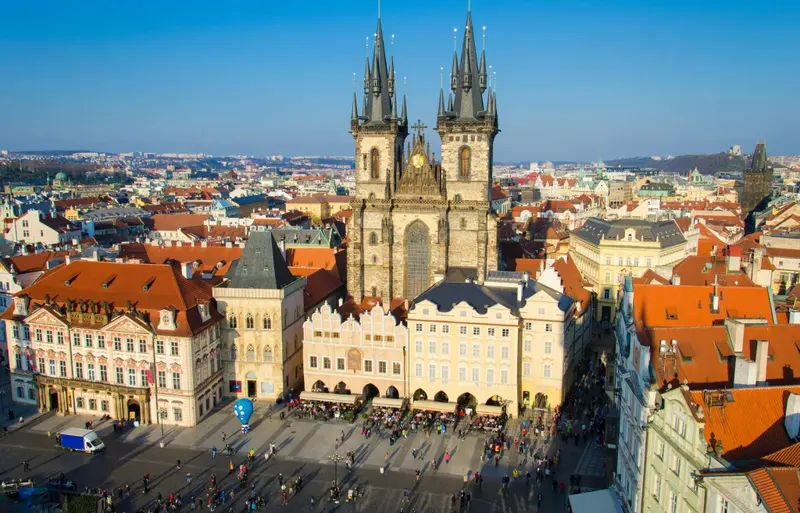
Bohemia and Moravia, the two historic lands that make up the Czech Republic, sit right in the middle of Europe, which is why armies, traders and composers have all passed through. Prague is the showpiece, a city of Gothic spires, a floodlit castle and the medieval Charles Bridge, largely spared by the twentieth century's wars. Beyond it, Bohemia unfolds into spa towns like Karlovy Vary, the sandstone gorges of Bohemian Switzerland, and Cesky Krumlov curled inside a bend of the Vltava. Moravia, to the east, is gentler and greener, with Brno's modernist architecture and vineyards along the Austrian border. The Czechs take their beer seriously, drinking more per head than anyone, and a pub is as much a civic institution as a castle.
Prague is the Czech Republic destination on Nuvoha today. Set your budget and Nuvoha builds the complete trip: flights and hotels together.
Why visit Czech Republic
- Cities you can explore on foot, from headline sights to quiet neighbourhoods
Best known for
- Prague's old town and castle
- Cesky Krumlov
- Czech beer and pubs
- Spa towns of West Bohemia
- Bohemian castles and chateaux
Bohemia and Moravia
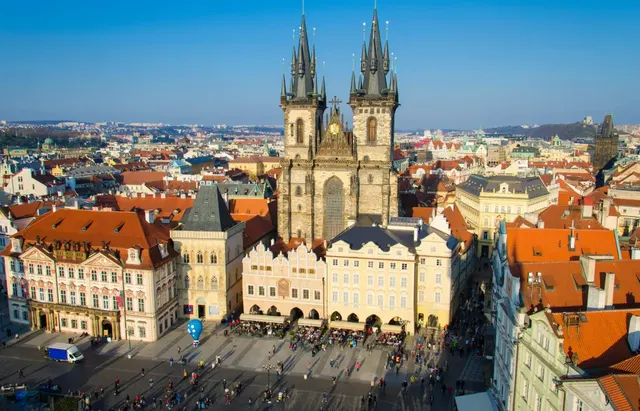
- Prague: The hundred-spired capital: Prague Castle, the Astronomical Clock, the baroque lanes of Mala Strana and the medieval Charles Bridge over the Vltava.
- Central Bohemia: Day-trip country around Prague, taking in the silver-mining town and bone-decorated chapel of Kutna Hora and the Gothic hilltop of Karlstejn Castle.
- West Bohemia: The spa belt of Karlovy Vary and Marianske Lazne, with their colonnades and thermal springs, and the brewing city of Pilsen, birthplace of pale lager.
- South Bohemia: Rolling countryside of ponds and castles, centred on Cesky Krumlov, whose UNESCO-listed old town curls inside a loop of the Vltava beneath its chateau.
- The north and Bohemian Switzerland: Sandstone country of gorges and rock towns, including the great natural arch of Pravcicka Gate and the crags of the Bohemian Paradise.
- Moravia: The gentler eastern half, with the modernist city of Brno, the vineyards and cellars of the south, and the chateaux of the Lednice-Valtice landscape, a UNESCO site.
Where to go
Good to know
| Currency | Czech Koruna (CZK) |
|---|---|
| Language | Czech; English and German are understood in Prague and tourist areas |
| Time zone | Central European Time (UTC+1, UTC+2 in summer) |
| Emergency number | 112 (general emergency) |
| Driving side | Right |
| Tap water | Safe to drink across the country |
Seasons at a glance in Prague
| Month | Typical range | Season |
|---|---|---|
| January | -3°C to 3°C | Cold winter |
| April | 5°C to 15°C | Fresh spring |
| July | 14°C to 26°C | Warm summer |
| October | 7°C to 14°C | Cool autumn |
Seasons vary across Czech Republic. Each destination page has its own climate table.
More in Europe
More Europe country guides
Frequently asked questions
Which Czech Republic destinations can I book with Nuvoha?
Prague, with complete flight and hotel trips built around your budget.
What kind of trips suit Czech Republic?
Czech Republic works for city breaks.
How do you travel around the Czech Republic?
Trains and coaches are frequent and reach most places: Prague to Brno takes around two and a half hours, and comfortable buses serve Cesky Krumlov and Karlovy Vary. Prague itself has an excellent metro, tram and bus network.
Does the Czech Republic use the euro?
No. The currency is the Czech koruna, even though the country is in the EU and the Schengen area. Some tourist businesses in Prague quote euros, though paying in koruna usually works out better, and cards are widely accepted.
When is the best time to visit?
Late spring and early autumn bring mild weather and thinner crowds. Summer is warm and busy, especially in Prague; December wraps the city squares in Christmas markets, while the spa towns and castles are pleasant across the seasons.
What plug type does the Czech Republic use?
Types C and E, the round two-pin European sockets with the French-style earth pin, at 230 volts. UK and North American visitors need an adapter.